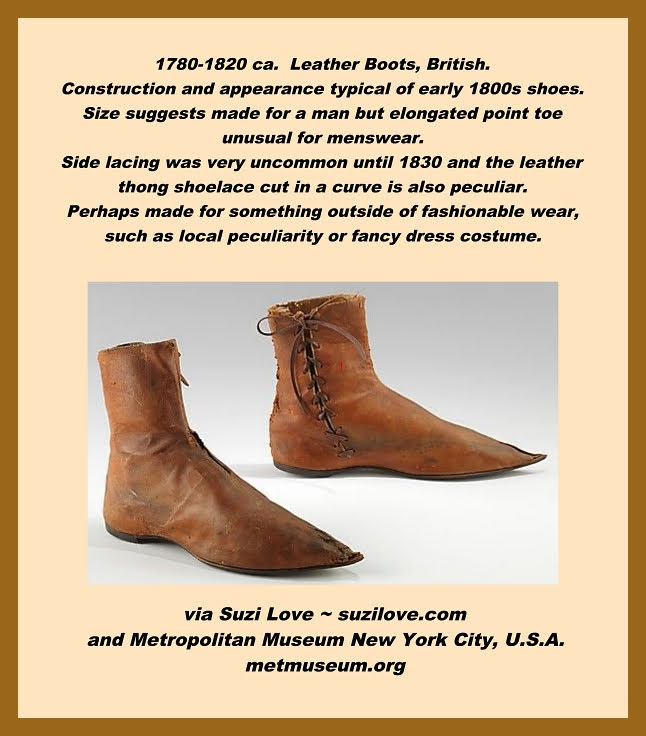
1780-1820 ca. Brown Leather Boots, British. Construction and appearance typical of early 1800s shoes. Size suggests made for a man but elongated point toe unusual for menswear. Side lacing was very uncommon until 1830 and the leather thong shoelace, cut in a curve, is also peculiar. Perhaps made for something outside of fashionable wear, such as local peculiarity or fancy dress costume. via Metropolitan Museum New York City, U.S.A. metmuseum.org
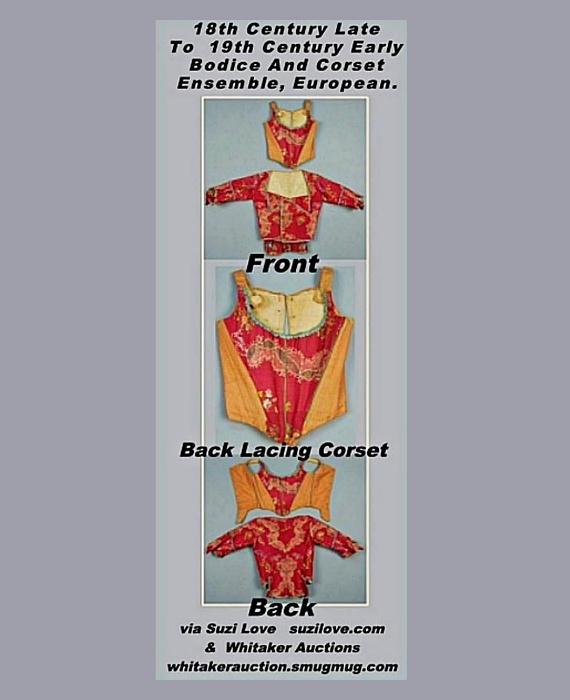
18th Century Late – 19th Century Early Bodice and Corset Ensemble, European. Cranberry silk faille with polychrome floral brocade, the square-neck bodice having folded front collar, narrow double breast and short sleeve with pleated and pointed cuff, peplum back. Corset front pieced with cranberry brocade and a tan dotted sawtooth stripe, the back in a similar dotted stripe. Both pieces trimmed in aqua ribbon and lined in linen. via Whitaker Auctions. whitakerauction.smugmug.com
Typical of the type of outfit a gentleman in the Georgian Era would wear to a wedding or important event. The jacket flares from the waist into multiple folds to give easier movement and the front has a long line of matching buttons. The breeches have a buttoning front flap. Part of the costume collection at Ham House, Surrey, UK. Part of the National Trust, UK. nationaltrustimages.org.uk
What did the Bridgerton ladies and Jane Austen use to carry her personal items? Ridicule, Reticule, Or Handbag? Call them what you like: purses, bags, handbags, reticules, ridicules, clutches, or pocket replacements. They all did the same job and they changed greatly with the prevailing fashions of time. books2read.com/suziloveReticules
Definition Of A Reticule; Bag or purse, often with a drawstring to pull closed and usually made of cloth or covered cardboard and often decorated with beading or embroidery. A reticule, or purse, or handbag, was usually carried by a woman during the Regency period to carry all their daily necessities. Earlier, women used pockets that tied at the waistline and were hidden in the folds of their skirts. Empire style, or early 1800s, high-waisted dresses made it impossible to either sewn in a pocket or to tie on a pocket, so women began carrying small, decorated bags called Reticules, or ridicules, which generally pulled close at the top with a drawstring. These Reticules, or bags, were the forerunners of our modern day purses.
The term ‘ridicule’ derived from the Latin ‘ridiculum’ and first used in France during the 17th century and meant subjecting something or someone to mockery. As women’s tiny bags were mocked, or ridiculed, for being a useless fashion accessory carried outside when they were first used in the late 1700s, it’s likely this is how the name ‘ridicule’ started. The later term ‘reticule’ derived from the Latin reticulum, meaning ‘netted bag’ and was applied when bags became larger and often made from netting. In the late 1700s and early 1800s, they were also known as indispensables as they carried all the personal items a lady needed upon her person every day. They were easily made by ladies, easy to carry and became an indispensable fashion accessory.
In the early nineteenth century, reticules started to look like future handbags as they were often made from rigid card or molded mâché or card into a variety of shapes. Early bags were circular and with a drawstring but as women wanted their reticules to look individual they could be made with two halves and a hinged metal closure or with concertina sides. Materials varied from silk, cotton and string and shapes were round, hexagonal or lozenge shapes with shell shaped bags becoming very popular during the Regency and Romantic Eras.
1800s magazines were written for well bred women who could read, so they gave plenty of ideas for how ladies could make and embellish reticules for their own use and as pretty gifts. Needlework was highly encouraged as a pastime for a lady so bags were frequently embroidered or decorated with beading. By the 1820s, reticules became more like our modern handbags using soft leather gathered at the top or hard leather with a rigid fastener and metal chain for carrying.
1795-1812 ca. Lord Nelson’s Vice-Admiral Undress Coat. Blue cloth tail coat, double breasted, nine gilt buttons on each lapel., two rows gold lace each sleeve with three buttons between, three buttons below each pocket flap, two buttons on skirt pleats, narrow band of wool cloth and two eyelet holes on shoulders to attach epaulettes, fastened edge to edge with three hooks and eyes, four embroidered stars of Nelson’s orders on left, Order of the Bath, Order of St Ferdinand Merit, Order of Crescent, Order of San Joachim. This is Nelson’s Trafalgar Coat worn by Nelson (1758-1805) at Battle of Trafalgar with bullet hole on left shoulder, close to epaulette. Damage to epaulette and blood stains on tails and left sleeve. National Maritime Museum, Greenwich, London, U.K. www.rmg.co.uk
For most of Jane Austen’s life, Britain was involved in conflicts and wars across the world. The Napoleonic Wars only ended in 1815, just two and a half years before Austen died. During her childhood, Britain was fighting the American Revolutionary War and when she was 14 years old, the French Revolution upset traditional roles of the monarchy, aristocracy and landed gentry in Britain, France and many other European countries.
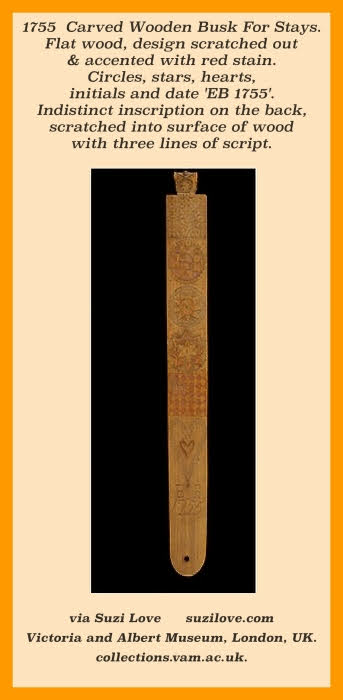
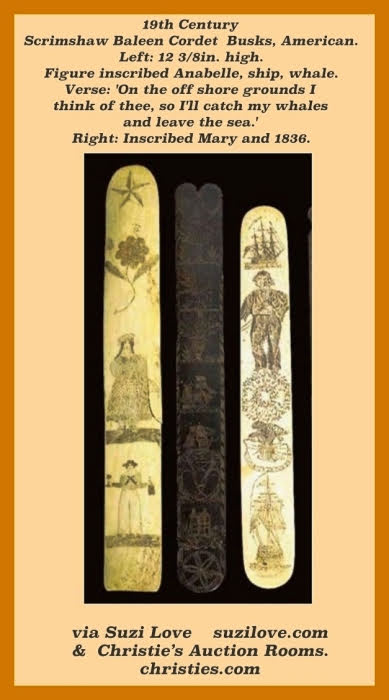
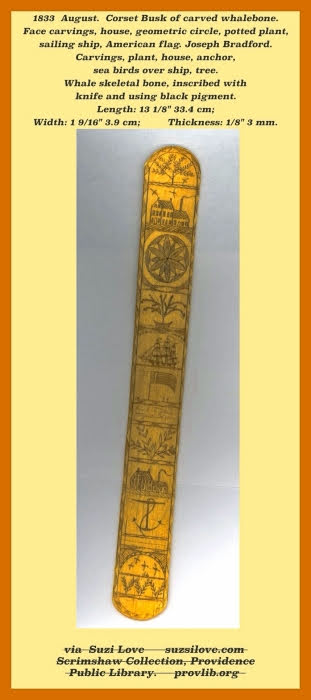
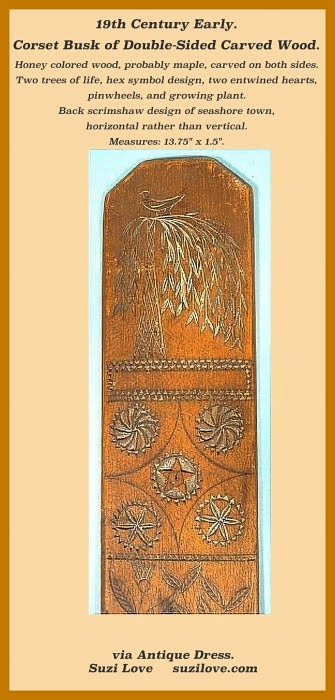
Busks shaped and reinforced the centre front of stays, or corsets. They were made from whalebone, wood, and bone, and were often inscribed with names, dates, and symbols of love because they were positioned close to the heart. The corsets worn in Jane Austen’s later years and by women in Bridgerton times often had busks to stiffen the corset and support the breasts.
1755 Wooden Busk For Stays, English. Flat piece of wood with design scratched or picked out, and accented with red stain. Design comprises of circles, stylized geometric stars, heart motifs, and the initials and date ‘EB 1755’. Indistinct inscription on the back, scratched into the surface of the wood with three lines of script.1800-1840 ca. Scrimshaw Corset Busk, American. Designs are of a ship and the places the sailor visited. Sailors made these as gifts to be worn close to the heart by their loved ones. Dimensions (inches) 12.5 (L) , 1.3 (W). Dimensions (centimeters). 31.7 (L) , 3.3 (W) via Winterthur Museum Collection.19th Century. Scrimshaw Baleen Corset Busks, American. The first with figure inscribed Annabelle, ship, whale, and verse On the off shore grounds I think of thee, so I’ll catch my whales and leave the sea; the second inscribed Mary and 1836 12 3/8in. high the longest. via Christie’s Auction Rooms. 1833 August. Corset Busk of carved whalebone. Face carvings, house, geometric circle, potted plant, sailing ship, American flag. Joseph Bradford. Carvings, plant, house, anchor, sea birds over ship, tree. Whale skeletal bone, inscribed with knife and using black pigment. Length: 13 1/8″ 33.4 cm; Width: 1 9/16″ 3.9 cm; Thickness: 1/8″ 3 mm.Busks shaped and reinforced front of corsets. Made from whalebone, wood and bone. Often inscribed with names, dates and symbols of love because they were positioned close to the heart. Via Hereford Museum. 1771 Wooden Corset Busk, American. Carved Maple wood. Via Winterthur Museum. 19th Century Early. Corset Busk of Double-Sided Carved Wood. Honey colored wood, probably maple, carved on both sides. Two trees of life, hex symbol design, two entwined hearts, pinwheels, and growing plant. Back has delicate scrimshaw-look design of seashore town, chapel, homes, lighthouse and ships, horizontal rather than front vertical. Measures: 13.75″ x 1.5″. via Antique Dress.18th Century Wooden Busk for Stays, European. Via metmuseum.org18th Century Late – 19th Early Carved Maple Wood Busk, American. Spirals top & bottom, two hearts meet at center, “PC” carved on reverse. Worn by member of Robbins family, inherited by Ellen A. Stone. Via Fine Arts Museum Of Boston, USA.
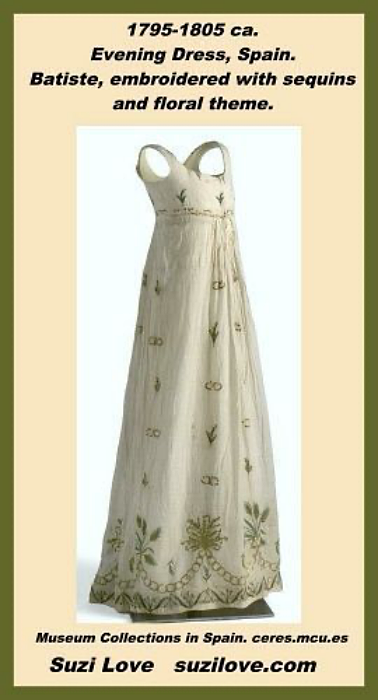
1795-1805 ca. Evening Dress, Spain. Batiste, embroidered with sequins and floral theme. Via Museum Collections in Spain. ceres.mcu.es
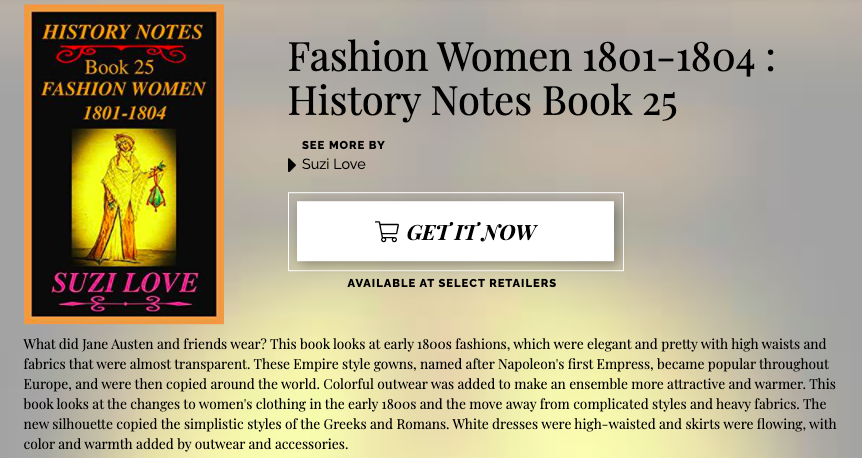
The Empire styles at the beginning of the 19th century were made of a soft, lightweight fabric gathered just under the breasts. It featured a low square neckline, and small, short, puffed sleeves with a low shoulder line. Although lawn and batiste were used, muslin was the fabric of choice as it was easy to clean. The thin muslin clung close to the body and emulated styles worn in ancient Greece. Shades of white predominated, with the addition of pale pastel shades worn for day wear.
Definition Batiste: Soft, sheer, cotton or linen fabric in white and delicate colors, used for handkerchiefs, nightwear and neckwear. Probably named for its inventor, Jean Baptiste, of Cambrai.
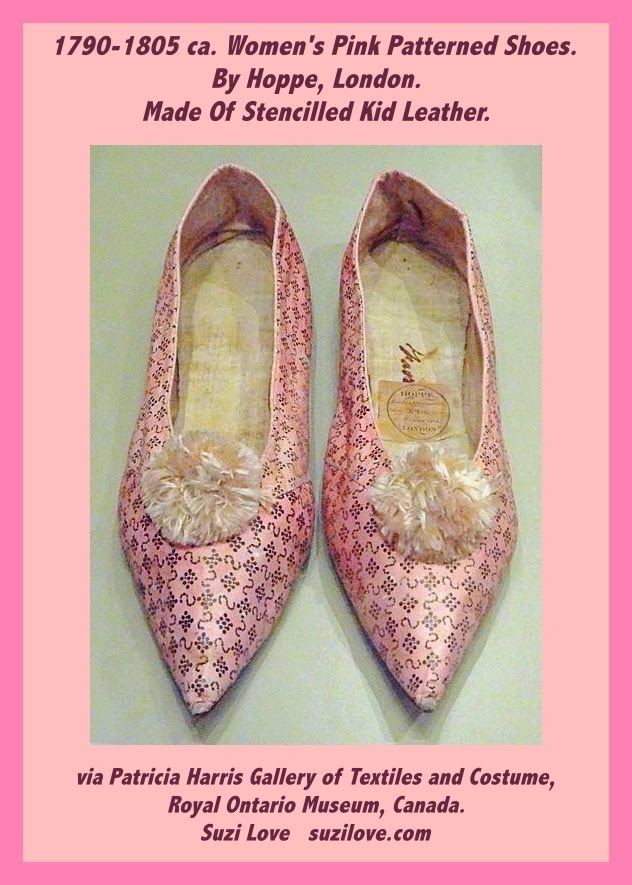
1790-1805 ca. Women’s pink patterned kid leather shoes as worn by Jane Austen and other ladies in her times. Made by Hoppe, London, of stencilled kid leather.
In Jane Austen’s years, fragile slippers were worn for balls and evening events but for walking sturdier shoes were needed, In the early 1800s, slippers were made of fabric such as satin or from leather, were flat or had a very small heel, slightly rounded toes and were laced up on the top. They were usually not made in right or left, but instead one shoe shape and in multiples so that when one slipper wore out, another was on hand to replace it.
Want To Know More About Georgian Era Men’s Fashions? Try History Notes Book 2 By Suzi Love. Fashion Men 1700s Late. books2read.com/suziloveFashMen1700 What was fashionable for men in the late 1700s? Extravagant colors and fabrics and outrageous styles. Take a look at their suits, hats, accessories and bedroom fashions.
What was fashionable for men in the late 1700s? Extravagant colors and fabrics and outrageous styles. Take a look at their suits, hats, accessories and bedroom fashions. Strictly speaking, the Georgian Era might include all the years that a ‘King George’ ruled in England, but for the purposes of this book the ‘Georgian Era’ is primarily the late 1700s when mad King George III ruled. His son became Prince Regent in the early 1800s, therefore creating the years known as the Regency, and became George IV on the death of his father.
The Georgian years officially ended with the death of King George IV in 1830.
George I ruled 1714-1727
George II ruled 1727-1760
George III ruled 1760-1820
George IV ruled 1820-1830
HN_2_D2D_Fashion Men 1700s
books2read.com/suziloveFashMen1700
Do you need more factual and visual information for your historical fiction? Try History Notes Books 1-28. Non-fiction Series: Fashion, corsets, Regency Era, music and social manners in the 18th and 19th centuries e.g.