↓
 

Suzi Love

Making history fun, one year at a time.

Header_
  • Home
  • Newsletter
  • Pre order form
  • Shop
    • Cart
    • Checkout
    • My account
    • Refund and Returns Policy
  • Blog
  • BOOKS
    • History Events
    • Kelly’s Justice
    • Irresistible Aristocrats
    • History Notes
    • Scandalous Siblings
    • Love After Waterloo
    • Regency Life Series
  • Privacy Policy
  • EVENTS
Home » Romantic Era » Page 4 << 1 2 3 4 5 6 >>

Tag Archives: Romantic Era

Post navigation

← Previous Post
Next Post→

1800s Top Hat Styles During the 1800s #Regency #Romantic #Victorian

Suzi Love Posted on January 9, 2025 by Suzi LoveJanuary 8, 2025

Top Hat Styles Chart during the 1800s, from the Regency Era through to the Victorian years. Most popular style was cone shaped and tall in height. Originally made of beaver and very short but later from silk and taller. Tall crown, widens at top, narrow brim turns up slightly at sides. https://books2read.com/SuziLoveFashionMen1800-1819

Top Hat Styles Chart during the 1800s, from the Regency Era through to the Victorian years. Most popular style was cone shaped and tall in height. Originally made of beaver and very short but later from silk and taller. Tall crown, widens at top, narrow brim turns up slightly at sides.
1800s Top Hat Styles During the 1800s #Regency #Romantic #Victorian https://books2read.com/SuziLoveFashionMen1800-1819 Share on X
HN_23_D2D_Fashion Men 1800-1819
https://books2read.com/SuziLoveFashionMen1800-1819
Posted in 1800s, 1800s Mens Fashions, Australia, England, Europe, hats, Regency Era, Regency Fashion, Romantic Era, Suzi Love Images, U.S.A, Victorian Era | Tagged 1800s men fashion, Bridgerton, fashion accessories, Fashion Plate, Hats And Hair, Jane Austen, Regency Fashion, Romantic Era, Victorian fashion
1836-1840 ca. Day Dress Of Printed Cotton, English. Printed in soft pink, red, white and green floral motif on light brown, edged with green silk satin piping, lined with linen and cotton and sleeves tightly gathered, loose at elbows, skirt gathered from tight fitting bodice. via Victoria and Albert Museum, London, UK. collections.vam.ac.uk.

1836-1840 ca. Floral Print Cotton Dress With Silk Satin Piping. #RomanticEra #Fashion #BritishHistory

Suzi Love Posted on December 4, 2024 by Suzi LoveNovember 26, 2024

1836-1840 ca. Floral Print Cotton Dress With Silk Satin Piping, English. Cotton printed in soft pink, red, white, and green floral motif on light brown, edged with green silk satin piping and lined with linen and cotton. Sleeves tightly gathered, loose at elbow, skirt gathered from tight fitting bodice edged with green satin piping. via Victoria and Albert Museum, London, UK. collections.vam.ac.uk.From the Museum: Soft colours and floral patterns are a distinctive feature of many 1830s day dresses. Here, pink, red and white flowers harmonise with the brown ground and green piping. The construction of the sleeves is also interesting as they are tightly gathered at the top and loose around the elbow. This accentuates the slope of the shoulder and the tightness of the wrist.

1836-1840 ca. Day Dress Of Printed Cotton, English. Printed in soft pink, red, white and green floral motif on light brown, edged with green silk satin piping, lined with linen and cotton and sleeves tightly gathered, loose at elbows, skirt gathered from tight fitting bodice. via Victoria and Albert Museum, London, UK. collections.vam.ac.uk.
.
1836-1840 ca. Day Dress Of Printed Cotton, English. Printed in soft pink, red, white and green floral motif on light brown, edged with green silk satin piping, lined with linen and cotton and sleeves tightly gathered, loose at elbows, skirt gathered from tight fitting bodice. via Victoria and Albert Museum, London, UK. collections.vam.ac.uk.
.
1836-1840 ca. Day Dress Of Printed Cotton, English. Printed in soft pink, red, white and green floral motif on light brown, edged with green silk satin piping, lined with linen and cotton and sleeves tightly gathered, loose at elbows, skirt gathered from tight fitting bodice. via Victoria and Albert Museum, London, UK. collections.vam.ac.uk.
1836-1840 ca. Floral Print Cotton Dress With Silk Satin Piping. #RomanticEraFashion #HistoricalFashion #BritishHistory https://www.bookbub.com/profile/suzi-love Share on X
Suzi Love Book Bub https://www.bookbub.com/profile/suzi-love
Posted in 1800s, 1800s women's fashion, Dress Or Robe, England, Romantic Era, Suzi Love Images | Tagged 1800s women's fashion, Dress Or Gown, Romantic Era, sewing, Victoria and Albert Museum, Victorian fashion

1830 Hatchetts, White Horse Cellar, Piccadilly, London, By James Pollard. #RegencyEra #BritishHistory #carriages #postage

Suzi Love Posted on November 15, 2024 by Suzi LoveNovember 13, 2024

1830 Hatchetts, the White Horse Cellar, Piccadilly, London, UK. By James Pollard. Denver Art Museum.

The dreadful condition of British roads caused great apprehension to all classes of travelers. Making a journey anywhere in the country was a big undertaking and often a gentleman composed his last will and testament before his departure.  Traveling in vehicles was only possible during the day or on the nights with very bright moonlight with few vehicles attempting road travel in winter and any travel on a Sunday was frowned upon. books2read.com/SuziLoveTravel

Description of Stage Coach Travel in England.  via 1815 Journal Tour of Great Britain. “The gentlemen coachmen, with half-a dozen great coats about them, immense capes, a large nosegay at the button-hole, high mounted on an elevated seat, with squared elbows, a prodigious whip, beautiful horses, four in hand, drive in a file to Salthill, a place about twenty miles from London, and return, stopping in the way at the several public-houses and gin-shops where stage-coachmen are in the habit of stopping for a dram, and for parcels and passengers on the top of the others as many as seventeen persons. These carriages are not suspended, but rest on steel springs, of a flattened oval shape, less easy than the old mode of leathern braces on springs. Some of these stage coaches carry their baggage below the level of the axletree.”

1830 Hatchetts, the White Horse Cellar, Piccadilly, London, UK. By James Pollard. Denver Art Museum.
1830 Hatchetts, the White Horse Cellar, Piccadilly, London, By James Pollard. #RegencyEra #BritishHistory #carriages #postage books2read.com/SuziLoveTravel Share on X
HN_10_D2D_RetailerBuyLink
books2read.com/SuziLoveTravel
HN_10_D2D_RetailerBuyLink_Travel and Luggage By Suzi Love History Notes Book 10 #History #travel How did people travel in past centuries? What did they take with them to make their long journeys easier? books2read.com/SuziLoveTravel
Posted in 1800s, Carriage, History, London, Regency Era, Suzi Love Images | Tagged art, British history, carriages, England, google books, postal, Romantic Era, travel, WikiMedia Commons

Are you following my Pinterest Boards? Images galore for history, books, Regency Era, fashion and writing. #RegencyEra #books #History #Pinterest #SuziLove

Suzi Love Posted on October 16, 2024 by Suzi LoveSeptember 16, 2024

Pinterest Boards By Suzi Love.

I love Pinterest for keeping thousands of historical images in some sort of order. And I love using Pinterest Boards as inspiration for my romance books. What about you? Do you use Pinterest for planning something, or just for fun? Need more hints for what to do with your boards and pins? Take a look at these fascinating articles on Pinterest. if you want even more Pinterest information and tips for becoming a power user, check out my Suzi Love Pinterest Boards

Are you following my Pinterest Boards? Images galore for history, books, Regency Era, fashion and writing. #Regency #books #Historyhttp://www.pinterest.com/suziloveoz/
Are you following my Pinterest Boards? Images galore for history, books, Regency Era, fashion and writing. #RegencyEra #books #History #Pinterest #SuziLove http://www.pinterest.com/suziloveoz Share on X
RL_2_D2D_RetailerBuyLink_RL_2
RL_2_D2D_RetailerBuyLink_RL_2 https://books2read.com/suziloveYGD
Posted in 1700s, 1700s Mens fashion, 1700s Womens Fashion, 1800s, 1800s Mens Fashions, 1800s women's fashion, 1900s, art, Australia, bedroom fashion, Box Or Container, Bridgerton, Canada, Carriage, cartoon, Chatelaine, children, Children, Coat or Pelisse Or Redingote, Corset, Couple, Customs & Manners, dancing, Decorative Item, Dress Or Robe, Edwardian Era, England, Europe, Events, fashion accessories, Food and Drink, furniture, Georgian Era, Georgian Fashion, Google Books, Grand Tour, hats, History, household, Jane Austen, Keanu Reeves, medical, military, money, mourning, Music, pants, Pastimes, peerage, People, Places, postal, Quotations, Regency Era, Regency Fashion, Reticule or Bag, riding, Romantic Era, Royalty, sewing, shoes, South Pacific, Spencer, sports, Suit, Suzi Love Books, Suzi Love Images, Suzi Love Writing, travel, U.S.A, underclothing, Vest or Waistcoat, Victorian Era, weapons, weddings, Writing Tools | Tagged 1800s men fashion, 1800s women's fashion, Battle of Waterloo, Bridgerton, Cartoons, Dress Or Gown, Edwardian Era, fans, fashion accessories, Fashion Plate, Georgian era, gloves, google books, Hats And Hair, historical erotic romance, Historical Mystery, historical romance, History Notes, Irresistible Aristocrats, Jane Austen, Journal des Dames et des Modes, La Belle Assemblee, military, money, pants, Regency Fashion, Romantic Era, Scandalous Siblings Series, Shoes, Suzi Love Books, The Lady's Magazine, The Lady's Monthly Museum, The Repository Of Arts, travel, Victorian Era

1820-1830 ca. Collections of Reticules, or Ridicules, Or Purses. #Antiques #RegencyEra #RomanticEra

Suzi Love Posted on October 12, 2024 by Suzi LoveOctober 10, 2024

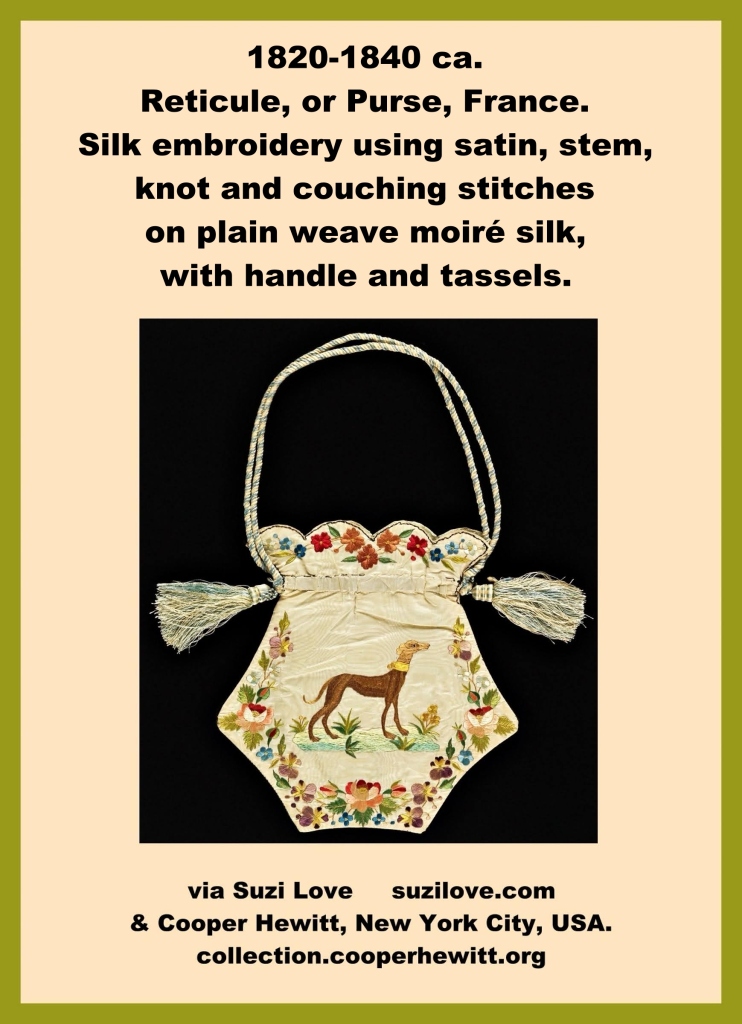
1820 ca. Collection of Reticules, or Purses. Silk silver gauze, netting, fine crochet. Bags have drawstrings, chains and tassels. via Ruby Lane Auctions. #RegencyFashion #JaneAusten #British

Definition Of A Reticule; Bag or purse, often with a drawstring to pull closed and usually made of cloth or covered cardboard and often decorated with beading or embroidery. A reticule, or purse, or handbag, was usually carried by a woman during the Regency period to carry all their daily necessities. Earlier, women used pockets that tied at the waistline and were hidden in the folds of their skirts. Empire style, or early 1800s, high-waisted dresses made it impossible to either sewn in a pocket or to tie on a pocket, so women began carrying small, decorated bags called Reticules, or ridicules, which generally pulled close at the top with a drawstring. These Reticules, or bags, were the forerunners of our modern day purses.

bag_1820 ca. Collection of Reticules, or Purses. Silk silver gauze, netting, fine crochet. Bags have drawstrings, chains and tassels. via Ruby Lane Auctions.
1820 ca. Collection of Reticules, or Purses. Silk silver gauze, netting, fine crochet. Bags have drawstrings, chains and tassels. via Ruby Lane Auctions.
bag_1830 ca. Collection of Four Tiny Purses, or Reticules with drawstrings to close. via Ruby Lane Antiques.
1830 ca. Collection of Four Tiny Purses, or Reticules with drawstrings to close. via Ruby Lane Antiques.
1820-1830 ca. Collections of Reticules, or Ridicules, Or Purses. #Antiques #RegencyEra #RomanticEra http://books2read.com/suziloveReticules Share on X
HN_3_D2D_RetailerBuyLink_HN_3 http://books2read.com/suziloveReticules
D2D_RetailerBuyLink_HN_3 http://books2read.com/suziloveReticules
Posted in 1800s, 1800s women's fashion, Decorative Item, England, Europe, fashion accessories, History, Jane Austen, Regency Era, Regency Fashion, Reticule or Bag, Romantic Era, sewing, Suzi Love Images, U.S.A | Tagged 1800s women's fashion, antiques, Augusta Auctions, British history, decorative, fashion accessories, Jane Austen, Regency Fashion, reticule or bag, Romantic Era, Ruby Lane Antiques, sewing

1800s Omnibus History, France and England. #RomanticEra #VictorianEra #BritishHistory #Travel

Suzi Love Posted on October 11, 2024 by Suzi LoveSeptember 16, 2024

‘Omnibuses, under the name of carrosses a cinq sous, were started in Paris in 1662. Seven vehicles to carry eight passengers each, all inside, were built, and on March 18th, 1662, they began running. The first one was timed to start at seven o’clock in the morning, but an hour or two earlier a huge crowd had assembled to witness the inauguration ceremony, which was performed l)y two Commissaires of the Chatelet, attired in their official robes. Accompanying them were four guards of the Grand Prevot, twenty men of the City Archers, and a troop of cavalry. ‘

In 1828, George Shillibeer, a London coach builder, visited Paris where he was impressed by the efficiency of the new horse-drawn bus service. The following year, he started a single horse-drawn omnibus connecting Paddington and Regent’s Park to the City of London. Passengers were picked up and set down anywhere along the route and fares were paid on board, in contrast to short-stage coaches which had to be booked in advance. 

This new omnibus was pulled by three horses and carried 22 passengers who sat inside and were protected from the weather. Fares were sixpence and one shilling, less than a hackney cab or short-stage coach, but still too expensive for the lower classes. 

1829 July 4th George Shillibeer's Omnibus, London, U.K. First Omnibus between Paddington and the Bank of
1829 July 4th George Shillibeer Omnibus, London, U.K. First Omnibus between Paddington and Bank of England via the New Road, now Marylebone Rd., Somers Town and City Rd. Via Wikimedia Commons.

In 1832, the London City monopoly of hackney carriages was removed, so horse buses expanded and within two years there were 620 licensed horse buses in London. By the Great Exhibition in 1851, London’s increase in visitors meant this number doubled and the number of routes increased to 150.  By 1856, several bus operators were taken over by the new London General Omnibus Company until, with 600 omnibuses, they were the largest bus company in the world.  In 1833, the first real steam omnibuses, the ‘Era’ and ‘Autopsy’ were invented by Walter Hancock, of Stratford, and started on the London roads. The ‘Era’ was the better omnibus of the two, and the most flattering things were said and predicted of it. Enthusiasts declared that omnibuses of this type would enable passengers to be carried at a cheaper rate and greater speed. The ‘Era’ ran from Paddington to the Bank, the same route as the horse-drawn omnibuses, and carried fourteen passengers, the fare being sixpence all the way. It travelled at the rate of ten miles an hour. Travel on these roads was also dangerous as highwaymen stopped and robbed anyone who came along. Male or female made no difference to highwaymen in Britain, nor to the bushrangers in Australia or the gangs on American roads, as they robbed indiscriminately and often with violence.   

By the end of the 18th Century, however, travel as a pleasurable pursuit came into vogue and numerous guides were written for traveling all over the British Isles as well as on the continent. The 1812  ‘Tour Of Dr. Syntax’ was an ironic look at the new obsession of travel and travel guides. Before he set off for the Lake District, Dr. Syntax said to his wife, “You well know what my pen can do, and I’ll employ my pencil too: I’ll ride and write, and sketch and print and thus create a real mint: I’ll prose it here, I’ll verse it there and picturesque it everywhere. I’ll do what all have done before; I think I shall and somewhat more.”  Georgian and Regency travelers were envious of aristocrats, even if they were of the nobility themselves, and loved to view all the British Great Houses. 

A gentleman and his wife would even drive up to the front door of a mansion house and demand to be given a tour of the house.  If they weren’t admitted, they would write in their journals of the inhospitable nature of the people on a particular estate. Thomas Pennant, William Mavor, and others, loved to write about these bad experiences and have them published.  Paterson’s British Itinerary, a travel guide had 17 editions between 1785-1832 – it outlined the roads used by the stage and mail coaches, the tolls, the bridges, etc.   This new touring craze created an industry of hospitality that encompassed more than simple mail coach trips from place to place, and more than a noble family traveling from their country seat to the Metropolis of London for parliamentary sittings. Inns had to improve the quality of the linens and meals if they wanted to attract the wealthier traveling class. Before that, many travelers carried their own linen, crockery, glasses, and utensils, as they didn’t trust the hygiene or standards of country inns.

Travel became something written about by poets with many sonnets written to the beauty of places like the Lake District in England, or the pyramids in Egypt. Inns became cleaner and more respectable so they could welcome travelers of the upper classes. This also meant that women could travel more as roads were slowly improved from rutted tracks that were only suitable for horse riding to roads that family coaches could travel along, though these roads were still narrow and subject to extremes of weather, such as flooding.  The race was on to travel from places like London to Edinburgh in the fastest possible time.

1800s Omnibus History, France and England. #RomanticEra #VictorianEra #BritishHistory #Travel books2read.com/SuziLoveTravel Share on X
HN_10_D2D_RetailerBuyLink

books2read.com/SuziLoveTravel
HN_10_D2D_RetailerBuyLink_ History Notes Book 10 books2read.com/SuziLoveTravel
Posted in 1800s, England, Europe, France, History, London, Quotations, Regency Era, Romantic Era, Suzi Love Images, travel, Victorian Era | Tagged British history, europe, google books, History Notes, Regency London, Romantic Era, travel, Victorian Era

1830-1835 ca. Canary Yellow Leather and Silk Slippers, British. #RomanticEra #Shoes #Fashion

Suzi Love Posted on September 27, 2024 by Suzi LoveSeptember 22, 2024

1830-1835 ca. Canary Yellow Leather and Silk Slippers, British. Silk satin lined, kid leather and linen. via Victoria and Albert Museum, London, UK. collections.vam.ac.uk.

1830s Shoes: Producing different shoes for right and left feet started around 1830 in France. In these first attempts, little paper labels on the insoles of the shoes indicated left and right. However, the shoes were still made on straight lasts with no differentiation between the left and right foot. By the end of the 19th century, producing left and right shoes had become common as shoemakers then worked with combinations of sole and vamp cuts tailored to fit either the right or the left foot. The first steps towards the mechanisation of shoemaking were taken during the Napoleonic Wars. In 1810, engineer Marc Brunel developed a machinery that could mass-produce nailed boots for the soldiers of the British Army. But after the end of the war in 1815, manual labour became cheap, and the demand for military shoes declined. The industrialization of shoemaking began around 1830.

1830-1835 ca. Canary Yellow Silk Slippers, British. Silk satin lined, kid leather and linen. via Victoria and Albert Museum, London, UK. collections.vam.ac.uk.
1830-1835 ca. Canary Yellow Leather and Silk Slippers, British. #RomanticEra #Shoes #HistoricalFashion https://www.bookbub.com/profile/suzi-love Share on X
Suzi Love Book Bub https://www.bookbub.com/profile/suzi-love

Posted in 1800s, 1800s women's fashion, England, London, Romantic Era, shoes, Suzi Love Images | Tagged 1800s women's fashion, Romantic Era, Shoes, Victoria and Albert Museum

1845 Silk Taffeta Dress, Probably Made In England. #RomanticEra #Fashion BritishHistory

Suzi Love Posted on September 27, 2024 by Suzi LoveSeptember 22, 2024

1845 Woman’s Dress, Probably Made In England. Silk Taffeta and glazed linen plain weave. via Los Angeles County Museum of Art, California, USA. collections.lacma.org

1845 Woman’s Dress, Probably Made In England. Silk Taffeta and glazed linen plain weave. via Los Angeles County Museum of Art, California, USA. collections.lacma.org
1845 Silk Taffeta Dress, Probably Made In England. #RomanticEra #HistoricalFashion #BritishHistory  https://www.bookbub.com/profile/suzi-love Share on X
Suzi Love Book Bub https://www.bookbub.com/profile/suzi-love
Posted in 1800s, 1800s women's fashion, Dress Or Robe, England, London, Romantic Era, Suzi Love Images | Tagged 1800s women's fashion, Dress Or Gown, Los Angeles County Museum, Romantic Era

1830 ca. Rosewood and Inlaid Brass Inkstand With Cut Glass Inkwells. #Antiques #RomanticEra #writing

Suzi Love Posted on September 2, 2024 by Suzi LoveSeptember 2, 2024

1830 ca. Rosewood and Inlaid Brass Inkstand, England. Each side has cut-glass inkwells with brass inlaid tops and pen trays, so ideal for a partners desk. via 1st Dibs Auctions 1stdibs.com

1830 ca. Rosewood and Inlaid Brass Inkstand, England. Each side has cut-glass inkwells with brass inlaid tops and pen trays, so ideal for a partners desk. via 1st Dibs Auctions 1stdibs.com
1830 ca. Rosewood and Inlaid Brass Inkstand With Cut Glass Inkwells. #Antiques #RomanticEra #writing. books2read.com/SuziLoveWritingTools Share on X
HN_13_D2D_WritingTools Book 13 What did the lady of the house use to pen notes? What sat on the desk of the man of the house when managing his accounts? #History #Nonfiction #travel books2read.com/SuziLoveWritingTools
Posted in 1800s, Box Or Container, Decorative Item, England, household, London, Romantic Era, Suzi Love Images, Writing Tools | Tagged 1st Dibs Auctions, antiques, Box Or Container, household, Romantic Era, Suzi Love Images, Writing Tools | Leave a reply

Do you love Jane Austen and Bridgerton fashions? Corsets Or Stays Worn During the Early 1800s, or Regency Era, Book 17 History Notes #Bridgerton #JaneAusten #RegencyFashion #Corsets

Suzi Love Posted on August 24, 2024 by Suzi LoveAugust 21, 2024

This book shows how corsets changed to fit well under clothing, give maximum support and comfort. Corsets pushed up breasts and showed off the bust line beneath a square-cut and low-cut neckline as in the early 1800s, or Regency years. Jane Austen and her female and friends wore these corsets. Corsets or stays worn during the early 1800s, or Jane Austen’s lifetime. https://books2read.com/SuziLoveCorsetBook17

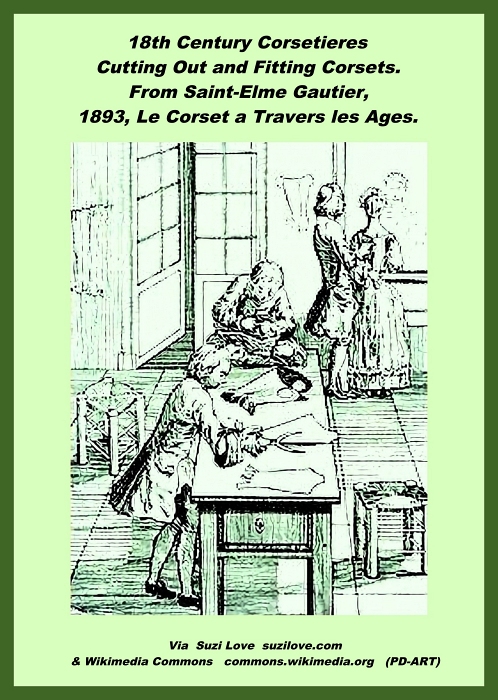
The main purpose of corsets was to support and shape the breasts. Though they still slimmed the midriff, this was not the prime purpose of a corset between 1810 and 1830. The waistlines of dresses were lowering to below the bust line but nearer to the true waist, so corsets were longer and were given added shaping by stitching and cording and by shaping the breasts with pleated or gathered cups.

HN_17_Corsets 1810-1830 History Notes Book 17 This book shows how corsets changed to fit well under clothing, give maximum support and comfort. Corsets pushed up breasts and showed off the bust line beneath a square-cut and low-cut neckline as in the early 1800s, or Regency years. Jane Austen and her female and friends wore these corsets. Corsets or stays worn during the early 1800s, or Jane Austen's lifetime. https://books2read.com/SuziLoveCorsetBook17
Do you love Jane Austen and Bridgerton fashions? Corsets Or Stays Worn During the Early 1800s, or Regency Era, Book 17 History Notes #Bridgerton #JaneAusten #RegencyFashion #Corset https://books2read.com/SuziLoveCorsetBook17 Share on X
HN_17_D2D_Corset_1810-1830
https://books2read.com/SuziLoveCorsetBook17
HN_17_D2D_Corset_1810-1830
Posted in 1800s, 1800s women's fashion, Australia, Bridgerton, Canada, Corset, England, Europe, France, Google Books, History Notes, Jane Austen, London, Regency Era, Regency Fashion, Suzi Love Books, Suzi Love Images, U.S.A, underclothing | Tagged 1800s women's fashion, Book 17, Bridgerton, Corset, Fashion Plate, History Notes, Jane Austen, Regency Fashion, Romantic Era, Romantic Era Fashion, Suzi Love Books, underclothing

Post navigation

← Previous Post
Next Post→

SUBSCRIBE TO SUZI LOVE'S NEWSLETTER.

Recent Posts

  • Book Hooks: Lady Laura Jamison hadn’t needed any announcements to know a bullet had been fired. #HistoricalMystery #RomCom #VictorianRomance #RegencyRomance
  • 1815 Typical English Dinner In Jane Austen and Bridgerton Times. Two Courses and Desert. #RegencyEra #JaneAusten #Food #History
  • Why Did Women Wear Chatelaines Dangling From Chains In Bridgerton and Jane Austen’s Times? Women carried essential items on them. #Bridgerton #JaneAusten #RegencyFashion #GeorgianFashion #VictorianFashion
  • 19th Century Food For The Upper Classes In Bridgerton and Jane Austen Times. #Bridgerton #JaneAusten #RegencyEra #HistoricalFood
  • 1813 October White At-Home Dress, Lace Cap and Red Shawl As Worn in Jane Austen and Bridgerton years. #RegencyFashion #JaneAusten #Bridgerton

Recent Comments

  1. Suzi Love on Book Hooks: Earl of Winchester requires a placid bride, the opposite of Lady Laura. #HistoricalRomance #RomCom #RegencyRomance
  2. Lisabet Sarai on Book Hooks: Earl of Winchester requires a placid bride, the opposite of Lady Laura. #HistoricalRomance #RomCom #RegencyRomance
  3. Suzi Love on Book Hooks: Earl of Winchester requires a placid bride, the opposite of Lady Laura. #HistoricalRomance #RomCom #RegencyRomance
  4. Maggie Blackbird on Book Hooks: Earl of Winchester requires a placid bride, the opposite of Lady Laura. #HistoricalRomance #RomCom #RegencyRomance
  5. Suzi Love on Book Hooks: Earl of Winchester requires a placid bride, the opposite of Lady Laura. #HistoricalRomance #RomCom #RegencyRomance

Login

  • Log in

Archives

  • May 2026
  • April 2026
  • March 2026
  • February 2026
  • January 2026
  • December 2025
  • November 2025
  • October 2025
  • September 2025
  • August 2025
  • July 2025
  • June 2025
  • May 2025
  • April 2025
  • March 2025
  • February 2025
  • January 2025
  • December 2024
  • November 2024
  • October 2024
  • September 2024
  • August 2024
  • July 2024
  • June 2024
  • May 2024
  • April 2024
  • March 2024
  • February 2024
  • January 2024
  • November 2023
  • October 2023
  • September 2023
  • August 2023
  • July 2023
  • June 2023
  • April 2023
  • March 2023
  • February 2023
  • June 2022
  • April 2022
  • March 2022

Categories

  • 1700s
  • 1700s Mens fashion
  • 1700s Womens Fashion
  • 1800s
  • 1800s Mens Fashions
  • 1800s women's fashion
  • 1900s
  • art
  • Australia
  • Bath
  • bedroom fashion
  • Book Hooks
  • Box Or Container
  • Bridgerton
  • Bus Trips
  • Canada
  • Carriage
  • cartoon
  • Celebrity
  • Chatelaine
  • children
  • Children
  • Christmas
  • Coat or Pelisse Or Redingote
  • Contemporary
  • Corset
  • Couple
  • Customs & Manners
  • dancing
  • December Scandal
  • Decorative Item
  • Dress Or Robe
  • Easter
  • Edwardian Era
  • Embracing Scandal
  • England
  • Ester In Images
  • Europe
  • Events
  • Fashion
  • fashion accessories
  • Food and Drink
  • Four Times A Virgin
  • France
  • furniture
  • Georgian Era
  • Georgian Fashion
  • Google Books
  • Grand Tour
  • Group
  • hats
  • History
  • History Events
  • History Notes
  • History Of Christmases Past
  • household
  • Hygiene
  • Irresistible Aristocrats
  • Jane Austen
  • Keanu Reeves
  • Kellys Justice
  • Legal
  • London
  • Love After Waterloo
  • Loving Lady Katharine
  • medical
  • military
  • money
  • mourning
  • Music
  • Outback Arrival
  • pants
  • Pastimes
  • peerage
  • People
  • Petunia and Pearl Diver
  • Places
  • Pleasure House Ball
  • postal
  • Queensland
  • Quotations
  • Regency Era
  • Regency Fashion
  • Regency Life Series
  • Reticule or Bag
  • riding
  • Romantic Era
  • Royalty
  • Russia
  • Scandalous Siblings Series
  • Scenting Scandal
  • Self Publishing
  • sewing
  • Shirt
  • shoes
  • South Pacific
  • Spencer
  • sports
  • Suit
  • Sunday Snippet
  • Suzi Love
  • Suzi Love Books
  • Suzi Love Images
  • Suzi Love Writing
  • Swain Cove
  • THe Viscount's Pleasure House
  • travel
  • U.S.A
  • underclothing
  • Vest or Waistcoat
  • Victorian Era
  • Victorian Fashion
  • weapons
  • weddings
  • Writing Tools

1800s men fashion 1800s women's fashion antiques Bridgerton British history Cartoons Corset cravat decorative Dress Or Gown England europe fashion accessories Fashion Plate France Georgian era Georgian Fashion gloves google books Hats And Hair historical romance History Notes household Jane Austen jewelry Journal des Dames et des Modes London Metropolitan Museum NYC pants Redingote Or Pelisse Or Coat Regency Era Regency Fashion Regency London Regency Men reticule or bag riding sewing shawls Shoes Suzi Love Books Suzi Love Images Tailcoat The Repository Of Arts underclothing Vest or Waistcoat

©2026 - Suzi Love - Weaver Xtreme Theme Privacy Policy
↑