1826 Sights the Bridgertons and Jane Austen Saw Around Regency England. The sights that the families and friends would have seen around while traveling around England. via 1826 The English Spy By Robert Cruikshank via Google Books (PD-150)


1826 Sights the Bridgertons and Jane Austen Saw Around Regency England. The sights that the families and friends would have seen around while traveling around England. via 1826 The English Spy By Robert Cruikshank via Google Books (PD-150)


1814 Statistics On Classes, Properties and Population In Great Britain. From: 1814 A Treatise On Wealth and Power. By Patrick Colquhoun. These are the statistics for England in Jane Austen’s time, or the early 1800s, or Regency Era.


1802 ‘The Cow Pock or The Wonderful Effects Of The New Inoculation’. By James Gillray. Caricature depicting the early controversy surrounding Dr. Edward Jenner’s cowpox vaccination program begun in 1796 in England. Recipients of the vaccine developing cow-like appendages. Via British Museum, London, UK. britishmuseum.org (PD-Art)


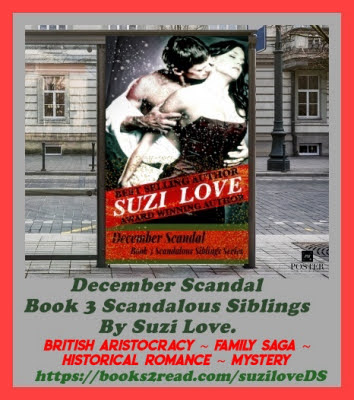
Michael Brandon travels to introduce the woman he loves to family but is shocked when his missing brother, presumed dead for years, arrives at the country estate of the Duke Of Sherwyn where several people are stranded due to a severe snow storm. https://books2read.com/suziloveDS December Scandal, Book 3, Scandalous Siblings.
1844 Martin House, England.
Michael Brandon strolled after Cayle St. Martin, the Duke of Sherwyn, when the duke strode to the hallway to greet the latest group of travelers. They’d be, like him, grateful to accept the duke’s hospitality because they’d all become stranded after heavy snowfalls had led to rapidly rising water levels and an impassable local bridge.
Michael and his party had been the first to beg assistance from Sherwyn this afternoon, as he’d known that Sherwyn had left London a week earlier and would already be in residence at his country home. There had been a flurry of social events in London over the past two weeks before the Ton left the city and retreated to their country estates to wait out the colder months. Though this extreme weather had caught everyone by surprise.
Michael would feel guilty for landing, unannounced, on the St. Martin’s doorstep, with Melissa and her daughter and their retinue in tow, except that he knew he was providing Becca and her sisters with the drama and excitement that they thrived on. The Jamisons had proved their resourcefulness when Becca and her siblings, with help from Cayle and Richard St. Martin, had tracked down a stock-investing madman or, as it had turned out to be, a madwoman, and handed her over to Scotland Yard. Becca, and the other ladies, appeared delighted to have new people and conversations to keep them entertained while snowstorms kept them all housebound.


1808 Fashionable English Couple, Dressed As In Jane Austen’s times. Lady in a white dress with pointed hem decorations, fitted white hat tied under her chin with yellow ribbon, yellow shawl and pink slippers. Gentleman in formal dress of blue tailcoat, black knee breeches, white stockings, black shoes, black bicorn hat, curly hair style and sideburns and a sword. Interestingly, this is English style fashions from a French magazine. Fashion Plate via Journal des Dames et des Modes, or Costume Parisien.


1805 Breeches, part of the Royal Naval Uniform of surgeon Joshua Horwood , who served as surgeon’s mate in HMS ‘Prince’ at Trafalgar, and was promoted to surgeon in 1807. via Royal Museums Greenwich, London, U.K. collections.rmg.co.uk


1830s Man’s Double-Breasted Frock Coat, English. Double-breasted frock coat with a nipped-in waist. The broad lapels are faced with silk velvet. This gentleman’s frock coat has a crescent-shaped breast pocket and two larger curved pockets on the front of the skirts. Woolen beaver cloth trimmed with silken velvet.
The waisted frock coat came into fashion in about 1816 and became an enduring style. Typically it had a narrow waist and full skirts hanging vertically in front. The frock coat was worn for everyday purposes such as morning dress, usually with a top hat, cane and trousers. By 1830 frock coats were made in a variety of designs according to taste, fashion or type of activity. This example has an out-breast pocket, a feature which appeared on coats during the 1830s. This coat was given by Messrs Harrods Ltd. Victoria and Albert Museum, London, UK. collections.vam.ac.uk.


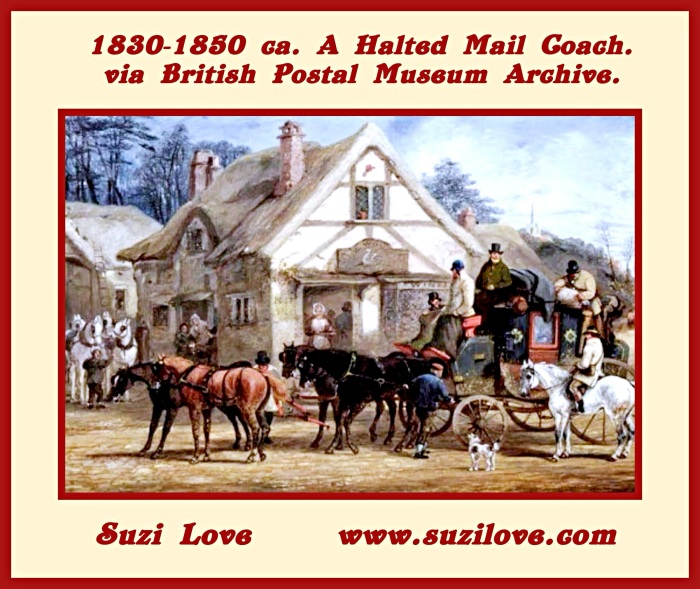
The London To Louth Royal Mail, England, U.K. Print by Charles Cooper Henderson. (1803-1877)
How did Jane Austen and her family? Did they go by stagecoach? The dreadful condition of British roads caused great apprehension to all classes of travelers. Making a journey anywhere in the country was a big undertaking and often a gentleman composed his last will and testament before his departure. Traveling in vehicles was only possible during the day or on the nights with very bright moonlight with few vehicles attempting road travel in winter and any travel on a Sunday was frowned upon. books2read.com/SuziLoveTravel
Description of Stage Coach Travel in England. via 1815 Journal Tour of Great Britain. “The gentlemen coachmen, with half-a dozen great coats about them, immense capes, a large nosegay at the button-hole, high mounted on an elevated seat, with squared elbows, a prodigious whip, beautiful horses, four in hand, drive in a file to Salthill, a place about twenty miles from London, and return, stopping in the way at the several public-houses and gin-shops where stage-coachmen are in the habit of stopping for a dram, and for parcels and passengers on the top of the others as many as seventeen persons. These carriages are not suspended, but rest on steel springs, of a flattened oval shape, less easy than the old mode of leathern braces on springs. Some of these stage coaches carry their baggage below the level of the axletree.”


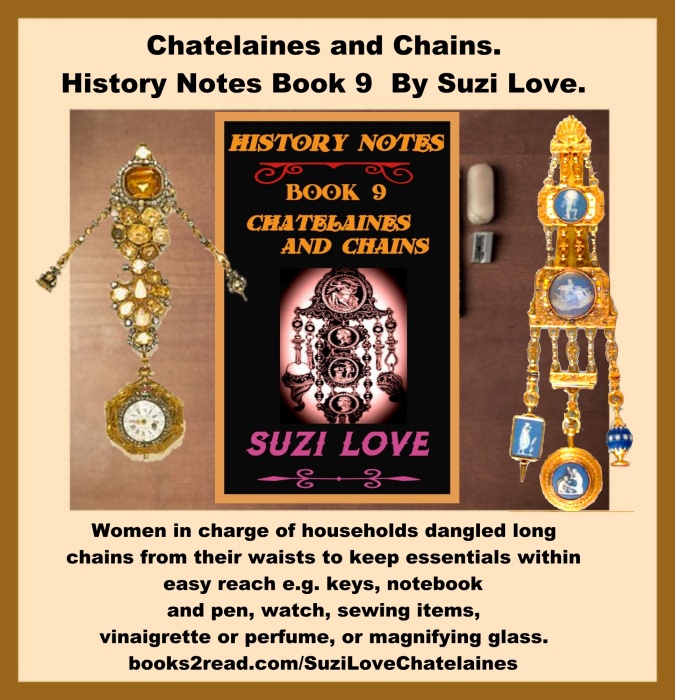
Love the charming chatelaines and chains women wore in Jane Austen’s and Bridgerton’s times? Check out this fascinating read! #bridgerton #janeausten #chatelaine #suzilovebooks books2read.com:SuziLoveChatelaines
The Bridgerton women and Jane Austen and contemporaries carried keys, writing tools, sewing items and other personal necessities on their person by long chains, or a chatelaine, that hung from their waist. Early chatelaines were simple essentials but later chatelaines were decorative and expensive. http://books2read.com/SuziLoveChatelaines

Definition Chatelaine: The word Chatelaine is French and means the keeper of the keys. Chatelaine” derives from the Latin word for castle. In Medieval times, the chatelaine was in charge of the day-to-day running of the castle. Women in charge of households dangled long chains from their waists to keep essentials within easy reach e.g. keys, notebook and pen, watch, sewing items, vinaigrette or perfume, or magnifying glass. Early chatelaine were simple essentials. Later chatelaine were decorative and expensive. books2read.com/SuziLoveChatelaines
What did a chatelaine do? Most important task was keeper of the keys. Also ordered supplies, did bookkeeping, supervised servants, taught castle children, and organized guests.
What were chatelaines used for?

1815 ca. Tailcoat, Probably British. Black wool, silk cotton and wood. Double-breasted, cutaway at the front waist, notched collar, straight sleeves, pleat falling from the back waist. via Metropolitan Museum, N.Y.C., U.S.A. As Worn By the Men in the Families of Jane Austen and the Bridgertons. #Regency #JaneAusten #Fashion #BritishHistory
Tailcoat: A Regency Era, or early 1800s, gentleman was outfitted in more practical fabrics, such as wool, cotton and buckskin rather than the fussy brocades and silks of the late 1700s. The men in Jane Austen’s life would have worn a black tailcoat like this for everyday wear. https://books2read.com/SuziLoveFashionMen1800-1819