Days and nights used to be counted separately, so the important night was often the night before rather than the night of, which is why some parts of the world celebrate Christmas on Christmas Eve. Therefore, the twelve days of Christmas actually begin on the eve of December 25th, the first night, and end on January 6th, which is Epiphany. The day of December 26 is the first day and the eve of December 26 the second night.
The famous Twelfth Night is the eve of Epiphany and the twelfth day is Epiphany itself. During these twelve days, traditional roles were relaxed or turned upside down so that masters waited on their servants, men were allowed to dress as women and women as men. These crazy antics can also be seen in modern Christmas pantomimes in which authority is mocked, women play male leads and the leading older female character is played by a man.
Twelfth Night
The Twelfth Night festival marked the onset of the winter solstice, the point in late December when the sun, whose daily arc had reached its lowest and darkest.
Twelfth Night is the eve before the twelfth day of Christmas or the Epiphany celebration, which commemorates the adoration of the Magi before the infant Jesus and marks the final night of the Christmas season. Twelve Nights,” which extended from the 25th of December to the 6th of January. The Twelve Nights were religiously observed by numerous feasts, and were regarded by the ancient Germans as among the holiest and most solemn of their festivals.
In Tudor England, the Twelfth Night marked the end of a winter festival that started on All Hallows Eve. A King or Lord of Misrule would be appointed to run the Christmas festivities, and the Twelfth Night was the end of his period of rule. Shakespeare’s play, Twelfth Night, or What You Will, was originally written to be performed as a Twelfth Night entertainment. After Twelfth Night, the Carnival season starts and lasts until Mardi Gras. In some places, Twelfth Night celebrations include food traditions such as the king cake or tortell.
In the Bavarian and Styrian Alps the Twelve Nights are called “Rumor Nights,” on account of their visions of ghosts and hobgoblins, when priests and prudent housewives, with prayer and invocation, holy-water and burning incense, fumigate dwelling and outhouse, and sprinkle their cattle with salt. Hence these nights were also called “Fumigating Nights.” As an additional protection against “witches’ feet” and “devils’ paws,” the initials of the holy magicians were formerly inscribed upon the door-posts. On the dreaded Twelfth-night, when Frau Holle, or Berchta, issues with her fearful train from her wild mountain home, where she dwells among the dead, she is generally preceded by the faithful Eckhart, an old man with a long beard and a white wand, who warns every one of her terrible approach.
Legend has it that during the 17th century, craftsmen created straight white sticks of candy in the shape of shepherds’ crooks at the suggestion of the choirmaster at the Cologne Cathedral in Germany. The treats were given to children to keep them quiet during ceremonies at the living creche, or Nativity scene, and the custom of passing out the crooks at such ceremonies soon spread throughout Europe.
‘The legends of the candy cane are many, including that the cane was shaped like a “J” for Jesus, the three red stripes symbolized the Holy Trinity, the hardness of the candy represented the Church’s foundation on solid rock and the peppermint flavor reflects the use of hyssop, an herb referred to in the Old Testament.’ via Encyclopedia Britannica
In celebrations of Saint Nicholas Day, candy canes are given to children as they are also said to represent the crosier of the Christian bishop, Saint Nicholas; crosiers themselves allude to the Good Shepherd, a title associated with Jesus. Some people explain the symbolism of a striped cane as white representing Christ’s purity, red the blood he shed, and the three red stripes the Holy Trinity.
In the mid 1600s, sugar roses were added but weren’t popular so plain white canes remained until red stripes were added around 1890. In 1847, a German immigrant living in Wooster, Ohio, U.S.A. looped candy canes that he brought with him from Europe over the boughs of his Christmas tree.
In 1919, Bob McCormack of Albany, Georgia, made candy canes for family, friends and local shopkeepers. The canes were bent by hand as they came off the assembly line into the ‘J’ shape of a shepherd’s crook, so breakage was often over 20 percent. In the 1920s, a cherubic child in a red-and-white hat sold peppermint candy cane to Albany natives in an advertisement for Bob’s candy company. McCormack was the first manufacturer to wrap his candy in cellophane. Bobs moved to a larger facility in the 1930s so that it could expand its product lines and was one of the few candy companies to remain solvent during the Great Depression.
As the economy improved, people bought more sweet treats, but Bobs Candy was then leveled by a tornado and, as the company had no tornado insurance, they had to rebuild on their own. By August 1940 the company was back in business and employed McCormack’s three children.
During World War II (1941-45), when sugar was rationed, coconuts were in short supply, and pecans were expensive, Bobs took advantage of a plentiful local product—the peanut—and sold peanut-butter crackers and vacuum-packed peanuts. During the 1950s, Bobs began making money with such innovations as break-proof packaging, moisture-proof candy wrappers.
In 1952, Bob McCormack’s brother-in-law, Catholic priest Gregory Keller, invented the Keller Machine which automated the process of twisting soft candy into spiral striping and then cutting them into precise lengths as candy canes.
Harding Keller invented the Keller Machine around 1950 for his brother-in-law Bob McCormack. The machine twisted and cut stick candy, allowing for the mass production of the company’s signature candy canes and other items. – Courtesy of Farley’s and Sathers Candy Company, Inc.
First, candy sticks cut to the desired length enter the machine. Each stick is bent individually, but the machine has a system of multiple grippers and rollers to continually bend the sticks, one after the other. As each stick enters the machine, it is positioned in a gripper which holds the straight portion of the cane with the part to be bent protruding out. Each gripper has on one side a curved die which the protruding end will be bent over. The candy stick is first bent to a right angle as it is moved past and put into contact with an inclined face. The patent application describes two potential versions of the mechanism which complete the bending process.
The first version of the mechanism has a chain around two sprockets on which are mounted bending rollers. Each bending roller is attached to a cam which rides along another inclined face to move the roller along the protruding surface of the cane to complete bending it around the die. In the second version, the chain and sprockets are replaced by a wheel on which the bending rollers are mounted. In modern candy cane production, the sticks are wrapped in cellophane before they are bent.
By the middle of the century, Bob’s company – originally the Famous Candy Company, then the Mills-McCormack Candy Company, and later Bobs Candies, had become one of the world’s leading candy cane producers.Bobs Candies was sold to Farley’s and Sathers in Spring 2005. Farley’s and Sathers merged with the Ferrara Candy Company which continues to make candy canes under the Bobs name.
By the middle of the century, Bob’s company – originally the Famous Candy Company, then the Mills-McCormack Candy Company, and later Bobs Candies, had become one of the world’s leading candy cane producers.
Christmas: Typical Christmas Food Eaten By the Bridgerton and Jane Austen Families. #Christmas #Food #JaneAusten #Bridgerton
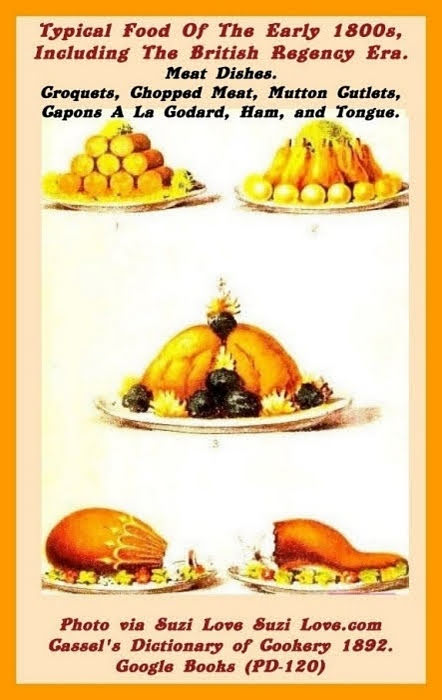
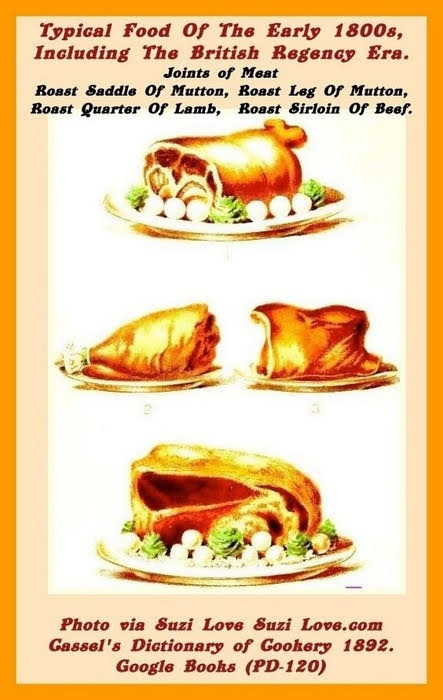
On the Christmas menu was generally mince pies and perhaps a goose or a piece of beef, depending on the family’s wealth and status. Mince pies were not made of fruit mince as we do now, but of offal or meat such as bullock’s tongue cooked with spices, orange peel, and wine and then used to fill pastry cases.
Another Christmas specialty was a Yorkshire Christmas pie which would be filled with turkey, goose, a hen, or perhaps woodcocks, partridge, or pigeons. And after the main courses, came the Plum Pudding, mixed on Stir-Up Sunday according to each family’s recipe and then boiled in a cloth.
At Christmas time, households had guests to stay and games were played to either fill in the time inside when the weather was too bad to venture out with sleds or skates, or to keep tradition. Blind man’s bluff, forfeits, and snap dragon were all played.
A list of some entertainments for Christmas…From The book Of Christmas by Thomas kibble Hervey. “jugglers, and jack-puddings, scrambling for nuts and apples, dancing the hobby-horse, hunting owls and squirrels, the fool-plough, hot-cockles, a stick moving on a pivot, with an apple at one end and a candle at the other, so that he who missed his bite burned his nose, blindman’s buffs, forfeits, interludes and mock plays :” — also of ” thread my needle, Nan,” ” he can do little that can’t do this,” feed the dove, hunt the slipper, shoeing the wild mare, post and pair, snap dragon, the gathering of omens….
Snap Dragon A favorite game was Snap Dragon, often played on Christmas Eve. Raisins were put into a large, shallow bowl and brandy was poured over them and then ignited. Lights were extinguished to increase the eerie effect of the blue flames playing across the liquor. The object of the game was to reach through the blue flames and grab as many raisins as possible from the flaming brandy and pop them into your mouth. The risk of burning yourself increased the excitement.
Samuel Johnson’s Dictionary of the English Language in 1755 describes the. game as “a play in which they catch raisins out of burning brandy and, extinguishing them by closing the mouth, eat them”. According to an eighteenth-century article in Richard Steele’s Tatler magazine, “the wantonness of the thing was to see each other look like a demon, as we burnt ourselves, and snatched out the fruit.”
Snap-dragon was played in England, Canada, U/S.A, and probably other countries with British backgrounds. The words snap-dragon and flap-dragon can refer to the game, the raisins used in the game, or the bowl with brandy and raisins.
The first reference to Snap-dragon as a game is in Francis Grose’s Dictionary of the Vulgar Tongue in 1811. “Christmas gambol: raisins and almonds being put into a bowl of brandy, and the candles extinguished, the spirit is set on fire, and the company scramble for the raisins.” Snap-dragon as a Christmas parlour game was mentioned in 1836 in Charles Dickens’ The Pickwick Papers and in 1861, in Anthony Trollope’s novel Orley Farm. Lewis Carroll, in Through the Looking-Glass, and What Alice Found There in 1871 describes “A snap-dragon-fly. Its body is made of plum pudding, its wings of holly-leaves, and its head is a raisin burning in brandy.”
Agatha Christie’s book Hallowe’en Party describes a children’s party during which a child’s murder causes Hercule Poirot to be brought in to solve the case and at which Snap-dragon is played at the end of the evening.
First made in 1850 by a London sweet maker called Tom Smith who decided it would a fun idea if his sweets and toys opened with a crack when their fancy wrappers were pulled in half. In early 1830, Tom Smith started work in a bakers and ornamental confectioners shop in London, selling sweets such as fondants, pralines and gum pastilles. He worked hard and took particular interest in the wedding cake ornaments and decorations, experimenting and creating new, more exciting and less crude designs in his spare time. Before long he was successful enough to leave and start up his own business in Goswell Road, Clerkenwell, East London. On a trip to Paris in 1840, he discovered the ‘bon bon’, a sugared almond wrapped in a twist of tissue paper. He brought the ‘bon bon’ to London and they sold extremely well, but in January demand virtually ceased and once again he was reliant on sales of cake and table decorations and ornaments.
Anxious to stimulate sales, Tom placed a small love motto in the tissue paper and encouraged his regular customers to take supplies. Tom took a risk and concentrated on developing it further, while still running the wedding cake ornament and confectionery business. The majority of ‘bon bons’ were sold at Christmas so Tom thought up ways to capitalize on this short, but very profitable, season. It was the crackle of a log as he threw it on his fire that gave him the flash of inspiration which eventually led to the crackers we know today. A ‘ crackle’ added excitement to his novelty ‘bon bon’ so he experimented to find a compound which gave a satisfactory bang. He perfected his chemical explosion to create a ‘pop’ caused by friction when the wrapping was broken and the trade jumped at Tom Smith’s latest novelty.
He quickly refined his product by dropping the sweet and the ‘bon bon’ name, calling his new crackers Cosaques, but he kept the motto and added a surprise gift. Delighted at his overnight success, Tom took his cracker abroad but an Eastern manufacturer copied his idea and delivered crackers to Britain just before Christmas. So Tom designed 8 different kinds of cracker, working his staff day and night and distributing stocks in time for Christmas. He lived to see the new branch of his firm grow to swamp the original premises in Goswell Road and the company moved to Finsbury Square in the City of London where it remained until 1953. When he died he left the business to his three sons, Tom Henry and Walter. A few years later, a drinking fountain was erected in Finsbury Square by Walter Smith in memory of his mother, Mary, and to commemorate the life of the man who invented the great British Cracker.
His three sons developed the cracker designs, contents and mottoes. Walter Smith, the youngest son, introduced a topical note to the mottoes which had previously been love verses. Special writers were commissioned to compose snappy and relevant maxims with references to every important event or craze at the time from greyhounds to Jazz, Frothblowers to Tutankhamen, Persian Art to The Riviera. The original early Victorian mottoes were mainly love verses. Eventually these were replaced by more complicated puzzles and cartoons, and finally by the corny jokes and riddles which characterise our crackers today.
Walter also introduced the paper hats, many of which were elaborate and made of best tissue and decorative paper on proper hatmakers stands and he toured the world to find new, relevant and unusual ideas for the surprise gifts, such as bracelets from Bohemia, tiny wooden barrels from America, and scarf pins from Saxony. Some were assembled in the factory, like the thousands of tiny pill boxes filled with rouge complete with powder puff.
A six foot cracker decorated Euston Station in London, and in 1927 a gentleman wrote to the Company enclosing a diamond engagement ring and 10 shilling note as payment for the ring to be put in a special cracker for his fiancee. Unfortunately he did not enclose an address and never contacted the Company again; the ring, letter and 10 shilling note are still in the safe today. In the early days, there was a large variety of specialist boxes, including Wedgwood Art Crackers from original designs by permission of Josiah Wedgwood and Sons, and designs such as Japanese Menagerie crackers containing the latest novelties from Japan, including animals, birds, reptiles and mottoes in Japanese.
Crackers were created for the War Heroes, Charlie Chaplin, The Wireless, Motoring, The Coronation and even the Channel Tunnel in 1914. Exclusive crackers were also made for members of the Royal Family and still are to this day. During the Second World War restrictions were placed on the production of cracker snaps.
The Ministry of Defence commissioned Tom Smith to fold and tie bundles of three to six snaps together with special string and regulation knots. These bundles were then used by soldiers in training as, when the string was pulled, they mimicked the noise of machine gun fire. After the war, vast quantities of these surplus cracker snaps were released back into the cracker trade. As the demand for crackers increased, Tom Smith merged with Caley Crackers in 1953 taking over their headquarters and factory in Norwich, East Anglia.
Tom Smith Group Limited currently hold a royal warrant from: HM QUEEN ELIZABETH II Ê 1906: Tom Smith were granted their first Royal Warrant by the then Prince of Wales which entitled them in 1909 to become members of the Royal Warrant Holders Association. 1910: In December, the reigning monarch, King George V granted Tom Smith his warrant as suppliers of Christmas Crackers. Tom Smith still holds the honour of producing special crackers each year for the Royal Household.
In the countries that now use them, a cracker is set next to each plate on the Christmas dinner table and a colourful party hat, a toy or gift and a festive joke falls out when the cracker is pulled in half with a loud bang! The party hats look like crowns, supposedly to symbolise the crowns worn by the Wise Men.
Another British company strongly associated with the cracker business was Batger and Co. Like Tom Smith, they sold a wide variety of crackers in highly decorated boxes and once again many were themed or in commemoration of a special event. Batger’s Gretna Green Crackers for the famous place for eloping lovers where couples in the Regency period ran off in a carriage to Scotland to be married at the blacksmiths forge at Gretna Green.
Crackers were an incredibly expensive luxury at the time costing from 14 shillings to 30 shillings a box. Others were Peerless Crackers and Mead and Field Crackers. Cabaret Girl from the Peerless series of Christmas crackers, from 1933, which promises that each cracker contains ‘both a juvenile costume and fancy hat or cap, amusing joke or riddle, a good snap.
1826 House Of Lords In High Debate. From A Regency Gentleman’s Life. From The English Spy By Robert Cruikshank.
Light-hearted look at a young man’s day in the early 1800s. Depicts the ups and downs of a young gentleman’s day in the Regency Era, or Jane Austen’s years. Through historic images, historical information, and funny anecdotes, it shows how a young man about town fills his day, where he goes, and who he spends time with. This light-hearted look at the longer Regency years is an easy to read overview of what people did and wore, and where they worked and played. There is plenty of information to interest history buffs, and lots of pictures to help readers and writers of historical fiction visualize the people and places from the last years of the 18th Century until Queen Victoria took the throne. Regency Life Series Book 3 Young Gentleman’s Day.com/suziloveYGD
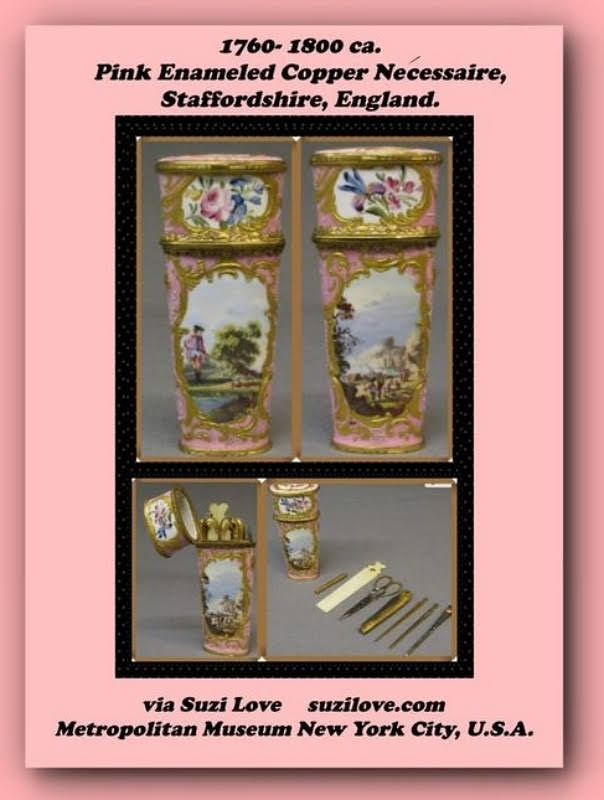
1760-1800 ca. Pink Enamel and Copper Necessaire Or Etui, Staffordshire, England. Dimensions: 3 3/4 x 1 5/8 in. (9.5 x 4.1 cm) Credit: Pierpont Morgan, 1917 via Metropolitan Museum, N.Y.C., U.S.A. metmuseum.org
Definition Necessaire Or Etui: Small toiletry, writing, or sewing containers were called Necessaire or Etui: Tiny boxes or containers were carried in large castles or sprawling manor houses so a lady or gentleman had their essentials with them all day. They were also important when traveling by coach, trains, or on ships where space was always limited. A necessaire or Etui was easily carried in a bag, reticule, or pocket so essentials were on hand for personal grooming, to repair a ripped hem, replace a button, to embroider, or to write a note or letter.
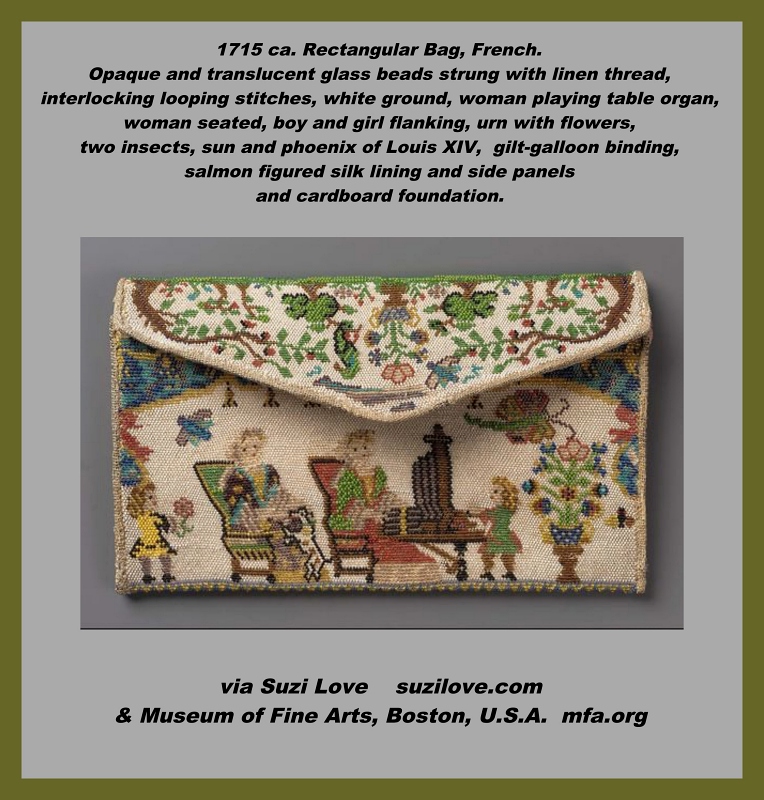
1715 ca. Rectangular Envelope Style Bag, French. Polychrome opaque and translucent glass beads strung with linen thread, held together by interlocking looping stitches (sablé). Design on white ground: woman playing table organ, woman seated, boy and girl flanking, urn with flowers right, two insects and curtain above (obv.); sun and phoenix of Louis XIV, ribbon above inscribed IE VIS SANS MOURIR, inscribed at bottom and right SI IE MEURS CE NEST QUE POVR REVIVRE (rev.); vegetative scene (flap). Gilt-galloon binding. Salmon figured silk lining and side panels. Cardboard foundation. via Los Angeles County Museum of Art, California, USA. collections.lacma.org
1863 Traveler’s Chest, French. Sewing Tools, Ruby Perfume, Aide de Memoire or Notebook, etc. Inside lid with theatre curtains. via Ruby Lane Antiques. rubylane.com
1864 Silk corset, made to be worn over a chemise. Made in France or Britain. Aqua blue silk lined with linen, edged with machine-made lace, reinforced with whalebone, metal, lined with cotton twill. The front has fastenings and the back has lacings. The wearer of this corset could dress without help because the steel ‘split busk’ fastens in front. The front fastening was invented in 1829 but did not become common until the 1850s. The whalebones press into the waist to shape the hipline into an extravagant curve, to flatter and support the fashionable cage crinoline. In the 1860s women relied on voluminous skirts, in addition to corsets, to make their waists appear small.
Flossing, or embroidery, to stop bones poking through fabric, edged with machine-made lace, reinforced with whalebone, metal fasteners, V-shaped front for better fit & extra shaping. The front has fastenings and the back has lacings. There are fewer bones in the back of the corset than the front and none over the hips. Trimmed at the top edge with a narrow band of machine-made lace. Stiffened with whalebone and machine-stitched with an incised swivel latch to lock the busk fastening. Boned at the centre front, back and diagonally from the side to back and sides to front. The boning is hand-stitched into place. Metal eyelets. Lined with cotton twill. The corset reaches the top of the hips and is gored at the bust and hips.
During the 19th century, corsets were made from a variety of materials and shapes changed often. Sometimes breasts were pushed up and almost over the top and waists could be tiny and other curves were emphasized. By the end of the 19th century, corsets weren’t laced so tightly because wide crinolines created the illusion of tiny waists. There are fewer bones in the back of the corset than the front and none over the hips. From the late 1840s to the 1860s skirts were full and bell-shaped, at which point corsets were relatively short and not particularly tightly laced, since the massive skirts made all waists look proportionally small.
The corset was worn over the chemise and it moulded the figure of the wearer into the fashionable shape of the day. These shapes ranged from slender to curvaceous and everything in between during the 19th century. Like the chemise, the corset in the 19th century was made of a wider variety of materials, in this case blue silk lined with linen. It did not need to be very tightly laced, for the illusion of a small waist was created by the very wide circumference of the crinoline.
Credit : Given by the Burrows family. Museum number:T.169-1961. The donors of this corset linked it to a 1864 marriage in the family. Victoria and Albert Museum, London, U.K.