1800s Silver and Carved Mother of Pearl Writing and Desk Set, French. Wax Seal, Dip Pen and Letter Opener in the style that Jane Austen would have used to write her novels and her letters. via Ruby Lane Antiques. rubylane.com



1800s Silver and Carved Mother of Pearl Writing and Desk Set, French. Wax Seal, Dip Pen and Letter Opener in the style that Jane Austen would have used to write her novels and her letters. via Ruby Lane Antiques. rubylane.com
1750 ca. Spanish colonial ‘escritorio’, or writing desk, Columbia. Bone and mother of pearl inlay, hand etched sgraffito and original hand forged iron hinges. Interior has checkerboard drop front and ten compartments, each with original 18th century drawer pulls. Facade over-layed in mother of pearl with hand etched city-scapes, cathedrals, geometric patterns and foliate motifs. Interior has hand carved and gilt wood columns. Via Live Auctions ~ liveauctioneers.com


19th Century Inkstand, English. Ormolu and tortoiseshell. The type of inkstand that households would have in Bridgerton’s and Jane Austen’s times for writing letters and keeping track of estate matters. Curved, recessed top, two square inkwells of faceted cut glass with round necks and ormolu lids. via 1st Dibs Auctions ~ 1stdibs.com


1810 Sarcophagus Shaped Inkstand, British. Inkstand is made in the shape of a sarcophagus. Ink pots and a tray for the quill. In Jane Austen’s time, young gentlemen went on their “Grand Tour’ to gain education and experience and they sent, or brought back, unique and decorative items to represent their travels. Often, these decorative items were copied by British manufacturers to sell for the home market. via Museum of Fine Arts, Boston. mfa.org

Writing and Publishing? Tips and Tricks in Self Publishing: Absolute Beginner’s Guide.
Information, contacts, and checklists steer you towards professionally produced books. Helps both fiction and non-fiction authors and available in digital and paperback.
Co-Authored by two Australians: multi-published Imogene Nix and best-selling and award winning Suzi Love.
books2read.com/selfpublishing


1800s Silver and Carved Mother of Pearl Writing and Desk Set, French. Wax Seal, Dip Pen and Letter Opener in the style that Jane Austen would have used to write her novels and her letters. via Ruby Lane Antiques. rubylane.com. books2read.com/SuziLoveWritingTools
19th Century Inkwell and Tomb of the Scipios Grand Tour Souvenir, Italian. The type of Grand Tour souvenir collected by travelers in Jane Austen and Bridgerton Times.
Siena marble with ink wells and pen holder. Lid removes to reveal pair of ink wells and pen holder. Scipios were a family of Roman war heroes and generals. Tomb of Scipios erected around 150 B.C.E and copied many times. 18th-19th Centuries, tomb models were favorites of Grand Tour souvenir hunters. The sort of exotic item a gentleman in Jane Austen’s times might send back to England during his Grand Tour of Europe and Asia. via 1st Dibs Auctions 1stdibs.com


18th Century Mid. Nécessaire, London, England. Wood, shagreen, silk, tortoiseshell with gold mounts, steel. Includes: pen knife, beard trimmer, scissors, bottles, paper cutter, 6 razors, hone, strop. via Metropolitan Museum New York City, U.S.A. metmuseum.org
Definition Shagreen: A type of rawhide, or rough untanned skin, originally made from the back of a horse or a wild donkey. In the 18th century, the skin of a shark or stingray also began to be called shagreen.

18th Century Mid. Gentleman's Toiletry Nécessaire Of Shagreen and Tortoiseshell, England. #GeorgianEra #Travel #Antiques books2read.com/SuziLoveTravel Share on X

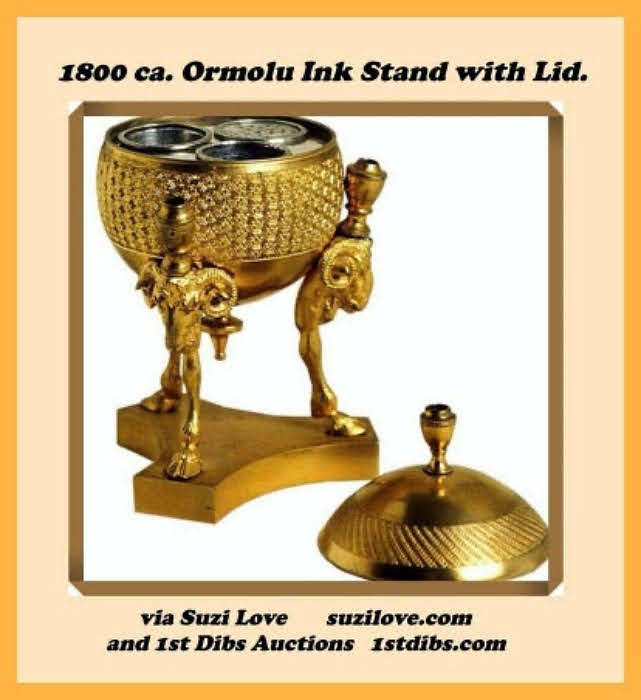
1800 ca. Ormolu Ink Stand with Lid, French. Ormolu ink stand in the shape of a globe surrounded by three rams head pen supports with animal legs and hoofs on a tripartite base. The top is removable revealing a silvered compartment with containers for sand and ink. via 1st Dibs Auctions 1stdibs.com
Definition Ormolu: Gold colored alloy of copper, zinc, and tin used in decoration and for making ornaments. Ormolu is used in mounts i.e ornaments on borders, edges, and as angle guards) for furniture, especially 18th-century furniture, and for other decorative purposes. Its gold colour may be heightened by immersion in dilute sulfuric acid or by burnishing.
1830 ca. Rosewood and Inlaid Brass Inkstand, England. Each side has cut-glass inkwells with brass inlaid tops and pen trays, so ideal for a partners desk. via 1st Dibs Auctions 1stdibs.com
