↓
 

Suzi Love

Making history fun, one year at a time.

Header_
  • Home
  • Newsletter
  • Pre order form
  • Shop
    • Cart
    • Checkout
    • My account
    • Refund and Returns Policy
  • Blog
  • BOOKS
    • History Events
    • Kelly’s Justice
    • Outback Arrival
    • Irresistible Aristocrats
    • History Notes
    • Scandalous Siblings
    • Love After Waterloo
    • Regency Life Series
  • Privacy Policy
  • EVENTS
Home » Suzi Love Images » Page 73 << 1 2 … 71 72 73 74 >>

Category Archives: Suzi Love Images

Post navigation

← Previous Post
Next Post→

1808 Richard Trevithick’s Steam Circus, Bloomsbury, London, U.K. Railway in Jane Austen and the Bridgerton times. #travel #JaneAusten #Bridgerton #railway

Suzi Love Posted on January 26, 2024 by Suzi LoveDecember 28, 2023

1808 Richard Trevithick’s Steam Circus, Bloomsbury, London, U.K. Site where Trevithick ran his locomotive ‘Catch Me Who Can’. Trevithick wanted to prove that traveling by train was faster than on horseback. Locomotive ran at top speed of 19 km per hour and people paid a shilling to sit in an attached car and be pulled around. Via Wikimedia Commons commons.wikimedia.org (PD-ART) This was the start of the railway expansions across England in Jane Austen’s time.

1808 Richard Trevithick's Steam Circus, Bloomsbury, London, U.K. Site where Trevithick ran his locomotive 'Catch Me Who Can'. Trevithick wanted to prove that traveling by train was faster than on horseback. Locomotive ran at top speed of 19 km per hour and people paid a shilling to sit in an attached car and be pulled around. Via Wikimedia Commons commons.wikimedia.org (PD-ART)
1808 Richard Trevithick’s Steam Circus, Bloomsbury, London, U.K. Site where Trevithick ran his locomotive ‘Catch Me Who Can’. Trevithick wanted to prove that traveling by train was faster than on horseback. Locomotive ran at top speed of 19 km per hour and people paid a shilling to sit in an attached car and be pulled around. Via Wikimedia Commons commons.wikimedia.org (PD-ART)
HN_10_D2D_RetailerBuyLink_HN_10.books2read.com/SuziLoveTravel
D2D_RetailerBuyLink_HN_10.books2read.com/SuziLoveTravel
Posted in 1800s, Bridgerton, Jane Austen, London, Regency Era, Suzi Love Images, travel | Tagged Bridgerton, British history, Jane Austen, railway, Regency Era, Regency Life, Regency London, travel, WikiMedia Commons

Regency Era writer or reader? Bridgerton and Jane Austen fan? A Coat Or Pelisse Or Redingote was a requisite Regency Era fashion accessory. #Bridgerton #RegencyEra #HistoricalFashion #JaneAusten

Suzi Love Posted on January 24, 2024 by Suzi LoveJanuary 2, 2024

What was fashionable outdoor wear for Jane Austen and contemporaries? Reticules, Spencers, and Pelisses, or Walking Dresses, Or Redingotes. History Notes Books 3, 4, and 5 By Suzi Love.

What sort of coats did women wear during the Regency years? them what you like: Coat, Pelisse, Redingote, Walking Dress, Promenade Dress. Take a look at what was being worn by women, men, and children. books2read.com/suzilovePelisse

HN_5_What was fashionable for outer wear in past centuries? Different names in different countries- Pelisse, Redingote, Or Walking Dress. #Regency #Fashion #History books2read.com:suzilovePelisse
HN_5 D2D_RetailerBuyLink_HN_5
books2read.com/suzilovePelisse
Posted in 1700s, 1800s, 1800s Mens Fashions, 1800s women's fashion, 1900s, Australia, Bridgerton, Canada, Coat or Pelisse Or Redingote, Edwardian Era, England, Europe, fashion accessories, Georgian Era, Georgian Fashion, History Notes, Jane Austen, Regency Era, Regency Fashion, Reticule or Bag, Romantic Era, Spencer, Suzi Love Books, Suzi Love Images, U.S.A, Victorian Era | Tagged 1800s women's fashion, Book 3, Book 4, Book 5, Bridgerton, fashion accessories, Fashion Plate, Georgian Fashion, History Notes, Jane Austen, Redingote Or Pelisse Or Coat, Regency Fashion, Romantic Era, Suzi Love Books, Victorian fashion

1800s French Palais Royal Sewing Box from Bridgerton and Jane Austen’s times with Mother of Pearl Tools. #bridgerton #Regency #Sewing #JaneAusten

Suzi Love Posted on January 24, 2024 by Suzi LoveDecember 29, 2023

1800s French Palais Royal Sewing Box and Twelve Mother of Pearl Enamel Tools. This is the style of sewing box Jane Austen and her family would have used in the early 1800s, or Regency years. via via suzilove.com and 1st Dibs Auctions 1stdibs.com

Definition: Palais Royal: Name of an area around the Royal Palace in Paris, France, that specialized in making small and exquisite works of art during the 18th and 19th centuries. Palais Royal sewing tools were elaborate and usually feature mother-of-pearl, often intricately carved or engraved. During the 19th century, workboxes were often works of art with engravings, carvings, mother-of-pearl, and elaborate gilt metal mounts. Most popular were scissors with steel blades and gilt mounts, thimbles and needle cases which were often shaped like animals or other natural forms. Workmanship was exceptional and the tools almost too fragile to use.

1800s French Palais Royal Sewing Box and Twelve Mother of Pearl Enamel Tools. via via suzilove.com and 1st Dibs Auctions 1stdibs.com
HN_11_D2D_Craftsmen created containers of precious metals, leather, silks, and decorated them with jewels to make exquisite and expensive items as well as practical carrying cases. books2read.com/suziloveBoxesCases
Posted in 1800s, Box Or Container, Decorative Item, Europe, France, History, Jane Austen, Regency Era, sewing, Suzi Love Images, travel | Tagged 1st Dibs Auctions, antiques, Book 11, Box Or Container, decorative, France, History Notes, Jane Austen, sewing, Suzi Love Books

Early 1800s Typical Regency Couple in a Curricle. #RegencyEra #JaneAusten #Carriage

Suzi Love Posted on January 22, 2024 by Suzi LoveJanuary 22, 2024

Early 1800s Typical Regency Couple in a Curricle. The sort of vehicle Jane Austen and her contemporaries would have driven in. Young men loved them and occasionally women drove them.

Early 1800s Typical Regency Couple in a Curricle.
RL_2_D2D_RetailerBuyLink_RL_2
RL_2_D2D_RetailerBuyLink_RL_2 https://books2read.com/suziloveYGD
Posted in 1800s, 1800s Mens Fashions, 1800s women's fashion, Carriage, England, Europe, fashion accessories, Jane Austen, Regency Era, Regency Fashion, Suzi Love Images, travel | Tagged 1800s men fashion, 1800s women's fashion, carriages, Fashion Plate, gloves, Jane Austen, Regency Fashion, Regency London
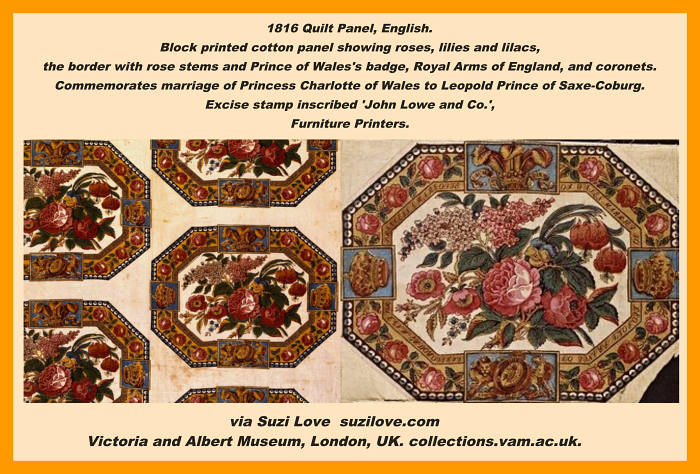
1816 Quilt Panel, English. Block printed cotton panel showing roses, lilies and lilacs. via collections.vam.ac.uk 3

1816 Block Printed Quilt Panel made to celebrate the Marriage of Princess Charlotte to Prince Leopold of Saxe-Coburg. #RegencyEra #Royalty #BritishHistory #Sewing

Suzi Love Posted on January 17, 2024 by Suzi LoveOctober 4, 2026

1816  Block Printed Quilt Panel made to celebrate the Marriage of Princess Charlotte to Prince Leopold of Saxe-Coburg.

Textile of block-printed white cotton in madder colours with pencilled blue. The cotton is printed with 9.5 octagonal panels intended to be cut out and applied to patchwork quilts. Each panels contains a bunch of flowers. Around the inner border is an inscription of Princess Charlotte of Wales married to Leopold Prince of Saxe-Coburg May 2, 1816. In the borders are three Prince of Wales feathers, the Royal Arms, and a crown on each side. At the end of the textile is printed a rectangular panel containing the manufacturers name and in a corner is the name ‘G. Swindels’.

This quilt has an excise stamp for 1816 and is inscribed ‘John Lowe and Co. Furniture Printers, Shepley Hall’, providing the name of the only identifiable manufacturer of these panels, although there are likely to have been others. John Lowe was a well-known firm of calico printers with large cotton factories and extensive bleaching grounds close to the River Tame near Ashton-under-Lyne in Lancashire.

Hand-quilting is done on a frame using needles called ‘betweens’. The stitches are executed with one hand; the other hand is kept underneath the quilt to feel for the needle. Small, uniform stitches (usually a ‘running stitch’) are taken through the three layers to form a decorative design. In ‘piecing’ or ‘patchwork’, small pieces of fabric are sewn together to produce a decorative design. The most enduring method in Britain is done by hand, and is known as ‘piecing over paper’. The pattern is first drawn onto paper and then accurately cut. Small pieces of fabric are tacked round each of the shapes, and then joined together from the back using overstitch. Most of the quilt top visible here has been pieced over paper, but in some areas the fabrics have been applied directly on to the earlier quilt that forms the wadding.

Victoria and Albert Museum, London, England.  

1816 Quilt Panel, English. Block printed cotton panel showing roses, lilies and lilacs. via collections.vam.ac.uk_1
1816 Quilt Panel, English. Block printed cotton panel showing roses, lilies and lilacs. via collections.vam.ac.uk_2
1816 Quilt Panel, English. Block printed cotton panel showing roses, lilies and lilacs. via collections.vam.ac.uk 4
1816 Quilt Panel, English. Block printed cotton panel showing roses, lilies and lilacs. via collections.vam.ac.uk 5
RL_1_D2D_Regency Overview RetailerLinks
https://books2read.com/suziloveROver
RL_1_D2D_Regency Overview RetailerLinks https://books2read.com/suziloveROver

Posted in Decorative Item, England, household, peerage, Regency Era, Royalty, sewing, Suzi Love Images | Tagged household, Regency Era, Regency London, Regency Royalty, sewing

1801 Typical Gentlemen’s Fashions for the early Regency Era, or Jane Austen’s times. #RegencyFashion #JaneAusten #HistoricalFashion

Suzi Love Posted on January 12, 2024 by Suzi LoveDecember 30, 2023

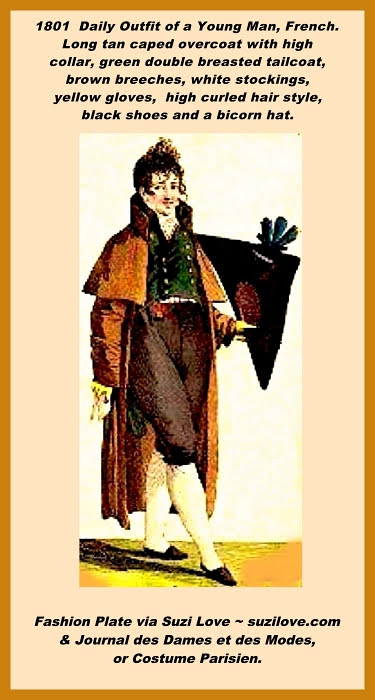
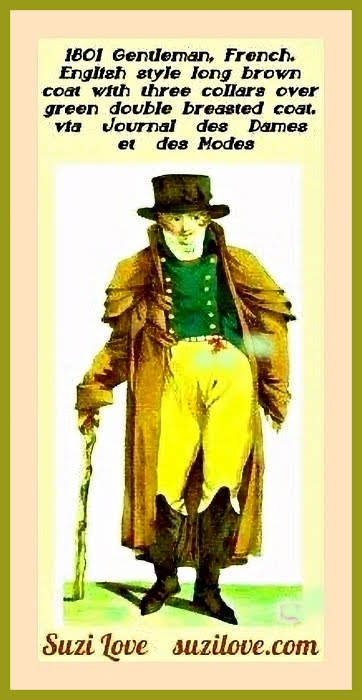
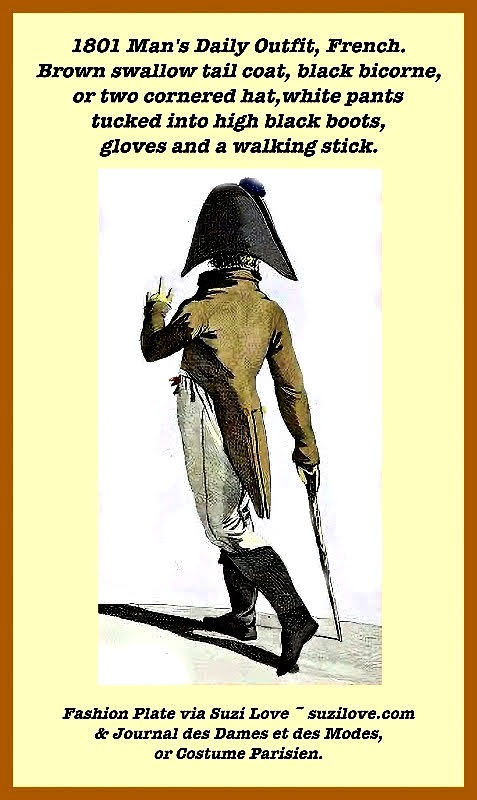
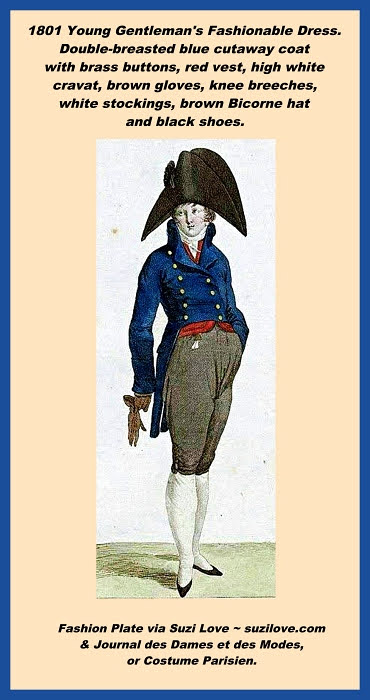
1801 Typical Gentlemen’s Fashions for the early 1800s, or Regency Era, or Jane Austen’s times. Fashion Plates via Journal des Dames et des Modes, Costume Parisien.

Typical menswear in the early 1800s included a tailcoat, a vest or waistcoat, either breeches, pants, or the newer trousers, stockings, shoes or boots, all worn with an overcoat and hat. This basic ensemble was accessorized with some form of neckcloth or cravat, gloves, a walking stick, cane or riding crop, handkerchief, fobs, a watch and perhaps a quizzing glass or eye glass.

1801 Typical Gentlemen's Fashions for the early Regency Era, or Jane Austen's times. #RegencyFashion #JaneAusten #HistoricalFashion https://books2read.com/SuziLoveFashionMen1800-1819
1801 Typical Gentlemen's Fashions for the early Regency Era, or Jane Austen's times.

From the finish of the 18th century until 1820, men’s fashions in European and European-influenced countries moved away from the formal wear of brocades, lace, wigs and powder to more informal and relaxed styles. Focus was on undress rather than formal dress. Typical menswear in the early 1800s included a tailcoat, a vest or waistcoat, either breeches, pants, or the newer trousers, stockings, shoes or boots, all worn with an overcoat and hat. This basic ensemble was accessorized with some form of neckcloth or cravat, gloves, walking stick, cane or riding crop, handkerchief, fobs, watch and perhaps a quizzing glass or eye glass. 

Skirted coats were replaced with short-fronted, or cutaway, tailcoats worn over fitted waistcoats and plain, white linen shirts. Knee breeches were gradually replaced by tight-fitting pantaloons and later trousers, decorative shoes with buckles were replaced with a variety of boot styles, and fussy and ruffled neckwear gave way to intricately tied, white linen neck cloths. A Regency Era, or early 1800s, gentleman was outfitted in more practical fabrics, such as wool, cotton and buckskin rather than the fussy brocades and silks of the late 1700s. 

HN_23_D2D_Fashion Men 1800-1819
Posted in 1800s, 1800s Mens Fashions, Coat or Pelisse Or Redingote, fashion accessories, hats, Jane Austen, pants, Regency Era, Regency Fashion, shoes, Suit, Suzi Love Images, Vest or Waistcoat | Tagged 1800s men fashion, boots, breeches, cravat, fashion accessories, Fashion Plate, gloves, Hats And Hair, Jane Austen, Journal des Dames et des Modes, pants, Redingote Or Pelisse Or Coat, Regency Fashion, Shoes, stockings, Vest or Waistcoat | Leave a reply

1802 Typical Gentlemen’s Fashions for the early 1800s, or Regency Era, or Jane Austen’s times. #RegencyEra #JaneAusten #Fashion

Suzi Love Posted on September 22, 2023 by Suzi LoveSeptember 16, 2023

1802 Typical Gentlemen’s Fashions worn during the early 1800s, or Regency Era, or Jane Austen’s times. Fashion Plates via Journal des Dames et des Modes, Costume Parisien.

Regency Menswear: Typical menswear in the early 1800s included a tailcoat, a vest or waistcoat, either breeches, pants, or the newer trousers, stockings, shoes or boots, all worn with an overcoat and hat. This basic ensemble was accessorized with some form of neckcloth or cravat, gloves, a walking stick, cane or riding crop, handkerchief, fobs, a watch and perhaps a quizzing glass or eye glass.

1802 Young French Man. Brown cutaway coat, calf length pants, frilled white shirt and cravat, jaunty hat, black shoes and gaiters, and carrying a walking stick. Fashion Plate via Journal des Dames et des Modes, Costume Parisien.
1802 Young French Man. Brown cutaway coat, calf length pants, frilled white shirt and cravat.
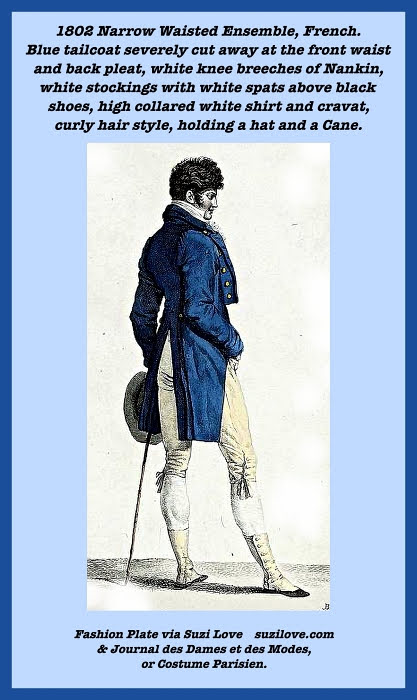
1802 Narrow Waisted Ensemble, French. Blue tailcoat severely cut away at the front waist and back pleat, white knee breeches of Nankin, white stockings with white spats above black shoes, high collared white shirt and cravat, curly hair style, holding a hat and a cane. Fashion Plate via Journal des Dames et des Modes, or Costume Parisien.
1802 Narrow Waisted Ensemble, French. Blue tailcoat severely cut away at front waist and back pleat, white knee breeches of Nankin.
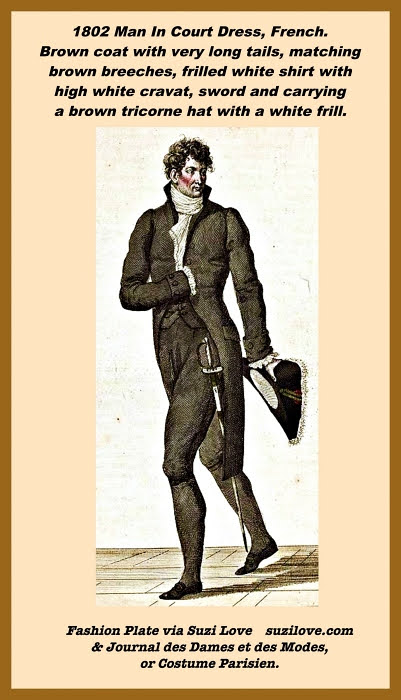
1802 Man In Court Dress, French. Brown coat with very long tails, matching brown breeches, frilled white shirt with high white cravat, sword and carrying a brown tricorne hat with a white frill. Fashion Plate via Journal des Dames et des Modes, Costume Parisien.
1802 Man In Court Dress, French. Brown coat with very long tails, matching brown breeches.

From the finish of the 18th century until 1820, men’s fashions in European and European-influenced countries moved away from the formal wear of brocades, lace, wigs and powder to more informal and relaxed styles. Focus was on undress rather than formal dress. Typical menswear in the early 1800s included a tailcoat, a vest or waistcoat, either breeches, pants, or the newer trousers, stockings, shoes or boots, all worn with an overcoat and hat. This basic ensemble was accessorized with some form of neckcloth or cravat, gloves, walking stick, cane or riding crop, handkerchief, fobs, watch and perhaps a quizzing glass or eye glass. 

Skirted coats were replaced with short-fronted, or cutaway, tailcoats worn over fitted waistcoats and plain, white linen shirts. Knee breeches were gradually replaced by tight-fitting pantaloons and later trousers, decorative shoes with buckles were replaced with a variety of boot styles, and fussy and ruffled neckwear gave way to intricately tied, white linen neck cloths. A Regency Era, or early 1800s, gentleman was outfitted in more practical fabrics, such as wool, cotton and buckskin rather than the fussy brocades and silks of the late 1700s. 

HN_23_D2D_Fashion Men 1800-1819
Posted in 1800s, 1800s Mens Fashions, Coat or Pelisse Or Redingote, fashion accessories, hats, Jane Austen, pants, Regency Era, Regency Fashion, shoes, Suit, Suzi Love Images, Vest or Waistcoat | Tagged 1800s men fashion, breeches, cravat, fashion accessories, Fashion Plate, gloves, Hats And Hair, Jane Austen, Journal des Dames et des Modes, Regency Fashion, Shoes, stockings, Tailcoat, Vest or Waistcoat

1805 November Typical Jane Austen Fashions With Accessories, English. #Regency #Fashion #JaneAusten

Suzi Love Posted on August 31, 2023 by Suzi LoveAugust 31, 2023

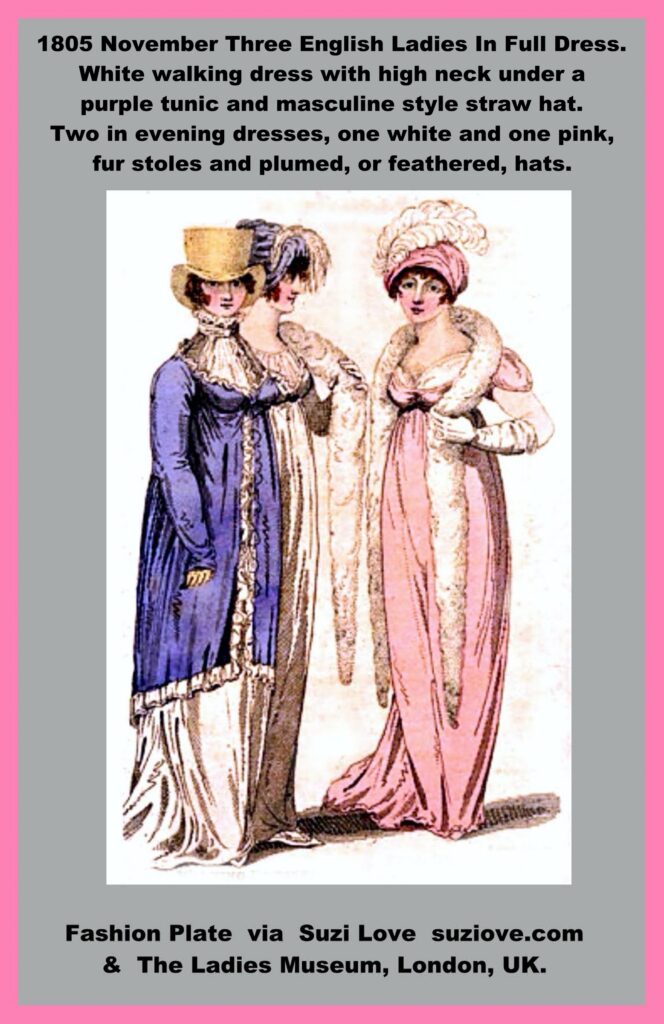
1805 November Three English Ladies In Full Dress. White walking dress with high neck under a purple tunic and masculine style straw hat. Two in evening dresses, one white and one pink, fur stoles and plumed, or feathered, hats. via Vernon and Hood Poultry at The Lady’s Monthly Museum, London, U.K. These gorgeous dresses show the transition from the round dresses of the late 1700s to the Empire style dresses with the waistline high under the bust. Small trains were still worn in the early 1800s, but much more manageable than the larger and more elaborate trains of the late 1700s. Jane Austen and her friends would have worn dresses like this to their assemblies and evening events.

Definition Accessory: An accessory completes and complements an outfit. Two groups – 1. Those worn e.g. bonnets, caps and hats, boots and shoes, cravats and ties, gloves, mittens and muffs, jewelry, scarves and shawls, socks and stockings. 2. Those carried e.g. bags, fans, and parasols. 

Definition Full Dress:  The most formal and complete ensemble, worn for day or night events, and includes the fullest range of accessories that could be added to the outfit to make the most impressive display. 

1805 November Three English Ladies In Full Dress. White walking dress with high neck under a purple tunic and masculine style straw hat. Two in evening dresses, one white and one pink, fur stoles and plumed, or feathered, hats. via Vernon and Hood Poultry at The Lady’s Monthly Museum, London, U.K.
HN_26_D2D
Fashion Women 1805-1809 History Notes Book 26 What did Jane Austen and friends wear? This book looks at early 1800s fashions, which were elegant and pretty with high waists and fabrics that were almost transparent. These Empire style gowns, named after Napoleon’s first Empress, became popular throughout Europe, and were then copied around the world. Colorful outwear was added to make an ensemble more attractive and warmer. https://books2read.com/SuziLoveFashionWomen1805-1809
Posted in 1800s, 1800s women's fashion, Coat or Pelisse Or Redingote, Dress Or Robe, fashion accessories, hats, Jane Austen, London, Regency Era, Regency Fashion, shoes, Suzi Love Images | Tagged 1800s women's fashion, Dress Or Gown, fashion accessories, Fashion Plate, gloves, Hats And Hair, Jane Austen, jewelry, Redingote Or Pelisse Or Coat, Regency Fashion, shawls, Shoes, The Lady's Monthly Museum

Fashion Must Haves In Jane Austen’s Times: Reticules, Spencers, Redingotes. History Notes Series Books 3, 4, and 5. #Regency #JaneAusten #Georgian #Victorian

Suzi Love Posted on August 27, 2023 by Suzi LoveAugust 27, 2023
  • Fashion Must Haves In Jane Austen’s times: Reticules, Spencers, Redingotes. History Notes Books 3, 4, and 5 By Suzi Love.
  • books2read.com/suziloveReticules
  • books2read.com/suziloveSpencers
  • books2read.com/suzilovePelisse
Fashion Accessories: Reticules, Spencers, Redingotes. History Notes Books 3, 4, and 5 By Suzi Love. #Regency #Fashion #History books2read.com/suziloveReticules books2read.com/suziloveSpencers books2read.com/suzilovePelisse
Fashion Must Haves In Jane Austen’s Times: Reticules, Spencers, Redingotes. History Notes Series Books 3, 4, and 5.
  • Reticule Or Bag: Purse, often with a drawstring to pull closed and usually made of cloth or covered cardboard and often decorated with beading or embroidery. Carried by a woman during the Regency period to carry all their daily necessities. in the place of pockets.
  • Spencer: Short jacket, cropped at the waist, worn over a dress, or gown. Delicate and regency dresses provided so little protection from the cold, so over garments were essential for warmth, modesty and good health.
  • Pelisse Or redingote Or Walking Dress: Coat worn over clothing of both sexes for warmth and protection from the elements.
History Notes Book 5 books2read.com/suzilovePelisse
D2D_RetailerBuyLink_HN_5_books2read.com/suzilovePelisse
Posted in 1700s, 1700s Womens Fashion, 1800s, 1800s Mens Fashions, 1800s women's fashion, 1900s, Australia, Canada, Coat or Pelisse Or Redingote, Dress Or Robe, Edwardian Era, England, Europe, fashion accessories, Georgian Era, Georgian Fashion, hats, History Notes, Regency Era, Regency Fashion, Reticule or Bag, Romantic Era, Spencer, Suzi Love Books, Suzi Love Images, U.S.A, Victorian Era | Tagged 1700s Women's Fashion, 1800s women's fashion, Book 3, Book 4, Book 5, Edwardian Era, fashion accessories, Fashion Plate, Georgian Fashion, History Notes, Jane Austen, Redingote Or Pelisse Or Coat, Regency Fashion, reticule or bag, Spencer, Suzi Love Books, Victorian fashion

Wedding ring customs that originated in long ago history. #weddings #Customs #history

Suzi Love Posted on June 2, 2022 by Suzi LoveMay 15, 2022

Wedding ring customs that originated in long ago history.

The first wedding rings can be traced back to the Ancient Egyptians when they exchanged rings made from braided reeds and hemp. The tradition of exchanging rings dates back 3,000 years. The first diamond wedding ring was recorded in the will of a widow who died in 1417. The ancient Egyptians believed in the vena amoris, literally the “vein of love” that runs directly from the heart to the fourth finger on the left hand. For the Ancient Greeks, the engagement ring was symbolized with a plain gold band worn on the left hand and at the marriage the same band was shifted to the right hand.

An engagement ring is given at a proposal or when a couple decides to get married whereas a wedding ring is exchanged at the wedding ceremony and represents the official bond of marriage and the binding pledge between spouses. Wedding rings symbolise eternal love and commitment within a relationship and are worn to show the world they are married. During the wedding service, the couple will say their vows to each other while exchanging rings.

Is a wedding ring biblical? : The use of wedding ring is not commanded in the Bible, and there is no indication that it was ever practised in the New Testament. The use of finger ring in the Bible was as a symbol of authority.

Betrothal ring: An old Roman custom confirming that the marriage contract would be carried out. It was the first part of a dowry given, and meant the woman was no longer for sale as the first part of the monetary settlement had been paid. The first betrothal, or engagement, rings were given because there was often a long time between betrothals and weddings. These were usually simple bands of gold, silver, or iron as on royalty or very wealthy people could afford gemstones and diamonds. In 1477, Archduke Maximillian of Austria commissioned the very first diamond engagement ring for his betrothed, Mary of Burgundy, and many of the European aristocracy and nobility followed his lead.

Wedding ring: Many primitive peoples who believed in magic used a rope around the waist or the hand and feet, and later  a ring, to symbolise that the bride was captured and spoken for, and also to ward off any evil spirits hovering around the bride and ensure marital bliss.

The ring hand: A symbol of the humiliating tradition of the man as the master – the right hand of the family –  and the woman being the slave .  The right hand stood for power and authority while the left hand expressed submission and serfdom.

The ring finger : Ancient Greek and Roman anatomists  believed a vein, the vena amoris or the “vein of love”, or a nerve led from the heart to the third finger, the healing finger , so they romantically linked this finger to the heart. Now we know that this is not true and there is no vein that runs from our ring fingers to our hearts. There are also some more practical reasons the third finger continues to be used. It’s the most prominent for displaying a ring and it cannot be extended to its full length on its own and usually remains slightly bent, preventing the ring slipping off.

The Wedding Ring: Also goes on the left ring finger because it is the only finger with a vein that connects to the heart although some countries, such as India, Germany, Spain, Norway, and Russia traditionally wear their wedding rings on their right hand.

Viking Wedding Rings: These were mostly made of silver and bronze and rarely of gold with the designs inspired by Norse Gods, geometric shapes, runes, and animal totems

Gimmel Rings: In the 16th and 17th centuries, European husbands gave their bride a gimmel ring with two interlocking bands. The bride and groom both wore one after their engagement and during the wedding ceremony the rings were joined and the wife wore the ring.

World Wars: During the first World War, many men on the front began wearing wedding rings as a remembrance of their wives and families at home. That custom carried through to World War Two so in the 1950s wedding rings for men became common practice.

Tri-Gold Rings: Gold is the traditional ring metal but some people prefer a mix of colors. Yellow gold represents fidelity, rose gold romantic love, and white gold friendship, so a tri-gold ring symbolizes your shared past, present, and future path. ding ring to symbolize all three, as well as your shared past, present, and future path.

Black Wedding Rings: Some couples choose black wedding bands because they represent everlasting commitment and the color can also mean power, strength and sophistication.

Anniversary or Push Ring: Given on the birth of a first child or an anniversary, usually an important one such as the first, five-year or 10-year anniversary.

Posted in 1700s, 1800s, 1900s, Australia, Canada, Customs & Manners, Decorative Item, Edwardian Era, England, Europe, Georgian Era, Regency Era, Romantic Era, South Pacific, Suzi Love Images, U.S.A, Victorian Era, weddings | Tagged British history, Customs and Traditions, Georgian era, Regency Era, Regency Life, Romantic Era, Suzi Love Research, Victorian Era, weddings | Leave a reply

Post navigation

← Previous Post
Next Post→

SUBSCRIBE TO SUZI LOVE'S NEWSLETTER.

Recent Posts

  • 1809 Lady In Purple Court Dress Worn In Jane Austen’s Times. #JaneAusten #RegencyFashion #CourtDress
  • 1813 French Couple In Morning Dress, French. Lady with watering can. #RegencyFashion #JaneAusten #HistoricalFashion
  • 1800s Omnibus History, France and England. #RomanticEra #VictorianEra #BritishHistory #Travel
  • 1800-1850 ca. Brown Reticule, Or Bag With Monogram and Drawstring, of the Sort Used by the Bridgertons and Jane Austen. #Bridgerton #RegencyFashion #JaneAusten
  • Pleasure House Ball: Lord Mallory attends his first courtesan’s ball in ten years to appease his concerned friends. #RegencyRomance #Historicalmystery #EroticRomance

Recent Comments

  1. Suzi Love on Book Hooks: Petunia and the Pearl Diver. Petunia was too well spoken for a brothel worker. #Regencyromance #historicalromance #London #mfrw
  2. Bianca White on Book Hooks: Petunia and the Pearl Diver. Petunia was too well spoken for a brothel worker. #Regencyromance #historicalromance #London #mfrw
  3. Suzi Love on Book Hooks: Petunia and the Pearl Diver. Petunia was too well spoken for a brothel worker. #Regencyromance #historicalromance #London #mfrw
  4. Suzi Love on Book Hooks: Petunia and the Pearl Diver. Petunia was too well spoken for a brothel worker. #Regencyromance #historicalromance #London #mfrw
  5. Suzi Love on Book Hooks: Petunia and the Pearl Diver. Petunia was too well spoken for a brothel worker. #Regencyromance #historicalromance #London #mfrw

Login

  • Log in

Archives

  • November 2026
  • October 2026
  • September 2026
  • August 2026
  • July 2026
  • June 2026
  • May 2026
  • April 2026
  • March 2026
  • February 2026
  • January 2026
  • December 2025
  • November 2025
  • October 2025
  • September 2025
  • August 2025
  • July 2025
  • June 2025
  • May 2025
  • April 2025
  • March 2025
  • February 2025
  • January 2025
  • December 2024
  • November 2024
  • October 2024
  • September 2024
  • August 2024
  • July 2024
  • June 2024
  • May 2024
  • April 2024
  • March 2024
  • February 2024
  • January 2024
  • October 2023
  • September 2023
  • August 2023
  • June 2022
  • April 2022

Categories

  • 1700s
  • 1700s Mens fashion
  • 1700s Womens Fashion
  • 1800s
  • 1800s Mens Fashions
  • 1800s women's fashion
  • 1900s
  • art
  • Australia
  • Bath
  • bedroom fashion
  • Book Hooks
  • Box Or Container
  • Bridgerton
  • Bus Trips
  • Canada
  • Carriage
  • cartoon
  • Celebrity
  • Chatelaine
  • Children
  • children
  • Christmas
  • Coat or Pelisse Or Redingote
  • Contemporary
  • Corset
  • Couple
  • Customs & Manners
  • dancing
  • December Scandal
  • Decorative Item
  • Dress Or Robe
  • Easter
  • Edwardian Era
  • Embracing Scandal
  • England
  • Ester In Images
  • Europe
  • Events
  • Fashion
  • fashion accessories
  • Food and Drink
  • Four Times A Virgin
  • France
  • furniture
  • Georgian Era
  • Georgian Fashion
  • Google Books
  • Grand Tour
  • Group
  • hats
  • History
  • History Events
  • History Notes
  • History Of Christmases Past
  • household
  • Hygiene
  • Irresistible Aristocrats
  • Jane Austen
  • Keanu Reeves
  • Kellys Justice
  • Legal
  • London
  • Love After Waterloo
  • Loving Lady Katharine
  • medical
  • military
  • money
  • mourning
  • Music
  • Outback Arrival
  • pants
  • Pastimes
  • peerage
  • People
  • Petunia and Pearl Diver
  • Places
  • Pleasure House Ball
  • postal
  • Queensland
  • Quotations
  • Regency Era
  • Regency Fashion
  • Regency Life Series
  • Reticule or Bag
  • riding
  • Romantic Era
  • Royalty
  • Russia
  • Scandalous Siblings Series
  • Scenting Scandal
  • Self Publishing
  • sewing
  • Shirt
  • shoes
  • Shopping
  • South Pacific
  • Spencer
  • sports
  • Suit
  • Sunday Snippet
  • Suzi Love
  • Suzi Love Books
  • Suzi Love Images
  • Suzi Love Writing
  • Swain Cove
  • THe Viscount's Pleasure House
  • travel
  • U.S.A
  • underclothing
  • Vest or Waistcoat
  • Victorian Era
  • Victorian Fashion
  • weapons
  • weddings
  • Writing Tools

1800s men fashion 1800s women's fashion antiques Bridgerton British history Cartoons Corset cravat decorative Dress Or Gown England europe fashion accessories Fashion Plate France Georgian era Georgian Fashion gloves google books Hats And Hair historical romance History Notes household Jane Austen jewelry Journal des Dames et des Modes London Metropolitan Museum NYC pants Redingote Or Pelisse Or Coat Regency Era Regency Fashion Regency London reticule or bag riding Romantic Era sewing shawls Shoes Suzi Love Books Suzi Love Images Tailcoat The Repository Of Arts underclothing Vest or Waistcoat

©2026 - Suzi Love - Weaver Xtreme Theme Privacy Policy
↑