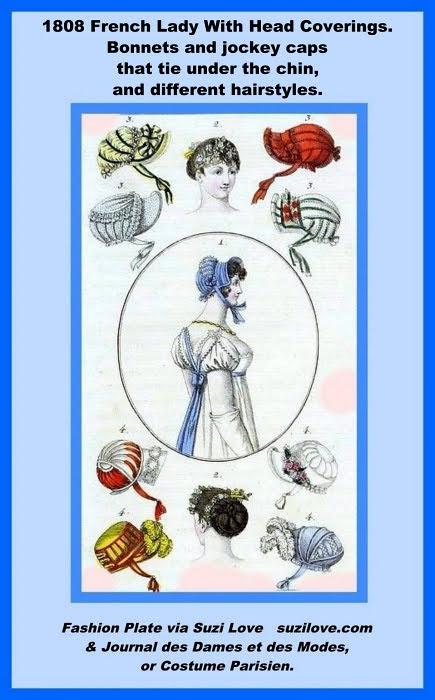
1808 French Lady With Head Coverings. Bonnets and jockey caps that tie under the chin and different hairstyles. Fashion Plate via Journal des Dames et des Modes, or Costume Parisien.
French fashions like this were copied by English magazines so these styles of hats would have been worn by Jane Austen and her contemporaries.
1808 French Lady With Head Coverings. Bonnets and jockey caps that tie under the chin and different hairstyles. Fashion Plate via Journal des Dames et des Modes,
or Costume Parisien.HN_26_D2D_FashionWomen1805-1809
https://books2read.com/SuziLoveFashionWomen1805-1809
1816 December. Promenade Dress, or Pelisse, English, also called a Redingote in France. High cambric muslin dress trimmed at the bottom with a single flounce of work, shaped without any fulness to fit the body, plain long sleeve finished by a triple fall of narrow lace. Over this is the Angouleme pelisse of crimson velvet, lined with white Sarsnet, and trimmed with a single Welt of crimson satin, a shade lighter than the pelisse. Shaped the to the body and without much fullness, confined at the short waist with narrow velvet band, edged to match. Small stand-up collar, supports a rich lace ruff, which is worn open in front of the throat. Sleeve has little fullness and is confined at the wrist by three narrow bands of puckered satin. Bonnet of white satin a la Royale with a large bunch of flowers and tied under the chin with satin ribbon and finished in front with a full quilling of tulle. Black silk ridicule, exquisitely worked in imitation of the ends of an India shawl and trimmed with black silk fringe. White kid gloves and black walking shoes. Fashion plate, hand-colored engraving on paper. Published in Rudolph Ackermann’s ‘The Repository of Arts’, London.
Promenade Dress, Pelisse, Redingote, Or Walking Dress. Jane Austen and her contemporaries wore long coats like these to keep warm when out and about, visiting, shopping etc. The thin muslin dresses worn in the early 1800s were little protection against European winters.
1816 December. Promenade Dress, or Pelisse, English, called Redingote in France. High cambric muslin dress trimmed at the bottom, plain long sleeve finished by a triple fall of narrow lace. Over this is the Angouleme pelisse of crimson velvet, lined with white Sarsnet, and trimmed with a single Welt of crimson satin, a shade lighter than the pelisse. Bonnet of white satin a la Royale with a large bunch of flowers and tied under the chin with satin ribbon. White kid gloves and black walking shoes. Fashion Plate in Rudolph Ackermann’s ‘The Repository of Arts’, London. Fashion Women 1815-1819 History Notes Book 28 https://books2read.com/SuziLoveFashionWomen1815-1819
1808 Richard Trevithick’s Steam Circus, Bloomsbury, London, U.K. Site where Trevithick ran his locomotive ‘Catch Me Who Can’. Trevithick wanted to prove that traveling by train was faster than on horseback. Locomotive ran at top speed of 19 km per hour and people paid a shilling to sit in an attached car and be pulled around. Via Wikimedia Commons commons.wikimedia.org (PD-ART) This was the start of the railway expansions across England in Jane Austen’s time.
1808 Richard Trevithick’s Steam Circus, Bloomsbury, London, U.K. Site where Trevithick ran his locomotive ‘Catch Me Who Can’. Trevithick wanted to prove that traveling by train was faster than on horseback. Locomotive ran at top speed of 19 km per hour and people paid a shilling to sit in an attached car and be pulled around. Via Wikimedia Commons commons.wikimedia.org (PD-ART)
D2D_RetailerBuyLink_HN_10.books2read.com/SuziLoveTravel
What was fashionable outdoor wear for Jane Austen and contemporaries? Reticules, Spencers, and Pelisses, or Walking Dresses, Or Redingotes. History Notes Books 3, 4, and 5 By Suzi Love.
What sort of coats did women wear during the Regency years? them what you like: Coat, Pelisse, Redingote, Walking Dress, Promenade Dress. Take a look at what was being worn by women, men, and children. books2read.com/suzilovePelisse
HN_5_What was fashionable for outer wear in past centuries? Different names in different countries- Pelisse, Redingote, Or Walking Dress. #Regency #Fashion #History books2read.com:suzilovePelisse
1800s French Palais Royal Sewing Box and Twelve Mother of Pearl Enamel Tools. This is the style of sewing box Jane Austen and her family would have used in the early 1800s, or Regency years. via via suzilove.com and 1st Dibs Auctions 1stdibs.com
Definition: Palais Royal: Name of an area around the Royal Palace in Paris, France, that specialized in making small and exquisite works of art during the 18th and 19th centuries. Palais Royal sewing tools were elaborate and usually feature mother-of-pearl, often intricately carved or engraved. During the 19th century, workboxes were often works of art with engravings, carvings, mother-of-pearl, and elaborate gilt metal mounts. Most popular were scissors with steel blades and gilt mounts, thimbles and needle cases which were often shaped like animals or other natural forms. Workmanship was exceptional and the tools almost too fragile to use.
1800s French Palais Royal Sewing Box and Twelve Mother of Pearl Enamel Tools. via via suzilove.com and 1st Dibs Auctions 1stdibs.comHN_11_D2D_Craftsmen created containers of precious metals, leather, silks, and decorated them with jewels to make exquisite and expensive items as well as practical carrying cases. books2read.com/suziloveBoxesCases
“I remember who you are, Lady Melton,” Captain Belling said in a cold voice, barely glancing over his shoulder at them. “The only thing I don’t know is why the hell you and that child are still anywhere near Waterloo, when all women were ordered to evacuate a week ago.”
“That child has a name, Captain. His name is Daniel, or if you are a stickler for formality, Viscount Melton.”The captain turned and frowned down at her son, who stared back at him with blatant curiosity and a small amount of animosity, as forthright as any young and intelligent child. Even at his young age, Daniel was a shrewd judge of character, and had been instructed by his uncles to be careful about trusting strangers. When the Captain turned back to the tattered maps spread over his makeshift desk, Anne ignored his unspoken dismissal and used the time to observe the infuriating man without having his condemning gaze fixed on her, as it had been a week earlier at the Duke and Duchess of Richmond’s extravagant Brussels ball. If she and Daniel were to travel with his group of wounded soldiers, Anne wanted to learn as much as possible about their leader. Her son’s survival depended on her being well informed and prepared for any eventuality.
Dust filtered down through a gaping hole in the high roof and settled in the Captain’s hair, turning it a darker brown than his normal golden yellow, though a bucketful of dust wouldn’t make any difference to the state of his stained uniform. His left pants’ leg had been sliced open to the knee, the two sides pinned clear of the large bandage winding down most of his leg, while a spindly wooden crutch was propped against the table.
His large physique had attracted her even before their dance at the ball, though his striking physical attributes didn’t compensate for his belligerent attitude, or for his obvious displeasure at encountering her both in Brussels and near the battlefield. Still, the Captain had undoubtedly scowled in a similar fashion at many women he’d met either in Brussels or at Waterloo, as she’d heard him spout his narrow-minded view at the ball to his fellow officers. The Captain believed that in the vicinity of battles only men should be allowed. Not women, and especially not ladies.
When Lady Melton and son join antagonistic Captain Belling and last group of wounded British soldiers evacuating Waterloo, she expects clashes with army deserters.What she doesn’t anticipate is how much she and her son will need the belligerent Captain after they reach London. #RegencyRomance #MilitaryRomance https://books2read.com/suziloveLAW
Early 1800s Typical Regency Couple in a Curricle. The sort of vehicle Jane Austen and her contemporaries would have driven in. Young men loved them and occasionally women drove them.
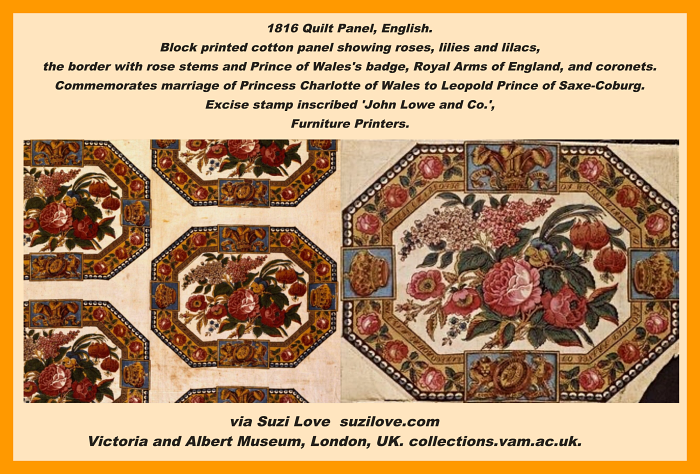
1816 Block Printed Quilt Panel made to celebrate the Marriage of Princess Charlotte to Prince Leopold of Saxe-Coburg.
Textile of block-printed white cotton in madder colours with pencilled blue. The cotton is printed with 9.5 octagonal panels intended to be cut out and applied to patchwork quilts. Each panels contains a bunch of flowers. Around the inner border is an inscription of Princess Charlotte of Wales married to Leopold Prince of Saxe-Coburg May 2, 1816. In the borders are three Prince of Wales feathers, the Royal Arms, and a crown on each side. At the end of the textile is printed a rectangular panel containing the manufacturers name and in a corner is the name ‘G. Swindels’.
This quilt has an excise stamp for 1816 and is inscribed ‘John Lowe and Co. Furniture Printers, Shepley Hall’, providing the name of the only identifiable manufacturer of these panels, although there are likely to have been others. John Lowe was a well-known firm of calico printers with large cotton factories and extensive bleaching grounds close to the River Tame near Ashton-under-Lyne in Lancashire.
Hand-quilting is done on a frame using needles called ‘betweens’. The stitches are executed with one hand; the other hand is kept underneath the quilt to feel for the needle. Small, uniform stitches (usually a ‘running stitch’) are taken through the three layers to form a decorative design. In ‘piecing’ or ‘patchwork’, small pieces of fabric are sewn together to produce a decorative design. The most enduring method in Britain is done by hand, and is known as ‘piecing over paper’. The pattern is first drawn onto paper and then accurately cut. Small pieces of fabric are tacked round each of the shapes, and then joined together from the back using overstitch. Most of the quilt top visible here has been pieced over paper, but in some areas the fabrics have been applied directly on to the earlier quilt that forms the wadding.
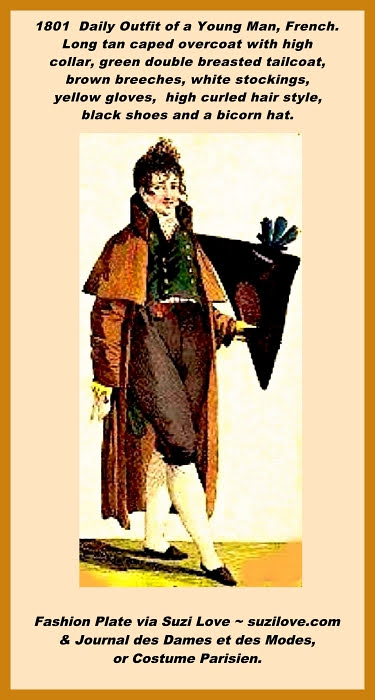
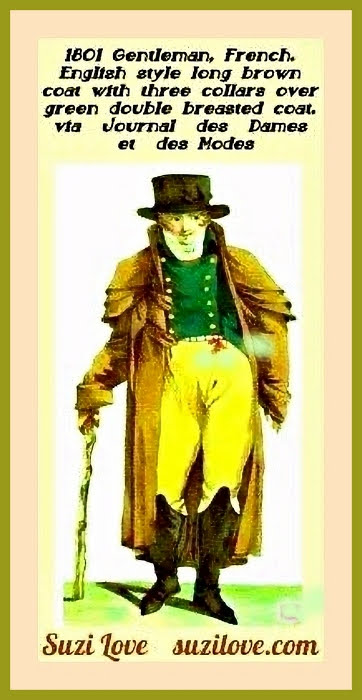
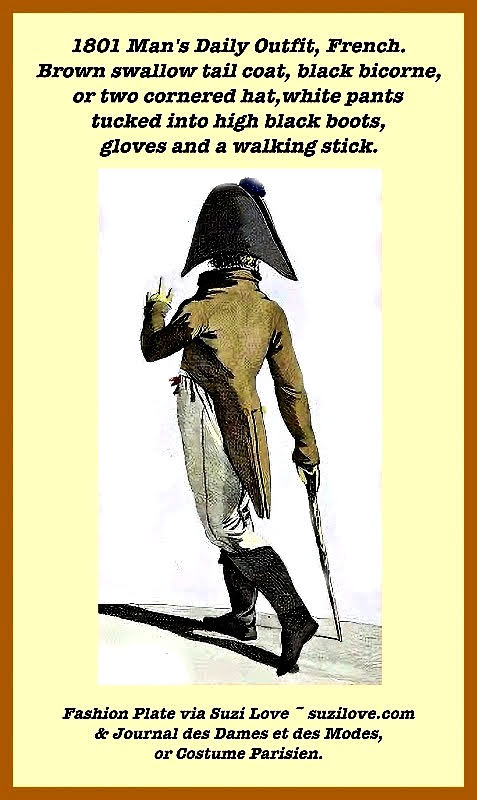
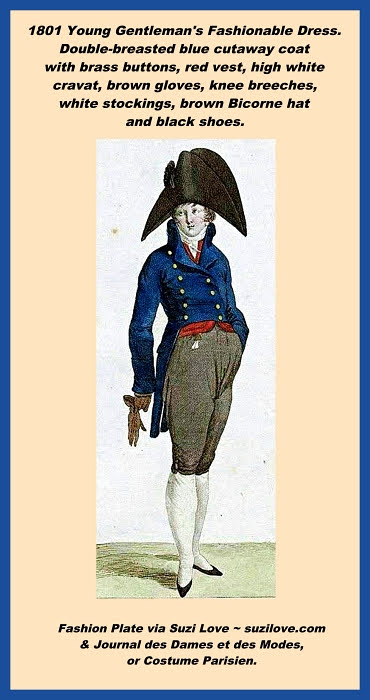
1801 Typical Gentlemen’s Fashions for the early 1800s, or Regency Era, or Jane Austen’s times. Fashion Plates via Journal des Dames et des Modes, Costume Parisien.
Typical menswear in the early 1800s included a tailcoat, a vest or waistcoat, either breeches, pants, or the newer trousers, stockings, shoes or boots, all worn with an overcoat and hat. This basic ensemble was accessorized with some form of neckcloth or cravat, gloves, a walking stick, cane or riding crop, handkerchief, fobs, a watch and perhaps a quizzing glass or eye glass.
From the finish of the 18th century until 1820, men’s fashions in European and European-influenced countries moved away from the formal wear of brocades, lace, wigs and powder to more informal and relaxed styles. Focus was on undress rather than formal dress. Typical menswear in the early 1800s included a tailcoat, a vest or waistcoat, either breeches, pants, or the newer trousers, stockings, shoes or boots, all worn with an overcoat and hat. This basic ensemble was accessorized with some form of neckcloth or cravat, gloves, walking stick, cane or riding crop, handkerchief, fobs, watch and perhaps a quizzing glass or eye glass.
Skirted coats were replaced with short-fronted, or cutaway, tailcoats worn over fitted waistcoats and plain, white linen shirts. Knee breeches were gradually replaced by tight-fitting pantaloons and later trousers, decorative shoes with buckles were replaced with a variety of boot styles, and fussy and ruffled neckwear gave way to intricately tied, white linen neck cloths. A Regency Era, or early 1800s, gentleman was outfitted in more practical fabrics, such as wool, cotton and buckskin rather than the fussy brocades and silks of the late 1700s.