↓
 

Suzi Love

Making history fun, one year at a time.

Header_
  • Home
  • Newsletter
  • Pre order form
  • Shop
    • Cart
    • Checkout
    • My account
    • Refund and Returns Policy
  • Blog
  • BOOKS
    • History Events
    • Kelly’s Justice
    • Outback Arrival
    • Irresistible Aristocrats
    • History Notes
    • Scandalous Siblings
    • Love After Waterloo
    • Regency Life Series
  • Privacy Policy
  • EVENTS
Home » Suzi Love Books » Page 16 << 1 2 … 14 15 16 17 18 … 21 22 >>

Category Archives: Suzi Love Books

Post navigation

← Previous Post
Next Post→

Christmas: European Traditions #Christmas #holidays #Traditions #Customs

Suzi Love Posted on December 2, 2025 by Suzi LoveDecember 1, 2025

Christmas European Traditions

From Harper’s Bazaar:- ‘Advent is the herald of Christmas. In Protestant as well as Catholic countries, choristers and school-boys during the “holy-nights” go from house to house singing songs or Christmas carols to usher in the auspicious day. In the south of Germany, they accompany the singing by knocking at the doors with a little hammer, or throwing pease, beans, or lentils at the windows. Hence the origin of the name of “knocking nights.”

In Bohemia, Styria, Carniola, and other German provinces, people group together and perform Christmas plays during Advent, with simple plots about the story of the Savior’s birth, his persecution by Herod, and the flight of the Holy Family into Egypt. The players usually consist of the Christ-child, St. Nicholas or St. Peter, St. Joseph and the Virgin, Herod, the varlet Ruprecht, several angels, together with shepherds and other less conspicuous personages.

The devil is the merriest character because he capers about through the village and furiously blows his horn, frightening or bantering with, the old and young, despite portraying the humble rôle of a messenger. A handsome youth of the strictest morals is usually selected to represent the Virgin Mary. The rehearsal is usually accompanied by a certain rhythmical movement, the players going four steps to and fro, so that a meter or foot corresponds to every step, and on the fourth, which includes the rhyme, the performer turns quickly around. The holy personages sing instead of rehearsing their parts, but accompany their singing with the same rhythmical movement.

On the first Sunday in Advent the play is inaugurated by a solemn procession, headed by the master singer bearing a gigantic star, followed by the others drawing a large fir-tree ornamented with ribbons and apples; and thus they go singing to the large hall where the play is to be performed. On arriving at the door they form a half circle, and sing the star-song; then, after saluting sun, moon, and stars, the emperor, the government, and the master singer, in the name of all the “herbs and roots that grow in the earth,” they enter the hall, and the performance begins.

The prologue and epilogue are sung by an angel. As the whole stage apparatus often consists of only a straw-bottomed chair and a wooden stool, every change of scene is indicated by a procession of the whole company singing an appropriate song; after which only those who take part in the next act remain standing, while the remainder go off singing.

These dramatic representations are often very simple, or only fragmentary, consisting, it may be, of a troop of boys and girls disguised as shepherds and shepherdesses, who go about singing shepherd songs, thus announcing the approaching advent of our Savior. At other times, they are performed from house to house and are associated with the distribution of Christmas presents.

In such cases, they are made the occasion of a solemn inquest into the conduct of the children, and constitute in Germany — which appears to be at once the paradise and purgatory of Christmas-loving juveniles — a potential auxiliary of pedagogic and parental discipline.

The archangel Gabriel, it may be, first appears upon the scene, and thus announces his advent: “May God give you a happy good-evening! I am his messenger, sent from angel-land. My name is Gabriel. In my hands I bear the scepter which the Son of God has given me. On my head I wear the crown with which the Son of God has crowned me.”

Thereupon the Christ-child, wearing a gilded paper crown, and carrying a basket full of apples and nuts, enters, singing the song commencing,

“Down from the high heaven I come,”

and greets the company with a similar salutation.

In the course of his song he informs the children that the object of his coming is to learn whether they have been good and obedient, and if they “pray and spin diligently.”

If so, they are to be rewarded with gifts from his golden chariot which stands at the door; if not, their backs are to be belabored with rods. St. Peter or St. Nicholas, as the case may be, is then called in to furnish a faithful account of the children’s deportment.

If it be St. Nicholas, he enters with a long staff or crozier in his hand, and a bishop’s miter of gilt paper upon his head. His report is not usually a flattering one. On their way from school the children loiter in the streets, they tear their books, neglect their tasks, and forget to say their prayers; and as a penance for all this evil-doing, he recommends a liberal application of the rod. The Christ-child interposes, almost supplicating,

“Ah, Nicholas, forbear.

Spare the little child.

Spare the young blood!”

The two then join with the angel in singing a song, when St. Peter is summoned, who promptly enters, jingling his keys. The saint, who rather plumes himself on his high office of heavenly janitor, carries matters with a high hand.

He examines the children’s copy-books, it may be, bids them kneel down and pray, and then, by virtue of his high prerogative, pronounces sentence upon the unfortunate delinquents, and calls upon the black Ruprecht, who stands waiting outside the door, to execute his orders.

“Ruperus, Ruperus, enter!

The children will not be obedient.”

The frightful bugbear, dressed in fur, and covered with chains, with blackened face and fiery eyes, and a long red tongue protruding out of his month, stumbles over the threshold, brandishing an enormous birch, and as he falls headlong into the room, roars out to the children, “Can you pray?” Whereupon they fall upon their knees and repeat their prayers at the top of their voices.

The five heavenly visitors, standing in a half circle, then sing another song or two descriptive of the heavenly joys, or freighted with wholesome advice to both children and parents. The latter give them in return a few farthings, while the Christ-child scatters apples and nuts here and there upon the floor for the further edification of the children, and then Christ-child, St. Nicholas, St. Peter, the archangel Gabriel, and devil exeunt.

St. Nicholas, as all the world knows, is the patron of children, with whom he is the most popular saint in the calendar. Bishop of Myra, in Lycia, in the time of Constantine the Great, if we are to credit the Roman breviary, he supplied three destitute maidens with dowries by secretly leaving a marriage-portion for each at their window. Hence the popular fiction that he is the purveyor of presents to children on Christmas-eve.

He usually makes his appearance as an old man with a venerable beard, and dressed as a bishop, either riding a white horse or an ass, and carrying a large basket on his arm, and a bundle of rods in his hand. In some parts of Bohemia he appear dressed up in a sheet instead of a surplice, with a crushed pillow on his head instead of a miter.

On his calling out, “Wilt thou pray?” all the children fall upon their knees, whereupon he lets fall some fruit upon the floor and disappears. In this manner he goes from house to house, sometimes ringing a bell to announce his arrival, visits the nurseries, inquiries into the conduct of the children, praises or admonishes them, as the case may be, distributing sweetmeats or rods accordingly.

St. Nicholas is the Santa Claus of Holland, and the Samiklaus of Switzerland, and the Sönner Klâs of Helgoland. In the Vorarlberg he is known as Zemmikias, who threatens to put naughty children into his hay-sack; in Nether Austria as Niklo, or Niglo, who is followed by a masked servant called Krampus. In the Tyrol he goes by the name of the “Holy Man,” and shares the patronage of his office with St. Lucy, who distributes gifts among the girls, as he among the boys. Sometimes he is accompanied by the Christ-child. In many parts of Switzerland, Germany, and the Netherlands St. Nicholas still distributes his presents on St. Nicholas’s Eve — the 5th of December — instead of on Christmas-eve.

In the Netherlands and adjoining provinces he is especially popular, and is perhaps the only saint who has maintained his full credit, even among the Protestants. For days previous to his expected advent busy housewives have been secretly conspiring with the bakers in gilding nuts, cakes, and gingerbread, and torturing pastry, prepared with flour, sugar, honey, spices, and sweetmeats, into the most fantastical forms, from which the good saint may from time to time replenish his supplies.

As to the children, St. Nicholas or Sünder Klaas is the burden of their prayers, the staple of their dreams, and the inspiration of their songs. As they importune him to let fall from the chimney-top some pretty gift into their little aprons, they go on singing with childish fervor,

“Sünder Klaas da gode Bloot!

Breng’ mi Nööt un Zuckerbrod,

Nicht to veel un nich to minn

Smiet in mine Schörten in!”

In Belgium, on the eve of the good bishop’s aerial voyage in his pastoral visitation of his bishopric of chimney-tops, the children polish their shoes, and after filling them with hay, oats, or carrots for the saint’s white horse, they put them on a table, or set them in the fireplace. The room is then carefully closed and the door locked. Next morning it is opened in the presence of the assembled household, when, mirabile dictu! the furniture is found to be turned topsy-turvy, while the little shoes, instead of horse’s forage, are filled with sweetmeats and toys for the good children, and with rods for the bad ones. In some places wooden or China shoes, stockings, baskets, cups and saucers, and even bundles of hay, are placed in the chimney, or by the side of the bed, or in a corner of the room, as the favorite receptacles of St. Nicholas’s presents.

In the Western world, where Christmas is characterized by the exchange of gifts among friends and family members, some of the gifts are attributed to a character called Santa Claus. He is also known as Father Christmas, Saint Nicholas, St. Nikolaus, Sinterklaas, Kris Kringle, Joulupukki, Weihnachtsmann, Saint Basil and Father Frost.

Father Christmas, who predates Santa Claus, was first recorded in the 15th century and then associated with holiday merrymaking and drunkenness. Today’s version of Santa Claus was created by the German-American cartoonist Thomas Nast (1840-1902), who drew a new image of the character annually, beginning in 1863.

By the 1880s, Nast’s Santa had become the one now know and in the 1920s, this image was used in most advertising. In Victorian Britain, his image was remade to match that of Santa and France’s Père Noël (Papa Noël) evolved the same way and eventually began using the same Santa image.

1873 January Christmas in Europe
Posted in 1700s, 1800s, Christmas, Europe, Georgian Era, History Of Christmases Past, Regency Era, Victorian Era | Tagged Christmas, Customs and Traditions, europe, History Of Christmases Past, Suzi Love Research

Christmas: Tree History #Christmas #holidays #Traditions #RegencyEra

Suzi Love Posted on December 1, 2025 by Suzi LoveDecember 1, 2025

Christmas Trees and Their History

Our modern Christmas tree tradition probably began in Germany in the 18th century, though some argue that Martin Luther began the tradition in the 16th century. An  evergreen fir tree was used to celebrate winter festivals (pagan and Christian) for thousands of years. Nobody is really sure when Fir trees were first used as Christmas trees but it probably began 1000 years ago in Northern Europe. Many early Christmas Trees seem to have been hung upside down from the ceiling using chains.

The English phrase “Christmas tree”, first recorded in 1835, came from the German words Tannenbaum (fir tree) or Weinachtenbaum (Christmas tree). The Christmas tree is often explained as a Christianization of pagan tradition and ritual surrounding the Winter Solstice, which included the use of evergreen boughs, and an adaptation of pagan tree worship.   At first, a figure of the Baby Jesus was put on the top of the tree. Over time it changed to an angel or fairy that told the shepherds about Jesus, or a star like the Wisemen saw.

Christian tradition associates the holly tree with the crown of thorns, and says that its leaves were white until stained red by the blood of Christ. Along with a Christmas tree, the interior of homes were decorated with plants, garlands, and evergreen foliage and in Victorian times, Christmas trees were decorated with candles to represent stars.

The early Germans conceived of the world as a great tree whose roots were hidden deep under the earth, but whose top, flourishing in the midst of Walhalla, the old German paradise, nourished the she-goat upon whose milk fallen heroes restored themselves. Yggdnafil was the name of this tree, and its memory was still green long after Christianity had been introduced into Germany, when much of its symbolic character was transferred to the Christmas-tree. At first fitted up during the Twelve Nights in honor of Berchta, the goddess of spring, it was subsequently transferred to the birthday of Christ, who, as the God-man, is become the “resurrection and the life.”

Queen Victoria saw a Christmas tree as a girl in 1832. The little princess wrote excitedly in her diary that her Aunt Sophia had set up two “trees hung with lights and sugar ornaments. All the presents being placed around the tree.” In 1841, Prince Albert, Queen Victoria’s German husband, arranged for a fir tree to be brought from Germany and decorated. By 1850, Victoria and Albert had Christmas trees erected in the British Royal Palaces and their children started the tradition of gathering around the tree.

Xmas_Christmas Tree
Xmas_Christmas Tree
Xmas_Christmas Tree
Xmas_Christmas Tree
Xmas_Christmas Tree
Xmas_Christmas Tree
Xmas_Christmas Tree
Xmas_Christmas Tree
Xmas_Christmas Tree
Xmas_Christmas Tree
Xmas_Christmas Tree
Xmas_Christmas Tree

‘The Christmas-tree is doubtless of German origin. Though in its present form it is comparatively of recent date, yet its pagan prototype enjoyed a very high antiquity.’ From 1873 Harper’s Bazaar, America.

A print of the royal family gathered about the Christmas tree at Windsor Castle appeared in the Illustrated London News in 1848, then in Godey’s Lady’s Book in 1850, and was reprinted again ten years later. The six-foot fir sits on a table, each tier laden with a dozen or more lighted wax tapers. An angel with outstretched arms poses at the top. Gilt gingerbread ornaments and tiny baskets filled with sweets hang by ribbons from the branches. Clustered around the base of the tree are dolls and soldiers and toys.

Christmas trees did exist in America before Queen Victoria made them famous, but mainly only amongst migrant groups from Europe. The writer of an 1825 article in The Saturday Evening Post mentions seeing trees in the windows of many houses in Philadelphia, a city with a large German population. He wrote, Their “green boughs laden with fruit, richer than the golden apples of the Hesperides, or the sparkling diamonds that clustered on the branches in the wonderful cave of Aladdin.” Gilded apples and nuts hung from the branches as did marzipan ornaments, sugar cakes, miniature mince pies, spicy cookies cut from molds in the shape of stars, birds, fish, butterflies, and flowers. A woman visiting German friends in Boston in 1832 wrote about their unusual tree hung with gilded eggshell cups filled with candies.

Not until the mid-nineteenth century did Christmas trees start spreading to homes with no known German connection.  But once Queen Victoria approved of the custom of a Christmas tree,  the practice spread throughout England and America and, to a lesser extent, to other parts of the world, through magazine pictures and articles. Upper-class Victorian Englishmen loved to imitate the royal family, and other nations copied the custom. Late in the century, larger floor-to-ceiling trees replaced the tabletop size.  

Posted in 1700s, 1800s, 1900s, Australia, Bridgerton, Canada, Christmas, Customs & Manners, Edwardian Era, Europe, Georgian Era, History Of Christmases Past, household, Jane Austen, Pastimes, Regency Era, Romantic Era, South Pacific, Suzi Love Images, U.S.A, Victorian Era | Tagged British history, Christmas, Customs and Traditions, europe, History Of Christmases Past, household, Regency Life, Regency Royalty, Suzi Love Research, Victorian Era

What did ladies do and wear in Bridgerton and Jane Austen’s time, or early 1800s? Books 4 and 5 Regency Life Series. #Bridgerton #RegencyEra #JaneAusten #BritishHistory #nonfiction

Suzi Love Posted on November 24, 2025 by Suzi LoveNovember 23, 2025

What did ladies do and wear in Jane Austen’s time, or early 1800s? #Regency #History #nonfiction Books 4 and 5 Regency Life Series. Young Lady’s Day and Older Lady’s Day in Books 4 and 5 in the Regency Life Series.
These books depict the often-frivolous life and fashions of ladies in the early 1800’s, or during the lifetime of Jane Austen, but also gives a glimpse into the more serious occupations ladies may undertake. Through historic images, historical information, and funny anecdotes, they show how a lady fills her day, where she is permitted to go, and who she spends time with. These light-hearted looks at the longer Regency years are an easy to read overview of what people did and wore, and where they worked and played. There is plenty of information to interest history buffs, and lots of pictures to help readers and writers of historical fiction visualize the people and places from the last years of the 18th Century until Queen Victoria took the throne. Young Lady’s Day ~ Older Lady’s Day

RL_4-5_YLD_Young Lady's Day Regency Life Series Book 4
D2D_RL_4_ Young Lady
http://books2read.com/suziloveYLD
Posted in 1800s, 1800s women's fashion, art, bedroom fashion, Box Or Container, Bridgerton, cartoon, Coat or Pelisse Or Redingote, Corset, Customs & Manners, dancing, Decorative Item, Dress Or Robe, England, Europe, fashion accessories, hats, household, Jane Austen, London, medical, mourning, Music, Pastimes, peerage, Regency Era, Regency Fashion, Regency Life Series, Reticule or Bag, riding, Royalty, sewing, shoes, Spencer, Suzi Love Books, Suzi Love Images, travel, U.S.A, underclothing | Tagged 1800s women's fashion, Book 4, Book 5, Bridgerton, Cartoons, Dress Or Gown, fashion accessories, Fashion Plate, Food, Hats And Hair, household, Jane Austen, magazines, music, peerage, Regency Fashion, Regency Life, Regency Life Series, Regency London, Regency Women, Shoes, Spencer, Suzi Love Books

Book Hook: “Mama, why doesn’t that man like me?” Daniel asked. Love After Waterloo. #RegencyRomance #ReadARegency #Militaryromance #Waterloo

Suzi Love Posted on October 8, 2025 by Suzi LoveOctober 9, 2025

“Mama, why doesn’t that man like me?” Daniel asked, his singsong voice echoing loudly around the walled chamber. 

Slowly, the Captain turned to face them. He took two steps closer to Daniel and squatted as low as he could manage on one leg, while keeping his bandaged leg straight and using it for balance. “I apologize, your lordship.” He spoke directly to Daniel. “My name is Gabe, and I don’t dislike you. In fact, you remind me of my three nephews and I like them. A lot.” He sighed. “I have several decisions to make, difficult decisions, but that isn’t an excuse for bad manners.” He glanced up at Anne. “As I’m certain your mother has told you.”

Daniel nodded. “Uncle Bren told me to be good for Mama, and you, ‘cause you’re the Captain and you’re taking me and Mama to En…En…” He tugged on her hand. “Where are we going, Mama?” 

Anne smiled at her son. “England, darling. We’re going to England.”

Daniel pulled his hand from hers and stepped up to the Captain, careful to avoid his bandaged leg. His tiny hand rested on Gabe’s shoulder and he patted him. “My mama will help. Mama knows ‘bout Englin, and she makes sores better.” He pointed at Gabe’s outstretched leg. “Kisses make it better.”

Anne gasped, while Gabe chuckled. His amber eyes held a twinkle as he spoke to Daniel. “I’m sure your mama’s kisses would make any man feel better.” He looked up at her and smirked. “Will you kiss me, Lady Melton?” 

Anne groaned and put her hands to her burning cheeks, thankful that Daniel’s focus was on his new friend and not her red face. When Gabe stood and slowly drew his bandaged leg under him, Anne realized that he didn’t have his crutch. 

“Captain, please, lean on me.” She moved closer and was relieved when, with a muffled groan, he slid his arm around her shoulder and settled a little of his weight on her.

LAW_When Lady Melton and son join antagonistic Captain Belling and last group of wounded British soldiers evacuating Waterloo, she expects clashes with army deserters.What she doesn’t anticipate is how much she and her son will need the belligerent Captain after they reach London. #RegencyRomance #MilitaryRomance https://books2read.com/suziloveLAW
When Lady Melton and son join antagonistic Captain Belling and last group of wounded British soldiers evacuating Waterloo, she expects clashes with army deserters.What she doesn’t anticipate is how much she and her son will need the belligerent Captain after they reach London. #RegencyRomance #MilitaryRomance https://books2read.com/suziloveLAW
LAW_D2D_RetailerBuyLink_LAW_2
books2read.com/suziloveLAW
Posted in 1800s, Book Hooks, Europe, Love After Waterloo, Regency Era, Sunday Snippet, Suzi Love Books | Tagged Battle of Waterloo, Book Hooks, europe, historical erotic romance, Historical Mystery, historical romance, Love After Waterloo, military romance, Regency Era, Regency romance, Suzi Love Books | Leave a reply

Fashion Must Haves In Bridgerton’s and Jane Austen’s Times: Reticules, Spencers, Redingotes. History Notes Series Books 3, 4, and 5. #bridgerton #JaneAusten #GeorgianFashion #Victorianfashion

Suzi Love Posted on September 17, 2025 by Suzi LoveSeptember 17, 2025
  • Fashion Must Haves In Jane Austen’s times: Reticules, Spencers, Redingotes. History Notes Books 3, 4, and 5 By Suzi Love.
  • books2read.com/suziloveReticules
  • books2read.com/suziloveSpencers
  • books2read.com/suzilovePelisse
HN_3-4-5_Fashion-accessories-reticules-spencers-redingotes.-regency-fashion-history-.-history-notes_books2read.comsuzilovesp
  • Reticule Or Bag: Purse, often with a drawstring to pull closed and usually made of cloth or covered cardboard and often decorated with beading or embroidery. Carried by a woman during the Regency period to carry all their daily necessities. in the place of pockets.
  • Spencer: Short jacket, cropped at the waist, worn over a dress, or gown. Delicate and regency dresses provided so little protection from the cold, so over garments were essential for warmth, modesty and good health.
  • Pelisse Or redingote Or Walking Dress: Coat worn over clothing of both sexes for warmth and protection from the elements.
HN_3_D2D_RetailerBuyLink_HN_3 http://books2read.com/suziloveReticules
D2D_RetailerBuyLink_HN_3 http://books2read.com/suziloveReticules
Posted in 1800s, 1800s Mens Fashions, 1800s women's fashion, Australia, Canada, Coat or Pelisse Or Redingote, England, Europe, fashion accessories, Georgian Era, Georgian Fashion, hats, History Notes, Regency Era, Regency Fashion, Reticule or Bag, Romantic Era, Suzi Love Books, Suzi Love Images, U.S.A, Victorian Era | Tagged Book 3, Book 4, Book 5, Bridgerton, History Notes, Jane Austen, Redingote Or Pelisse Or Coat, Regency Fashion, reticule or bag, Spencer Or Short Jacket, Suzi Love Books

How did people travel in Jane Austen’s Day? What did they take to make themselves comfortable? #Bridgerton #JaneAusten #GeorgianEra #RegencyEra #VictorianEra

Suzi Love Posted on September 2, 2025 by Suzi LoveAugust 30, 2025

Travel and Luggage By Suzi Love History Notes Book 10. How did people travel in Jane Austen’s times. In past centuries? What did they take with them to make their long journeys easier? Travel by road, ship, canal, or railway all took a long time and had dangers so people learned to prepare. And then, in the nineteenth century, road improvements, inventions, and scientific developments made travel more pleasurable. books2read.com/SuziLoveTravel

Travel and Luggage By Suzi Love History Notes Book 10. How did people travel in past centuries? What did they take with them to make their long journeys easier? Travel by road, ship, canal, or railway all took a long time and had dangers so people learned to prepare. And then, in the nineteenth century, road improvements, inventions, and scientific developments made travel more pleasurable.  books2read.com/SuziLoveTravel
HN_10_D2D_RetailerBuyLink_HN_10.books2read.com/SuziLoveTravel
D2D_RetailerBuyLink_HN_10. books2read.com/SuziLoveTravel
Posted in 1700s, 1800s, Australia, Box Or Container, Carriage, cartoon, Decorative Item, Edwardian Era, England, Europe, Food and Drink, Georgian Era, Grand Tour, History, History Notes, Jane Austen, medical, Regency Era, Romantic Era, sewing, Suzi Love Books, Suzi Love Images, travel, U.S.A, Victorian Era, Writing Tools | Tagged Book 10, Box Or Container, Bridgerton, carriages, drinks, fashion accessories, Food, Georgian era, History Notes, Jane Austen, medical, sewing, Suzi Love Books, travel, Writing Tools

1826 A Regency Gentleman’s Life In Jane Austen’s and Bridgerton Times. #bridgerton #JaneAusten #RegencyEra #Cartoon #England

Suzi Love Posted on August 16, 2025 by Suzi LoveAugust 11, 2025

1826 A Regency Gentleman’s Life In Jane Austen’s Times. #JaneAusten #RegencyEra #Cartoon #England. via 1826 The English Spy By Robert Cruikshank via Google Books (PD-150)

The young man’s friends may help him decide what activities they would engage in.  Perhaps they would decide to watch a dogfight or a cockfight.  Or perhaps go and see a mill, where two burly boxers would pummel each other’s faces until one was declared winner and bets could be settled. Later that night, the rowdy group would head to whatever gambling hell was in vogue where they would pass several hours drinking and playing cards. Dark and sordid rooms, smoky interiors, loud and drunken men, and losing your quarter’s allowance from your father were all willingly suffered if a  young man had enticed a buxom wench to sit on his lap and make him forget his woes. And how angry his father would be when he learned his son had gambled away yet another three months of his allowance.

Having filled in their morning, the men wander into Town to meet their cronies for luncheon. Thank goodness it’s time for a few bottles of claret!!  Just the thing for fixing a hang-over, plus, a great place to discuss how to eke out their never-enough allowances until the young men could beg their long-suffering fathers for a little more spending money.

Price Egan’s ‘Life In London in 1823 described a young man’s entertainment choices.  ‘ …bit of a stroll,’ in order to get rid of an hour or two. A turn or two in Bond Street, a stroll through Piccadilly, a look in at Tattersall’s, a ramble through Pall Mall, and a strut on the Corinthian path, fully occupied the time until the hour for dinner arrived, when a few glasses of rich wine put them on the path for vice.’ A group of young men would then head to Vauxhall. ‘‘…if enjoyment is your motto, you may make the most of an evening at Vauxhall, more than at any other place in the metropolis. It is all free-and-easy. Stay as long as you like, and depart when you think proper.’

1826 The Buff Club at the Pig and Whistle, Avon Street, Bath, U.K. A Regency Gentleman's English Life. via 1826 The English Spy By English Cartoonist, Robert Cruikshank.
1826 The Buff Club at the Pig and Whistle, Avon Street, Bath, U.K.
1826 House of Lords in High Debate, London, England. A Regency Gentleman's Life. via 1826 The English Spy By Robert Cruikshank via Google Books (PD-150)
1826 House of Lords in High Debate, London,
1826 The Cyprian Ball At The Argyll Rooms. A Regency Gentleman's Life. via 1826 The English Spy By Robert Cruikshank via Google Books (PD-150)
1826 The Cyprian Ball At The Argyll Rooms.
1826 A Cyprian Ball at the Argyll Rooms, London. A Regency Gentleman's Life. via 1826 The English Spy By Robert Cruikshank via Google Books (PD-150)
1826 A Cyprian Ball at the Argyll Rooms, London.
1826 A Sarcastic Look At Those Admitted To The Stock Exchange, London. A Regency Gentleman's Life. via 1826 The English Spy By Robert Cruikshank via Google Books (PD-150)
1826 A Sarcastic Look At Those Admitted To The Stock Exchange, London.
1826 Buff Club at the Pig and Whistle, Avon Street, Bath, England. A Regency Gentleman's Life. via 1826 The English Spy By Robert Cruikshank via Google Books (PD-150)
1826 Buff Club at the Pig and Whistle, Avon Street, Bath, England.
RL_2_D2D_RetailerBuyLink_RL_2
https://books2read.com/suziloveYGD
Posted in 1800s, 1800s Mens Fashions, 1800s women's fashion, cartoon, Customs & Manners, England, fashion accessories, Food and Drink, Google Books, Jane Austen, London, Music, peerage, Regency Era, Regency Fashion, Regency Life Series, Suzi Love Books, Suzi Love Images | Tagged Book 2, Cartoons, England, google books, Jane Austen, Regency Fashion, Regency Life Series, Regency London, Regency Men, Suzi Love Books, Young Gentlemans Day

What Did An Older Gentleman Do In Early 1800s, or Jane Austen’s and the Bridgerton’s Regency Era. #bridgerton #Regencyfashion #JaneAusten #BritishHistory

Suzi Love Posted on August 13, 2025 by Suzi LoveAugust 9, 2025

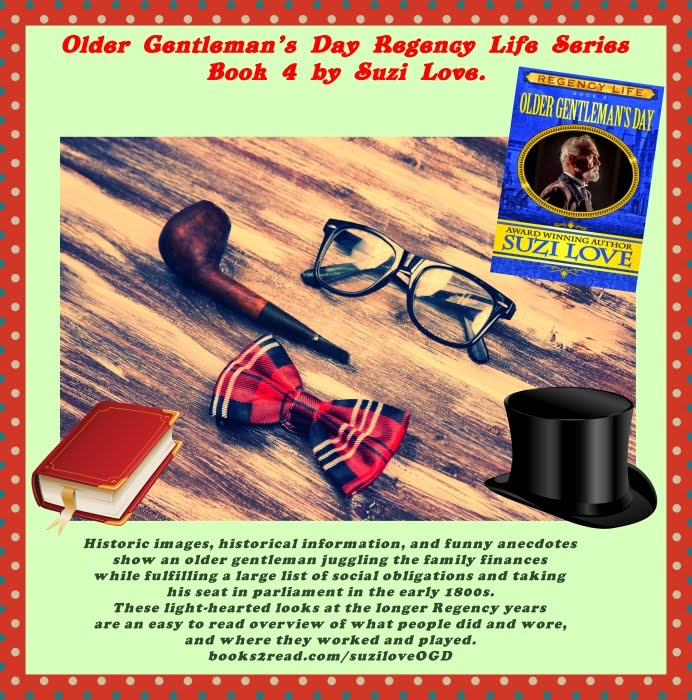
Writing Regency Era Fiction Or Nonfiction? Need more information on Older Gentleman’s Day in early 1800s, or the Bridgerton family or Jane Austen’s Regency Era. A lighthearted overview of an older gentleman’s clothing, social life, and responsibilities in the early 1800s. Take a look at where an older man went, what he wore, and how he managed the family’s finances and his estates. Older Gentleman’s Day Regency Life Series Book 3 books2read.com/suziloveOGD

RL_3_OGD_Older Man's Day Regency Life Series Book 3 by Suzi Love #Regency #History books2read.com_suziloveOGD
RL
RL_3_D2D_RetailerBuyLink_ books2read.com/suziloveOGD
An overview of an older gentleman’s clothing, social life, and responsibilities in the early 1800s. books2read.com/suziloveYGD
Posted in 1800s, 1800s Mens Fashions, art, Australia, bedroom fashion, Bridgerton, Canada, Carriage, cartoon, Coat or Pelisse Or Redingote, Customs & Manners, England, Europe, fashion accessories, Google Books, hats, Jane Austen, money, pants, peerage, Regency Era, Regency Fashion, Regency Life Series, riding, shoes, sports, Suit, Suzi Love Books, U.S.A, Vest or Waistcoat | Tagged 1800s men fashion, Book 3, boots, Bridgerton, fashion accessories, Fashion Plate, Hats And Hair, Jane Austen, legal, London, money, peerage, Regency Fashion, Regency Life Series, Regency London, Regency Men, Shoes, Suzi Love Books

Book Hooks: Drama and romance at the duke’s snowbound British country estate in December. #historicalmystery #FamilySaga #HistoricalRomance

Suzi Love Posted on August 13, 2025 by Suzi LoveAugust 12, 2025

Michael Brandon nodded. “Yes, I’m related to Lord Brandon, Frederick, who disappeared four years ago.” He faced the sick man. “We searched everywhere for you. Men scoured the streets of London for weeks after you disappeared, and then we widened our search. Ports, inns, the countryside, anywhere you might have gone. Or anywhere that you might have been taken if you’d been kidnapped and held for ransom.”

Michael groaned. “Three years of nothing. Not a sign. The police declared you a missing person, most likely deceased, and told us to wait out the seven years until we could officially declare you dead.” He swiped at his eyes, brushing aside the gathering tears. He took Frederick’s hand. “But we never gave up hope. None of us, and especially not mother.” 

Tears trickled down Michael’s cheek and he brushed them aside impatiently. He didn’t care that everyone saw his raw grief. He only cared that his brother, if this shell of a man truly was his previously vibrant brother, heard his words and understood the truth in them. The heartache and sorrow that they’d all carried for years. The pain they’d suffered thinking they might never set eyes on Frederick again. 

“Your mother …” His words caught as a sob escaped him, echoing the continuing sobbing from Melissa behind him. “Your mother died a year ago, but her last words were a desperate plea for me to keep looking for you. To find you, and to bring you home.” 

Michael watched tears trickle and run over the creases on the aged face before him, and he knew. This was Frederick, his constant companion during hundreds of childish escapades. 

 https://books2read.com/suziloveDS December Scandal, Book 3 Scandalous Siblings.

DS_December Scandal Book 3 Scandalous Siblings #HistoricalRomance Michael Brandon travels to introduce the woman he loves to family but is shocked when his missing brother arrives. https://books2read.com/suziloveDS
DS_December Scandal D2D_RetailerLinkhttps://books2read.com/suziloveDS
MFRW_Book Hooks
Posted in 1800s, Book Hooks, December Scandal, England, Regency Era, Romantic Era, Scandalous Siblings Series, Suzi Love Books, Victorian Era | Tagged Book 3, Book Hooks, December Scandal, Family Saga, Historical Mystery, historical romance, mystery, Scandalous Siblings Series, Suzi Love Books, Victorian Romance | Leave a reply

Fan of Regency London in the times of Jane Austen and Bridgertons? Regency Overview Book 1 Regency Life Series #JaneAusten #RegencyEra #Bridgerton #Nonfiction #amwriting

Suzi Love Posted on August 12, 2025 by Suzi LoveAugust 9, 2025

Fan of Regency London in the times of Jane Austen and Bridgertons? Regency Overview Book 1 Regency Life Series #JaneAusten #RegencyEra #Bridgerton #Nonfiction #amwriting https://books2read.com/ROver

Continue reading →
Posted in 1800s, Carriage, cartoon, Customs & Manners, Decorative Item, Food and Drink, History, household, Legal, military, money, Pastimes, peerage, Regency Era, Regency Life Series, riding, sports, Suzi Love Books, Suzi Love Images, travel, weapons | Tagged 1800s men fashion, Book 1, Bridgerton, British history, fashion accessories, Fashion Plate, gloves, Hats And Hair, Jane Austen, King George IV, peerage, Regency Era, Regency Fashion, Regency Life, Regency Life Series, Regency London, Regency Men, Regency Overview, Regency People, Regency Royalty, Regency Women, Shoes, Suzi Love Books

Post navigation

← Previous Post
Next Post→

SUBSCRIBE TO SUZI LOVE'S NEWSLETTER.

Recent Posts

  • 1815 March Evening Full Dress For the Opera in Bridgerton and Jane Austen years. #Bridgerton #RegencyFashion #JaneAusten #HistoricalFashion
  • 1798 Gentleman’s Outfit Of Long Green Overcoat With Yellow Buttons, Tan Gloves, and Black Boots, French. #GeorgianEra #France #FashionPlate
  • Duke of Stirkton throws off his rigid upbringing after his grandfather’s death. #ReadARegency #RegencyRomance #EroticHistoricalRomance
  • 1823 Hackney Cab, London, built by coach builder, David Davies. #Regency #London #Carriage #Travel
  • 1815 Beaded Coin Purse With Pinchback Ormolu Frame from Jane Austen and Bridgerton years. #JaneAusten #Bridgerton #handbag #RegencyFashion

Recent Comments

  1. Suzi Love on Book Hooks: Ironic that Lady Melton and her unborn child had been safer in battle-torn Europe than in England.  #MilitaryRomance #RegencyRomance #BattleofWaterloo
  2. Suzi Love on Book Hooks: Ironic that Lady Melton and her unborn child had been safer in battle-torn Europe than in England.  #MilitaryRomance #RegencyRomance #BattleofWaterloo
  3. Suzi Love on Book Hooks: Ironic that Lady Melton and her unborn child had been safer in battle-torn Europe than in England.  #MilitaryRomance #RegencyRomance #BattleofWaterloo
  4. Suzi Love on Book Hooks: Ironic that Lady Melton and her unborn child had been safer in battle-torn Europe than in England.  #MilitaryRomance #RegencyRomance #BattleofWaterloo
  5. Jana Richards on Book Hooks: Ironic that Lady Melton and her unborn child had been safer in battle-torn Europe than in England.  #MilitaryRomance #RegencyRomance #BattleofWaterloo

Login

  • Log in

Archives

  • August 2026
  • July 2026
  • June 2026
  • May 2026
  • April 2026
  • March 2026
  • February 2026
  • January 2026
  • December 2025
  • November 2025
  • October 2025
  • September 2025
  • August 2025
  • July 2025
  • June 2025
  • May 2025
  • April 2025
  • March 2025
  • February 2025
  • January 2025
  • December 2024
  • November 2024
  • October 2024
  • September 2024
  • August 2024
  • July 2024
  • June 2024
  • May 2024
  • April 2024
  • March 2024
  • February 2024
  • January 2024
  • November 2023
  • October 2023
  • September 2023
  • August 2023
  • July 2023
  • April 2023
  • March 2023
  • June 2022
  • April 2022

Categories

  • 1700s
  • 1700s Mens fashion
  • 1700s Womens Fashion
  • 1800s
  • 1800s Mens Fashions
  • 1800s women's fashion
  • 1900s
  • art
  • Australia
  • Bath
  • bedroom fashion
  • Book Hooks
  • Box Or Container
  • Bridgerton
  • Bus Trips
  • Canada
  • Carriage
  • cartoon
  • Celebrity
  • Chatelaine
  • children
  • Children
  • Christmas
  • Coat or Pelisse Or Redingote
  • Contemporary
  • Corset
  • Couple
  • Customs & Manners
  • dancing
  • December Scandal
  • Decorative Item
  • Dress Or Robe
  • Easter
  • Edwardian Era
  • Embracing Scandal
  • England
  • Ester In Images
  • Europe
  • Events
  • Fashion
  • fashion accessories
  • Food and Drink
  • Four Times A Virgin
  • France
  • furniture
  • Georgian Era
  • Georgian Fashion
  • Google Books
  • Grand Tour
  • Group
  • hats
  • History
  • History Events
  • History Notes
  • History Of Christmases Past
  • household
  • Hygiene
  • Irresistible Aristocrats
  • Jane Austen
  • Keanu Reeves
  • Kellys Justice
  • Legal
  • London
  • Love After Waterloo
  • Loving Lady Katharine
  • medical
  • military
  • money
  • mourning
  • Music
  • Outback Arrival
  • pants
  • Pastimes
  • peerage
  • People
  • Places
  • Pleasure House Ball
  • postal
  • Queensland
  • Quotations
  • Regency Era
  • Regency Fashion
  • Regency Life Series
  • Reticule or Bag
  • riding
  • Romantic Era
  • Royalty
  • Russia
  • Scandalous Siblings Series
  • Scenting Scandal
  • Self Publishing
  • sewing
  • Shirt
  • shoes
  • Shopping
  • South Pacific
  • Spencer
  • sports
  • Suit
  • Sunday Snippet
  • Suzi Love
  • Suzi Love Books
  • Suzi Love Images
  • Suzi Love Writing
  • Swain Cove
  • THe Viscount's Pleasure House
  • travel
  • U.S.A
  • underclothing
  • Vest or Waistcoat
  • Victorian Era
  • Victorian Fashion
  • weapons
  • weddings
  • Writing Tools

1800s men fashion 1800s women's fashion antiques Bridgerton British history Cartoons Corset cravat decorative Dress Or Gown England europe fashion accessories Fashion Plate France Georgian era Georgian Fashion gloves google books Hats And Hair historical romance History Notes household Jane Austen jewelry Journal des Dames et des Modes London Metropolitan Museum NYC pants Redingote Or Pelisse Or Coat Regency Era Regency Fashion Regency London reticule or bag riding Romantic Era sewing shawls Shoes Suzi Love Books Suzi Love Images Tailcoat The Repository Of Arts underclothing Vest or Waistcoat

©2026 - Suzi Love - Weaver Xtreme Theme Privacy Policy
↑