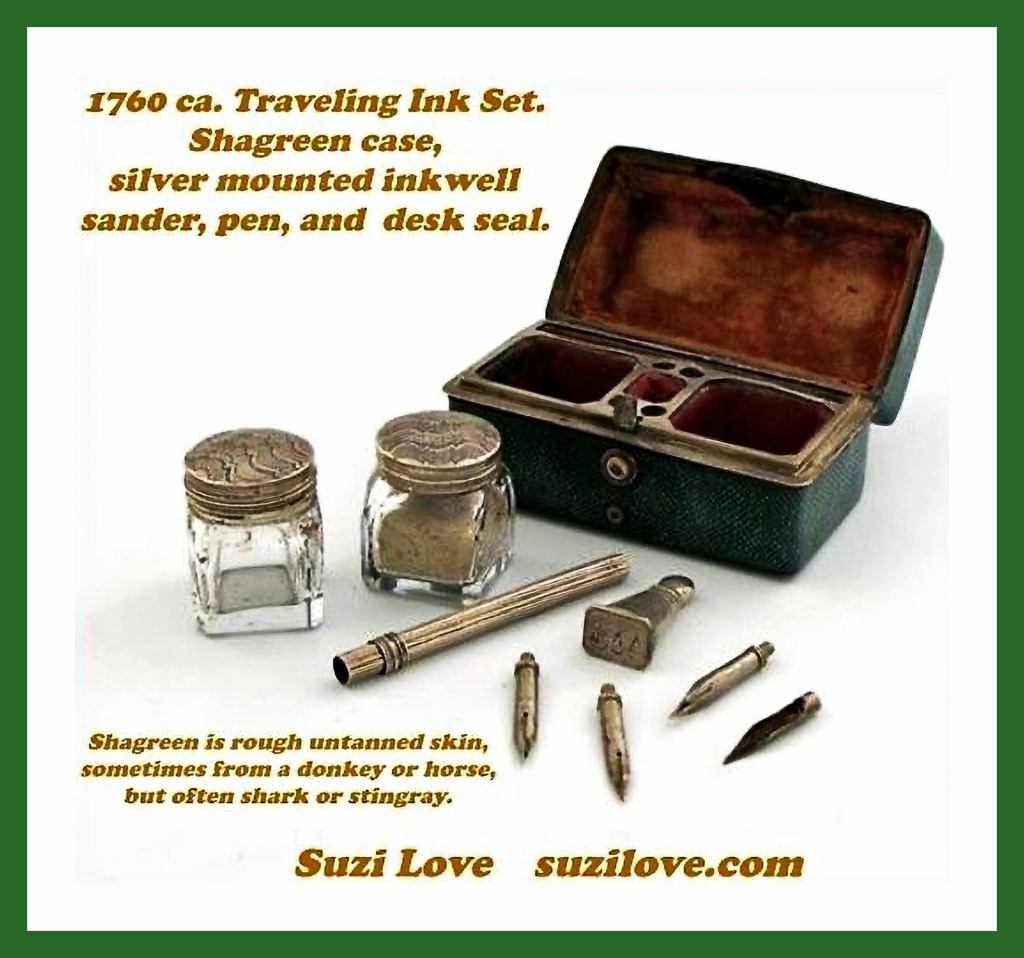
1760 ca. Traveling Ink Set. Rectangular Shagreen case with hinged cover which opens to reveal an unmarked silver mounted inkwell and sander, a pen, and a desk seal.
Definition Shagreen: Type of rough untanned skin, sometimes made from a donkey or a horse, but often from a shark or a stingray.
1800-1820 ca. Small Pieces Of Drawing Room Furniture as would have been used in houses where Jane Austen lived. Side tables, book tables, chest and foot stool. Collage by Suzi Love.
1801 November 9th Playing Cards. Men and women play cards at round table. Supreme Bon Ton Plate 2. Published by S W Fores. Men and women play cards at round table. Man and woman talk to players. Woman sleeps in upright chair, two others, one with parasol and other fan, walk off arm-in-arm.Men: High-waisted coats, high collars, huge neck-cloths, with pumps or Hessian boots. Women: High-waisted dresses, short sleeves, long trains, very low necklines, short ringlets, two in caps. Via British Museum, London, UK. britishmuseum.org (PD-Art)
In Jane Austen’s times, cartoons posted in the windows of shops were one of the main ways people found news. Common people couldn’t afford newspapers so cartoonists ridiculed the people and the places with cartoons of the daily events happening in London and other cities. The ridiculous fashion trends of the late 1700s and early 1800s were easy targets for satirical cartoons as was the addiction to gambling by women and men alike.
Light-Hearted look at an Older Lady’s Life In Jane Austen’s Times, or early 1800s. An easy to read overview of what an older lady did, wore, and how she lived in the early 19th Century. Information for history buffs and pictures for readers and writers of historical fiction. Older Lady’s Day, Regency Life Series, Book 5, by Suzi Love. books2read.com/suziloveOLD
The older lady’s day usually started with her toilette in her bedroom, where her maid helped her dress for the day and styled her hair. After that, she would join her family downstairs for breakfast unless she preferred a tray with either tea or hot chocolate in her bedroom as she prepared for her busy day. Her day would be made up of speaking with the housekeeper and the cook about the week’s menus, assuring that the servants were all available that day and no one was ill, and checking the list of foods needed. She would also enquire if the laundry was up to date and that they had enough good linen to make up all the beds before extended family members and guests arrived. If she was in the country and hosting a weekend house party, she would assign rooms to the guests on her lists and query that all was in readiness for their arrival.
1815 May. Walking Dress, or Pelisse, or Redingote, English. Purple walking dress with wide collar, high white lace neck frill, and white trim down the vertical opening, white reticule, and a high white plumed hat. Fashion Plate via Rudolph Ackermann’s ‘The Repository of Arts’. Google Books (PD-180) suzilove.com Fashion Plate via Rudolph Ackermann’s ‘The Repository of Arts’.
Definition: Walking Dress Or Pelisse Or Redingote Woman’s long, fitted coat often worn open in front to show off the dress underneath. Walking Dress Or Pelisse are the terms used in English fashion plates, while Redingote is seen in European fashion plates, especially the French one, Journal des Dames et des Modes, or Costume Parisien.
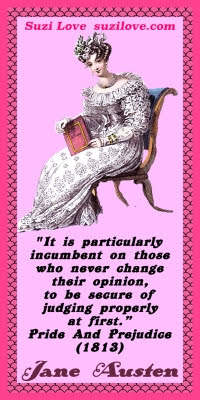
“It is particularly incumbent on those who never change their opinion, to be secure of judging properly at first.” Jane Austen Pride and Prejudice (1813) .#JaneAusten #Regency #Quote
1798 Two ladies in Jane Austen style white walking dresses. Left: Dress has gold trim, white bonnet, green Parasol. Right: Stand up collar, short puffed sleeves, brown shawl and coiled head dresses, both with necklaces. via Rijks Museum, Amsterdam, Netherlands. rijksmuseum.nl
1800s Different Degrees Of Nobility In Great Britain and Ireland. FIVE LEVELS.
BENEATH THESE COME THE BARONS: The rank and precedence of Baronets is immediately after the younger sons of Barons, and before all Knights, whether of the Order or Knights. When the Order of Baronets was first instigated, its numbers were limited to 200. Members were carefully selected from the most wealthy and distinguished families of landed gentry. In the reign of the first Charles, it was the stimulus and reward for devoted loyalty. Later, it was often bestowed as an honorary recompense for sufferings and attachment when royalty was unable or unwilling to give solid remuneration. FROM: 1835 Debrett’s Baronetage of England
PRINCES of the BLOOD ROYAL: The Sovereign’s sons, brothers, and uncles are styled Princes of the Blood Royal, and have precedency of all other dukes, with the title of Royal Highness, which title was also, by special warrant, in 1816, conferred on the duke of Gloucester, deceased, and, 6th April 1818, on Prince Leopold of Saxe Cobourg (King of the Belgians). FROM: 1840 Debrett’s Peerage of the UK
THE PRIVILEGES OF THE PEERS OF THE UNITED KINGDOM OF GREAT BRITAIN AND IRELAND. The nobility of England enjoy many great privileges, the principal of which are as follow:-
1. They are free from all arrest for debts, as being the king’s hereditary counsel
lors. Therefore a peer cannot be outlawed in any civil action and no attachment lies against his Person. This privilege extended also to their members of the lower house, till the year 1770, when their lordships joined the house of commons in a bill for abolishing it.
2. In criminal causes they are only tried by their peers, who give their verdict, not upon oath as other juries, but only upon their honor: and then a court is fitted up for the purpose in the middle of Westminster hall, at the king’s charge.
3. To secure the honor of, and prevent the spreading of any scandal upon peers, or any great officer of the realm,there is an express law called scanda lum magnutum by which any man convicted of making a scandalous report against a peer of the realm ( though true ) is condemned to an arbitrary fine , and to remain in custody till the same be paid .
4. Upon any great trial in a court of justice a peer may come into the court and sit there uncovered. No peer can be covered in the royal presence without permission for that purpose, except the lord baron of Kinsale, of his majesty’s kingdom of Ireland. In case of the poll tax, the peers bear the greatest share of the burden, they being taxed every one according to his degree.