Travel and Luggage By Suzi Love History Notes Book 10. How did people travel in Bridgerton and Jane Austen’s times. What did they take with them to make their long journeys easier? Travel by road, ship, canal, or railway all took a long time and had dangers so people learned to prepare. And then, in the nineteenth century, road improvements, inventions, and scientific developments made travel more pleasurable. books2read.com/SuziLoveTravel
Horse Power To Steam. Various alternatives to horse power were tested in London’s streets during the 19th century. Steam powered road engines and trams proved too heavy and damaged the roads. Stationary steam engines were used to haul trams attached to a cable but these were only really effective on hills that we too steep for horses. There were also experiments with trams driven gas engines and battery electric power. but was successfully developed. Petrol engines were still primitive and unreliable in the 1890s. In 1900 the reliable horse still dominated the streets of London but new technology was to revolutionize road transport.
18th Century Mid. Nécessaire, London, England. Wood, shagreen, silk, tortoiseshell with gold mounts, steel. Includes: pen knife, beard trimmer, scissors, bottles, paper cutter, 6 razors, hone, strop. via Metropolitan Museum New York City, U.S.A. metmuseum.org
Definition Shagreen: A type of rawhide, or rough untanned skin, originally made from the back of a horse or a wild donkey. In the 18th century, the skin of a shark or stingray also began to be called shagreen.
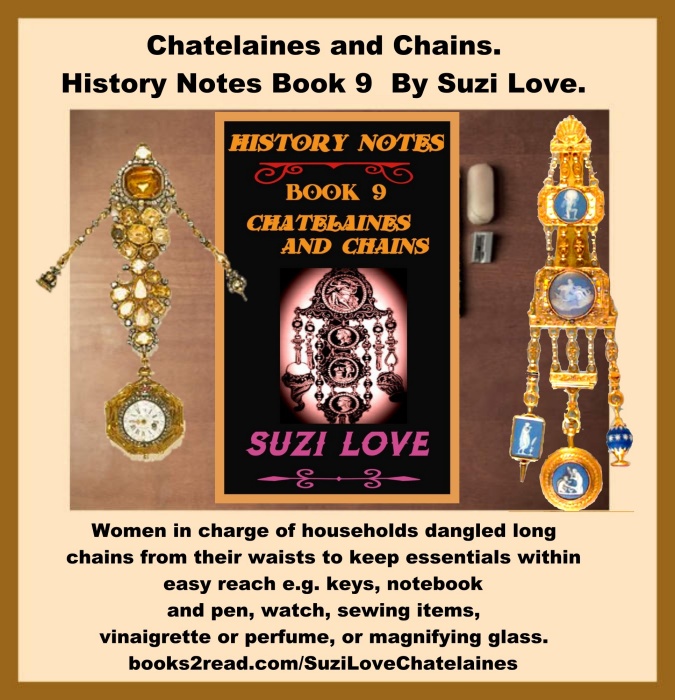
Chatelaines and Chains History Notes Book 9 By Suzi Love. What do you know about Chatelaines and Chains worn in Jane Austen’s and Bridgerton times? Women in charge of households carried important items with them. History Notes Book 9 Chatelaines and Chains. books2read.com/SuziLoveChatelaines
Personal Necessities, keys, or chatelaines was a set of useful items hung from waist by decorative chain. Chatelaines and Chains. History Notes Book 9 By Suzi Love. Women in charge of households dangled long chains from their waists to keep essentials within easy reach e.g. keys, notebook and pen, watch, sewing items, vinaigrette or perfume, or magnifying glass. Early chatelaine were simple essentials. Later chatelaine were decorative and expensive. http://books2read.com/SuziLoveChatelaines
Definition Chatelaine: The word Chatelaine is French and means the keeper of the keys. Chatelaine” derives from the Latin word for castle. In Medieval times, the chatelaine was in charge of the day-to-day running of the castle. Women in charge of households dangled long chains from their waists to keep essentials within easy reach e.g. keys, notebook and pen, watch, sewing items, vinaigrette or perfume, or magnifying glass. Early chatelaine were simple essentials. Later chatelaine were decorative and expensive.books2read.com/SuziLoveChatelaines
What did a chatelaine do? Most important task was keeper of the keys. Also ordered supplies, did bookkeeping, supervised servants, taught castle children, and organized guests.
By 1700’s, a metal jeweled ornament hung from pockets, attached to belts, or by hooks into skirt waistbands
During 1800’s, women wore large collections of tools hung from chains
Young girls sewed and did needlework and needed to carry sewing notions eg scissors, thimbles
Worn by women of all classes, from workers to nobility
Varied depending on class and finances.
Made of silver, brass, steel, leather, or fabric
During 19th century, fashionable dresses often had no waist and nowhere to hang chatelaines
Chatelaines became decorative brooches
Often given as a wedding present from a husband to bride
Later became fashion accessories
HN_9 Chatelaines and Chains History Notes Book 9 books2read.com:SuziLoveChatelainesD2D_RetailerBuyLink_HN_9. Chatelaines and Chains History Notes Book 9 books2read.com/SuziLoveChatelaines
I love Pinterest for keeping thousands of historical images in some sort of order.And I love using Pinterest Boards as inspiration for my romance books.What about you? Do you use Pinterest for planning something, or just for fun?Need more hints for what to do with your boards and pins? Take a look at these fascinating articles on Pinterest. if you want even more Pinterest information and tips for becoming a power user, check out my Suzi Love Pinterest Boards
1800s Late. Doctor’s Traveling Apothecary Cabinet. 29 Single bottle compartments and instrument tray. Original bottles with labels: Hamamelis, or Witch Hazel.
1800s Late. Doctor’s Traveling Apothecary Cabinet. 29 Single bottle compartments and instrument tray. Original bottles w/ labels: Hamamelis (Witch Hazel.)
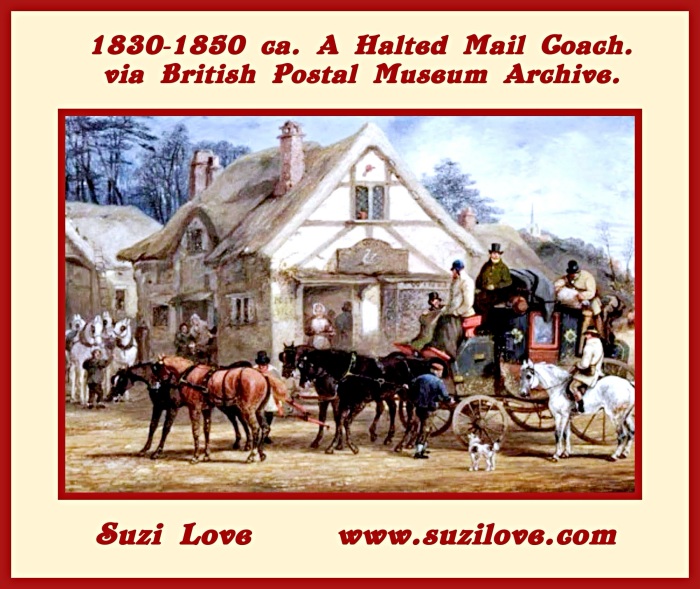
1830-1850 A Halted Mail Coach via British Postal Museum.
For many years in England, mounted carriers rode between posts and carried letters to and from local postmasters who delivered them to people in his area. The system was inefficient and post riders often robbed. John Palmer, a theatre owner, transported actors and materials and wanted to improve mail delivery so the Chancellor of the Exchequer, William Pitt, let Palmer try. He beat the old delivery time by 22 hours and brought the mail from Bristol to London in 16 hours. A year later, in 1785, the mail coach, sometimes called a post coach, was delivering mail from London to Norwich, Liverpool, Leeds, Dover, Portsmouth, Poole, Exeter, Gloucester, Worcester, Holyhead and Carlisle.
Palmer’s mail service improved after turnpike roads were introduced in the late 1780s, allowing faster travel and encouraged business between the proprietors of stage coaches.” The first mail coaches were supplied by contractors who received on average “one penny-halfpenny per mile.”, despite these contracted coaches being poorly built.. By the 1800s, the Post Office owned their own fleets of coaches with black and scarlet livery.
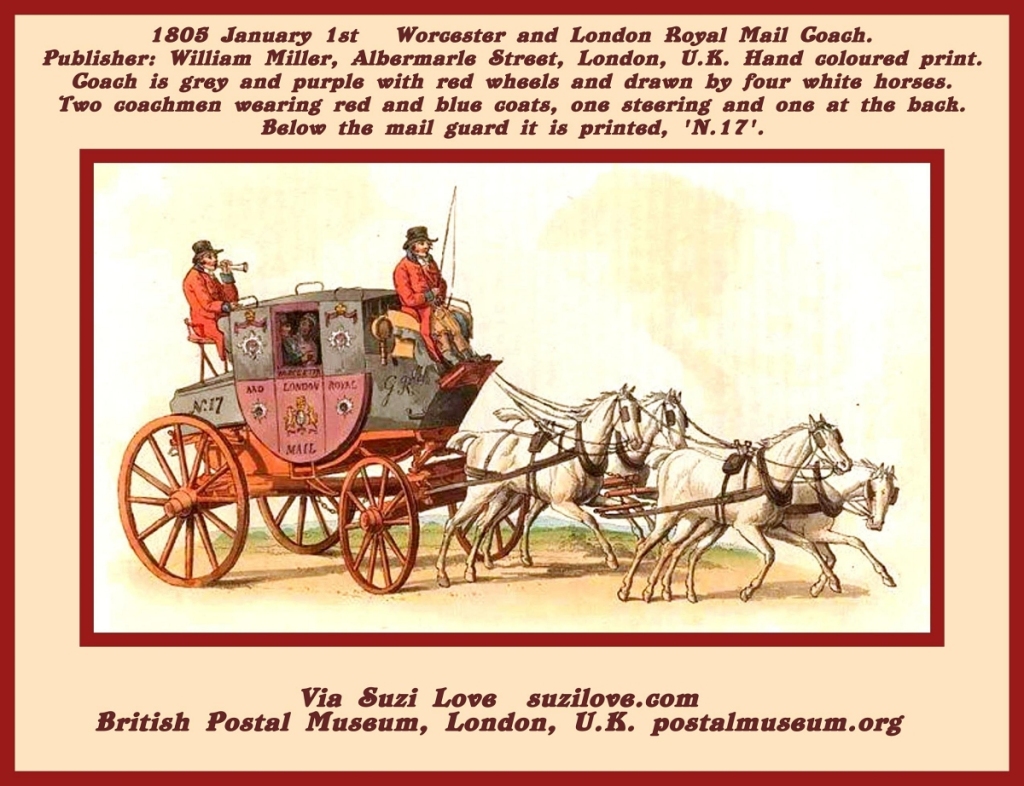
Mail coaches were usually drawn by four horses and took four passengers inside and three outside. The mail box was locked and secured at the rear of the coach and guarded by an armed Royal mail post office guard who followed strict rules.
Travel and Luggage By Suzi Love History Notes Book 10. How did people travel in Jane Austen’s times. In past centuries? What did they take with them to make their long journeys easier? Travel by road, ship, canal, or railway all took a long time and had dangers so people learned to prepare. And then, in the nineteenth century, road improvements, inventions, and scientific developments made travel more pleasurable. books2read.com/SuziLoveTravel
1813 October White Empire style, or high-waisted, Carriage Dress, English. Brown shawl, brown boots, and a lace cap tied under the chin. Typical of the carriage fashions that would have been worn by Jane Austen and her contemporaries. Fashion Plate via The Lady’s Magazine Or Entertaining Companion for the Fair Sex.
Definition Empire Style Dress: High-waisted white gown defined women’s fashion during the Regency Era. ‘Empire’ is the name given to the period when Napoleon Bonaparte built his French Empire. High-waisted, loose gowns were adopted by the aristocracy as a symbol of turning away from the fussy, elaborate and expensive clothing worn in the 1700s. https://books2read.com/SuziLoveFashion1810-1814
How did Jane Austen and her family? Did they go by stagecoach? The dreadful condition of British roads caused great apprehension to all classes of travelers. Making a journey anywhere in the country was a big undertaking and often a gentleman composed his last will and testament before his departure. Traveling in vehicles was only possible during the day or on the nights with very bright moonlight with few vehicles attempting road travel in winter and any travel on a Sunday was frowned upon.
Description of Stage Coach Travel in England. via 1815 Journal Tour of Great Britain. “The gentlemen coachmen, with half-a dozen great coats about them, immense capes, a large nosegay at the button-hole, high mounted on an elevated seat, with squared elbows, a prodigious whip, beautiful horses, four in hand, drive in a file to Salthill, a place about twenty miles from London, and return, stopping in the way at the several public-houses and gin-shops where stage-coachmen are in the habit of stopping for a dram, and for parcels and passengers on the top of the others as many as seventeen persons. These carriages are not suspended, but rest on steel springs, of a flattened oval shape, less easy than the old mode of leathern braces on springs. Some of these stage coaches carry their baggage below the level of the axletree.”
Coach Carriage Line Drawing. Photo Editing by Suzi Love ~ suzilove.com via Pearson Scott Foresman donation to Wikimedia Commons.1805 January 1st Worcester and London Royal Mail Coach. Publisher: William Miller, Albermarle Street, London, U.K. Hand colored print. Coach is grey and purple with red wheels and drawn by four white horses. Below the mail guard it is printed, ‘N.17’. Via Suzi Love suzilove.com British Postal Museum, London, U.K. postalmuseum.org
In Jane Austen’s times craftsmen created boxes and containers of precious metals, leather, silks, and decorated them with jewels. Boxes, Cases, Etui, Necessaire and everything else that was used to carry essential items for travel, sewing, medicine, writing, and toiletries. Containers were engraved to make exquisite and expensive items as well as practical carrying cases. books2read.com/suziloveBoxesCases
A sedan chair is a portable enclosed chair for a single passenger. It was generally carried by two “chairmen” holding poles attached to either side of the chair. Sedan chairs were fashionable in England and Europe during the 17th, 18th and early 19th centuries and were an important part of the social life of the times. They were very useful for negotiating crowded, unsafe, narrow, winding and often filthy streets and were particularly used by “invalids, ladies and party goers”. Sedan chairs had the advantage of being able to be carried up and down stairs and could deliver the passenger from inside their own home to inside their destination without having to step outside.
1784 Sedan Chair. ‘The return from a masquerade. A morning scene.’ A young lady dressed as shepherdess with staff slumps in a sedan chair. Asleep or drunk her head and shoulders hang outside window. Two porters smile and dwarf chimney sweep carries a mask.’ By Robert Dighton and Cari.
1784 Sedan Chair. ‘The return from a masquerade. A morning scene.’ A young lady dressed as shepherdess with staff slumps in a sedan chair. Asleep or drunk her head and shoulders hang outside window. Two porters smile and dwarf chimney sweep carries a mask.’ By Robert Dighton and Cari.
The 19th century English author, Elizabeth Gaskell, described the use and function of the sedan perfectly in her novel “Wives and Daughters” when she reminisced how the Browning sisters chose to be transported to a ball by sedan chair, which ‘came into the parlor, and got full of the warm air, and nipped you up, and carried you tight and cosy into another warm room, where you could walk out without having to show your legs by going up steps, or down steps.’
The Bath Chair was invented in Bath, England, in the mid 18th Century to transport the wealthy and the sick around the city. It could be steered by the passenger and rivaled and then outdid the Sedan Chair as only one chairman was needed to operate it. The last Bath Chairman retired in 1949.
Typical 1700s, or Eighteenth Century Sedan Chair. Portable enclosed chair for single passenger usually carried by two chairmen holding poles attached to either side of chair. Fashionable during 17th, 18th and early 19th centuries when needed to negotiate crowded, unsafe, narrow, and dirty streets. Used by invalids, ladies and party goers. The sedan chair comprises a small kiosk with a curved timber roof which is covered with leather and studded with brass nails. The front and side panels are painted in green with floral decorations of cherubs and flowers. The back panel is of plain timber. Access to the chair was via a hinged door at the front. Inside, the chair is upholstered in silk and features padded upholstered arm rests. The windows have raw silk curtains which are gathered with tassels. The present brackets and poles are reproductions made in 1986 prior to display in the Transport exhibition. The total length of the new poles are 80 inches. The sedan chair door lock features the initials “V.F.” and a set of crossed keys with the wording “PARIS” and the number “34”. Via Powerhouse Museum, Sydney, Australia.
Typical 1700s, or Eighteenth Century Sedan Chair. Portable enclosed chair for single passenger usually carried by two chairmen holding poles attached to either side of chair. Fashionable during 17th, 18th and early 19th centuries when needed to negotiate crowded, unsafe, narrow, and dirty streets. Used by invalids, ladies and party goers. The sedan chair comprises a small kiosk with a curved timber roof which is covered with leather and studded with brass nails. The front and side panels are painted in green with floral decorations of cherubs and flowers. The back panel is of plain timber. Access to the chair was via a hinged door at the front. Inside, the chair is upholstered in silk and features padded upholstered arm rests. The windows have raw silk curtains which are gathered with tassels. The present brackets and poles are reproductions made in 1986 prior to display in the Transport exhibition. The total length of the new poles are 80 inches. The sedan chair door lock features the initials “V.F.” and a set of crossed keys with the wording “PARIS” and the number “34”. Via Powerhouse Museum, Sydney, Australia.
The longest journey recorded in a sedan chair was made by Princess Amelia, youngest daughter of King George III, who in 1728 was carried by 8 chairmen working in reliefs from London to Bath, a distance of 172 kms (107 miles). This sedan chair door lock features the initials “V.F.” and a set of crossed keys with the wording “PARIS” and the number “34”.
HN_10_D2D_RetailerBuyLink_ History Notes Book 10 books2read.com/SuziLoveTravel