↓
 

Suzi Love

Making history fun, one year at a time.

Header_
  • Home
  • Newsletter
  • Pre order form
  • Shop
    • Cart
    • Checkout
    • My account
    • Refund and Returns Policy
  • Blog
  • BOOKS
    • History Events
    • Kelly’s Justice
    • Outback Arrival
    • Irresistible Aristocrats
    • History Notes
    • Scandalous Siblings
    • Love After Waterloo
    • Regency Life Series
  • Privacy Policy
  • EVENTS
Home » Victorian Era » Page 3 << 1 2 3 4 5 >>

Tag Archives: Victorian Era

Post navigation

← Previous Post
Next Post→

Christmas: Christmas Card History #Christmas #holidays #Traditions #Customs #VictorianEra

Suzi Love Posted on December 11, 2025 by Suzi LoveDecember 11, 2025

Sending Christmas Cards.

At the end of the winter term, schoolmasters would set their pupils to work on Christmas Pieces, samplers of writing on superior paper with engraved borders, to show parents how they had progressed during the year. By about 1820, the engraved borders were enhanced with color and the children’s pieces became more decorative.

However, the custom of sending cards at Christmas was started in the United Kingdom in 1843 by Sir Henry Cole. Postage had been standardized three years earlier and Cole was a civil servant who had played a key role in initiating Uniform Penny Post. He wanted ordinary people to become more interested in the new ‘Public Post Office’. With his artist friend John Horsley, they designed the first card which was issued from a periodical, Felix Summerley’s Home Treasury, and were sold for 1 shilling each.

The card was lithographed, hand-colored, had three panels and was in a rustic frame of carved wood and ivy. The outer two panels showed people caring for the hungry and the naked. The centre panel showed a family of three generations having Christmas dinner, although the temperate classes strongly objected to the idea of a child being given a glass of wine with dinner.

Xmas_Christmas Card

New railways carried more post, and a lot faster, than a horse and carriage so the Post Office offered a Penny stamp. Cards became even more popular when they could be posted in an unsealed envelope for one halfpenny. Christmas cards became truly popular when printing improved and cards could be produced in large numbers, around 1860. By the early 1900s, the custom had spread over Europe and especially in Germany.

Early cards usually pictured Nativity scenes, but in the late Victorian times, robins and snow-scenes became popular because the postmen wore red uniforms and were nicknamed ‘Robin Postmen’. Snow-scenes were also popular because they were a reminder of the very bad winter of 1836.

Snow scenes reflected the snowy and often harsh northern hemisphere winters when opening and reading Christmas cards was an enjoyable family experience.  In 1860, Charles Goodall & Son, a British publisher of visiting cards, began mass producing cards to be used for visits during the Christmas period. These Christmas and New Year’s visiting cards were decorated with simple designs such as a twig of holly or flowers.

Sales of cards grew and designs and sizes changed. The first cards were meant to appeal to the masses and encourage them to send large numbers by post, so rather than focus on religious images, they showed sentimental or humorous images of family and children, fanciful designs of flowers, fairies, or reminders of the approach of spring. Religious themes of nativity scenes, children looking at the manger, or angels and candles remain popular to the modern day.

Cards could be shaped like bells, a fan, a crescent, a circle, or a diamond and were folding, decorated with jewels, iridescent, embossed, and carried either simple Christmas and New Year greetings or had verses and carols written in them. The next year, Mr W.C.T. Dobson produced a sketch symbolizing the ‘Spirit of Christmas’ which sold many more than the previous thousand and the novelty caught on.

Many artists became famous for their annual illustrations that became postcards and cards.  Printing technology became more advanced in the age of industrialisation and the price of card production dropped. With the introduction of the halfpenny postage rate, the Christmas card industry industry increased until in 1880 11.5 million cards were produced.

Xmas_Christmas Card
Xmas_Christmas Card
Xmas_Christmas Card
Xmas_Christmas Card
Xmas_Christmas Card
Xmas_Christmas Card
Xmas_Christmas Card
Xmas_Christmas Card
Xmas_Christmas Card
Posted in 1800s, Australia, Canada, Christmas, Customs & Manners, England, Europe, household, Pastimes, Suzi Love Images, U.S.A, Victorian Era | Tagged British history, British Postal Museum, Christmas, Customs and Traditions, europe, History Of Christmases Past, postal, Victoria and Albert Museum, Victorian Era

Christmas: Candy Cane And It’s Fascinating History #Christmas #holidays #Traditions #Customs

Suzi Love Posted on December 11, 2025 by Suzi LoveDecember 10, 2025

Legend has it that during the 17th century, craftsmen created straight white sticks of candy in the shape of shepherds’ crooks at the suggestion of the choirmaster at the Cologne Cathedral in Germany. The treats were given to children to keep them quiet during ceremonies at the living creche, or Nativity scene, and the custom of passing out the crooks at such ceremonies soon spread throughout Europe.

‘The legends of the candy cane are many, including that the cane was shaped like a “J” for Jesus, the three red stripes symbolized the Holy Trinity, the hardness of the candy represented the Church’s foundation on solid rock and the peppermint flavor reflects the use of hyssop, an herb referred to in the Old Testament.’ via Encyclopedia Britannica

In celebrations of Saint Nicholas Day, candy canes are given to children as they are also said to represent the crosier of the Christian bishop, Saint Nicholas; crosiers themselves allude to the Good Shepherd, a title associated with Jesus. Some people explain the symbolism of a striped cane as white representing Christ’s purity, red the blood he shed, and the three red stripes the Holy Trinity.

In the mid 1600s, sugar roses were added but weren’t popular so plain white canes remained until red stripes were added around 1890. In 1847, a German immigrant living in Wooster, Ohio, U.S.A. looped candy canes that he brought with him from Europe over the boughs of his Christmas tree.

In 1919,  Bob McCormack of Albany, Georgia, made candy canes for family, friends and local shopkeepers. The canes were bent by hand as they came off the assembly line into the  ‘J’ shape of a shepherd’s crook, so breakage was often over 20 percent. In the 1920s, a cherubic child in a red-and-white hat sold peppermint candy cane to Albany natives in an advertisement for Bob’s candy company.  McCormack was the first manufacturer to wrap his candy in cellophane. Bobs moved to a larger facility in the 1930s so that it could expand its product lines and was one of the few candy companies to remain solvent during the Great Depression.

As the economy improved, people bought more sweet treats,  but Bobs Candy was then leveled by a tornado and, as the company had no tornado insurance, they had to rebuild on their own. By August 1940 the company was back in business and employed McCormack’s three children.

During World War II (1941-45), when sugar was rationed, coconuts were in short supply, and pecans were expensive, Bobs took advantage of a plentiful local product—the peanut—and sold peanut-butter crackers and vacuum-packed peanuts. During the 1950s, Bobs began making money with such innovations as break-proof packaging, moisture-proof candy wrappers.

In 1952, Bob McCormack’s brother-in-law, Catholic priest Gregory Keller, invented the Keller Machine which automated the process of twisting soft candy into spiral striping and then cutting them into precise lengths as candy canes.

Harding Keller invented the Keller Machine around 1950 for his brother-in-law Bob McCormack. The machine twisted and cut stick candy, allowing for the mass production of the company’s signature candy canes and other items. – Courtesy of Farley’s and Sathers Candy Company, Inc.

First, candy sticks cut to the desired length enter the machine. Each stick is bent individually, but the machine has a system of multiple grippers and rollers to continually bend the sticks, one after the other. As each stick enters the machine, it is positioned in a gripper which holds the straight portion of the cane with the part to be bent protruding out. Each gripper has on one side a curved die which the protruding end will be bent over. The candy stick is first bent to a right angle as it is moved past and put into contact with an inclined face. The patent application describes two potential versions of the mechanism which complete the bending process.

The first version of the mechanism has a chain around two sprockets on which are mounted bending rollers. Each bending roller is attached to a cam which rides along another inclined face to move the roller along the protruding surface of the cane to complete bending it around the die. In the second version, the chain and sprockets are replaced by a wheel on which the bending rollers are mounted. In modern candy cane production, the sticks are wrapped in cellophane before they are bent.

By the middle of the century, Bob’s company – originally the Famous Candy Company, then the Mills-McCormack Candy Company, and later Bobs Candies, had become one of the world’s leading candy cane producers.Bobs Candies was sold to Farley’s and Sathers in Spring 2005. Farley’s and Sathers merged with the Ferrara Candy Company which continues to make candy canes under the Bobs name.

By the middle of the century, Bob’s company – originally the Famous Candy Company, then the Mills-McCormack Candy Company, and later Bobs Candies, had become one of the world’s leading candy cane producers.

Xmas_Candy Cane
Xmas_Candy Cane
Xmas_Candy Cane
Posted in 1800s, 1900s, Christmas, Customs & Manners, Edwardian Era, Food and Drink, History Of Christmases Past, Suzi Love Books, U.S.A, Victorian Era | Tagged Christmas, Customs and Traditions, Edwardian Era, Food, History Of Christmases Past, Suzi Love Images, Suzi Love Research, USA, Victorian Era

Christmas: How did they celebrate Christmas in Bridgerton and Jane Austen times? #Christmas #Christianity #Bridgerton #JaneAusten #holidays

Suzi Love Posted on December 10, 2025 by Suzi LoveDecember 9, 2025

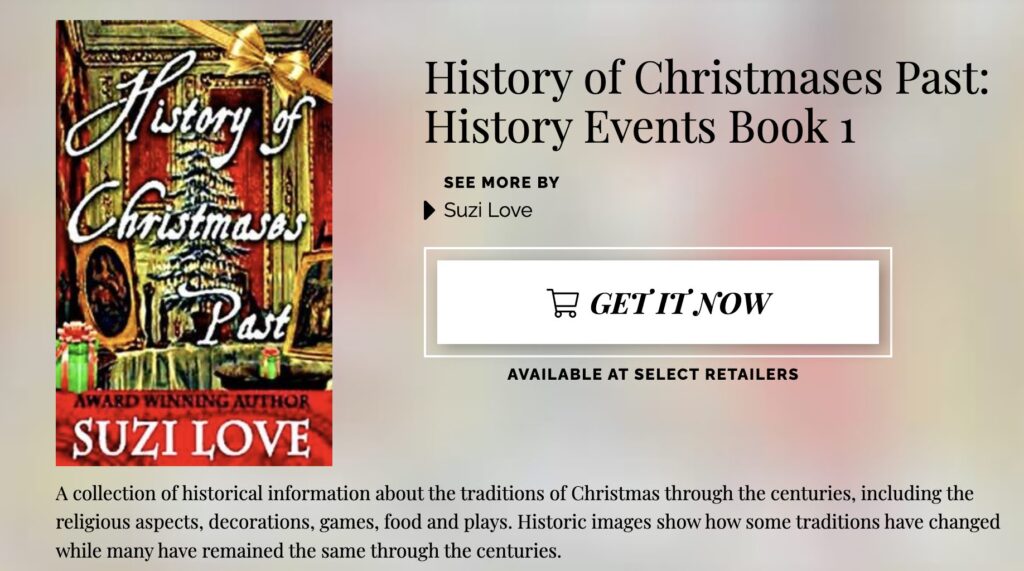
How did they celebrate Christmas in Bridgerton and Jane Austen times? Historical information about the traditions of Christmas through the centuries, including the religious aspects, decorations, games, food and plays. History Of Christmases Past has lots of information and images about Christmas through the centuries, including religious aspects, decorations, games, food and plays. Historic images show how some traditions have changed while many have remained the same through the centuries. books2read.com/suziloveHOCP

How did they celebrate Christmas in Bridgerton and Jane Austen times? Historical information about the traditions of Christmas through the centuries, including the religious aspects, decorations, games, food and plays. #holidays #Christmas #Christianity #Bridgerton #JaneAusten http://books2read.com/suziloveHOCP


Posted in 1700s, 1800s, 1900s, Australia, Bridgerton, Canada, Christmas, Customs & Manners, Edwardian Era, England, Europe, Events, Food and Drink, Georgian Era, History Of Christmases Past, household, Jane Austen, Music, Regency Era, Romantic Era, Royalty, South Pacific, Suzi Love Books, Suzi Love Images, U.S.A, Victorian Era | Tagged Book 1, Bridgerton, British history, Christmas, Customs and Traditions, drinks, Edwardian Era, Food, Georgian era, History Events, History Of Christmases Past, household, Jane Austen, music, Queen Victoria, Regency Era, Regency Royalty, Suzi Love Books, Victorian Era

Christmas: Symbols and Their Meanings #Christmas #holidays #Traditions #Customs

Suzi Love Posted on December 3, 2025 by Suzi LoveDecember 1, 2025

Christmas Symbols and Their Meanings

Angels – Heralds for the news of the birth of a baby in a manger.

Bells – Bells have rung out for all important events for centuries, plus lost sheep are found by the sound of the bell.

Candy Cane  – Symbolizes the crook of the shepherds who visited Christ.  Red represents the blood that was spilled and white is for purity. The peppermint oil that flavors is known for its strong healing properties.

Cards – Produced in Britain in 1843 to be sent with love to family and friends around the world by the new Postal services.

Carols – Poems and stories of worship made into songs.

Carolers – Groups of people who strolled the streets singing Christmas songs

Feasting – To celebrate the joy of the baby’s arrival on the 25th December. 

Gift Giving – The Wise Men bowed before the baby and gave him gold, frankincense and myrrh.

Gold – Decorating using the color of one of the gifts of the wise men.

Green – Decorating using the color of evergreens which show everlasting love.

Holly – Represents Eternal Life and the crown of thorns worn by Jesus.

Mistletoe: In the 18th Century, men kissed a woman who stood under mistletoe to show love, friendship and goodwill. If a woman was un-kissed, she would (supposedly) never marry.

Nativity: The birth of Jesus Christ

Poinsettia –  Red flowers used in countries such as Mexico to symbolize Christmas time.

Stockings – Hung by children to receive gifts

Twelve Days of Christmas: Twelve days between the birth of Christ on December 25 and the coming of the Magi on January 6, the Epiphany.

Tree – Evergreen tree symbolizes eternal life and love

Wreath – Made of evergreens to symbolize never ending love

Posted in 1700s, 1800s, 1900s, Bridgerton, Christmas, Customs & Manners, Edwardian Era, England, Europe, Food and Drink, Georgian Era, History Of Christmases Past, household, Jane Austen, Pastimes, Regency Era, Suzi Love Books, Victorian Era | Tagged Bridgerton, British history, Christmas, Customs and Traditions, europe, History Of Christmases Past, Jane Austen, Regency Era, Victorian Era

Christmas: Tree History #Christmas #holidays #Traditions #RegencyEra

Suzi Love Posted on December 1, 2025 by Suzi LoveDecember 1, 2025

Christmas Trees and Their History

Our modern Christmas tree tradition probably began in Germany in the 18th century, though some argue that Martin Luther began the tradition in the 16th century. An  evergreen fir tree was used to celebrate winter festivals (pagan and Christian) for thousands of years. Nobody is really sure when Fir trees were first used as Christmas trees but it probably began 1000 years ago in Northern Europe. Many early Christmas Trees seem to have been hung upside down from the ceiling using chains.

The English phrase “Christmas tree”, first recorded in 1835, came from the German words Tannenbaum (fir tree) or Weinachtenbaum (Christmas tree). The Christmas tree is often explained as a Christianization of pagan tradition and ritual surrounding the Winter Solstice, which included the use of evergreen boughs, and an adaptation of pagan tree worship.   At first, a figure of the Baby Jesus was put on the top of the tree. Over time it changed to an angel or fairy that told the shepherds about Jesus, or a star like the Wisemen saw.

Christian tradition associates the holly tree with the crown of thorns, and says that its leaves were white until stained red by the blood of Christ. Along with a Christmas tree, the interior of homes were decorated with plants, garlands, and evergreen foliage and in Victorian times, Christmas trees were decorated with candles to represent stars.

The early Germans conceived of the world as a great tree whose roots were hidden deep under the earth, but whose top, flourishing in the midst of Walhalla, the old German paradise, nourished the she-goat upon whose milk fallen heroes restored themselves. Yggdnafil was the name of this tree, and its memory was still green long after Christianity had been introduced into Germany, when much of its symbolic character was transferred to the Christmas-tree. At first fitted up during the Twelve Nights in honor of Berchta, the goddess of spring, it was subsequently transferred to the birthday of Christ, who, as the God-man, is become the “resurrection and the life.”

Queen Victoria saw a Christmas tree as a girl in 1832. The little princess wrote excitedly in her diary that her Aunt Sophia had set up two “trees hung with lights and sugar ornaments. All the presents being placed around the tree.” In 1841, Prince Albert, Queen Victoria’s German husband, arranged for a fir tree to be brought from Germany and decorated. By 1850, Victoria and Albert had Christmas trees erected in the British Royal Palaces and their children started the tradition of gathering around the tree.

Xmas_Christmas Tree
Xmas_Christmas Tree
Xmas_Christmas Tree
Xmas_Christmas Tree
Xmas_Christmas Tree
Xmas_Christmas Tree
Xmas_Christmas Tree
Xmas_Christmas Tree
Xmas_Christmas Tree
Xmas_Christmas Tree
Xmas_Christmas Tree
Xmas_Christmas Tree

‘The Christmas-tree is doubtless of German origin. Though in its present form it is comparatively of recent date, yet its pagan prototype enjoyed a very high antiquity.’ From 1873 Harper’s Bazaar, America.

A print of the royal family gathered about the Christmas tree at Windsor Castle appeared in the Illustrated London News in 1848, then in Godey’s Lady’s Book in 1850, and was reprinted again ten years later. The six-foot fir sits on a table, each tier laden with a dozen or more lighted wax tapers. An angel with outstretched arms poses at the top. Gilt gingerbread ornaments and tiny baskets filled with sweets hang by ribbons from the branches. Clustered around the base of the tree are dolls and soldiers and toys.

Christmas trees did exist in America before Queen Victoria made them famous, but mainly only amongst migrant groups from Europe. The writer of an 1825 article in The Saturday Evening Post mentions seeing trees in the windows of many houses in Philadelphia, a city with a large German population. He wrote, Their “green boughs laden with fruit, richer than the golden apples of the Hesperides, or the sparkling diamonds that clustered on the branches in the wonderful cave of Aladdin.” Gilded apples and nuts hung from the branches as did marzipan ornaments, sugar cakes, miniature mince pies, spicy cookies cut from molds in the shape of stars, birds, fish, butterflies, and flowers. A woman visiting German friends in Boston in 1832 wrote about their unusual tree hung with gilded eggshell cups filled with candies.

Not until the mid-nineteenth century did Christmas trees start spreading to homes with no known German connection.  But once Queen Victoria approved of the custom of a Christmas tree,  the practice spread throughout England and America and, to a lesser extent, to other parts of the world, through magazine pictures and articles. Upper-class Victorian Englishmen loved to imitate the royal family, and other nations copied the custom. Late in the century, larger floor-to-ceiling trees replaced the tabletop size.  

Posted in 1700s, 1800s, 1900s, Australia, Bridgerton, Canada, Christmas, Customs & Manners, Edwardian Era, Europe, Georgian Era, History Of Christmases Past, household, Jane Austen, Pastimes, Regency Era, Romantic Era, South Pacific, Suzi Love Images, U.S.A, Victorian Era | Tagged British history, Christmas, Customs and Traditions, europe, History Of Christmases Past, household, Regency Life, Regency Royalty, Suzi Love Research, Victorian Era

1895 Nursing Corset, French, From American Catalogue. #Corset #VictorianEra #VictorianFashion #USA

Suzi Love Posted on August 25, 2025 by Suzi LoveAugust 24, 2025

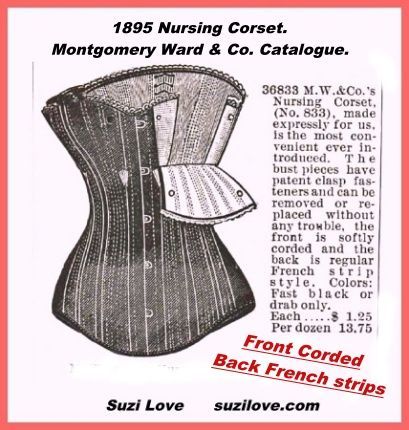
1895 Nursing Corset, French. via Montgomery Ward and co. Catalogue. Boned, soft and pliable busts, French sateen covered strips.

Definition Montgomery Ward:  World first American mail order business and later a department store chain that operated between 1872 and 2001. 

Corsets 1880-1900 History Notes Book 20 This book shows how a fashionable silhouette became of paramount importance and how a well-fitted corset became a fashion essential. As well as a decorative fashion item,  tight lacing gave a narrow waist and the desired feminine form under clothing. https://books2read.com/SuziLoveCorsetBook20

corset_1895-Nursing-Corset.Montgomery-Ward-Co.-Catalogue.-Front-Corded-Back-French-Strips.
1895-Nursing-Corset.Montgomery-Ward-Co.-Catalogue.-Front-Corded-Back-French-Strips.
HN _20_D2D_Corsets 1880-1900
HN_20_D2D_Corsets 1880-1900 History Notes Book 20 https://books2read.com/SuziLoveCorsetBook20
Posted in 1800s, 1800s women's fashion, Suzi Love Images, underclothing, Victorian Era | Tagged 1800s women's fashion, Corset, France, underclothing, USA, Victorian Era, Victorian fashion

1840 ca. Silver sewing chatelaine, Russian. #VictorianEra #Russia #Chatelaine

Suzi Love Posted on July 16, 2025 by Suzi LoveJune 18, 2025

1840 ca. Silver sewing chatelaine, Russian. With tiny coin purse, scissors, writing and sewing tools.

Definition

  • The word Chatelaine is French and means the keeper of the keys
  • Chatelaine” derives from the Latin word for castle
  • In Medieval times, the chatelaine was in charge of the day-to-day running of the castle.

What did a chatelaine do?

  • Most important task was keeper of the keys.
  • Also ordered supplies, did bookkeeping, supervised servants, taught castle children, and organized guests.

What were chatelaines used for?

  • Castle keepers needed keys safe, yet easily accessible.
  • By 1700’s, a metal jeweled ornament hung from pockets, attached to belts, or by hooks into skirt waistbands
  • During 1800’s, women wore large collections of tools hung from chains
  • Young girls sewed and did needlework and needed to carry sewing notions eg scissors, thimbles
  • Worn by women of all classes, from workers to nobility
  • Varied depending on class and finances.
  • Made of silver, brass, steel, leather, or fabric
  • During 19th century, fashionable dresses often had no waist and nowhere to hang chatelaines
  • Chatelaines became decorative brooches
  • Often given as a wedding present from a husband to bride
  • Later became fashion accessories
1840 ca. Silver sewing chatelaine, Russian.
D2D_RetailerBuyLink_HN_9
D2D_RetailerBuyLink_HN_9. Chatelaines and Chains History Notes Book 9 By Suzi Love. #regency Women in charge of houses wore long chains holding important household items around their waist e.g. keys, pen, notebook, sewing. books2read.com/SuziLoveChatelaines

Posted in 1800s, Box Or Container, Decorative Item, Europe, Georgian Era, household, money, Reticule or Bag, sewing, Suzi Love Images, Writing Tools | Tagged 1800s women's fashion, Book 9, chatelaines, decorative, fashion accessories, History Notes, Regency Era, Romantic Era, Suzi Love Books, Victorian Era

19th Century Silver Chatelaine With Vinaigrette, Thimble and Scissors as carried in Jane Austen’s and Bridgerton times. JaneAusten #Bridgerton #RegencyEra #France #Chatelaine

Suzi Love Posted on July 5, 2025 by Suzi LoveJune 18, 2025

19th Century Silver Chatelaine. Thimble holder, vinaigrette as a trumpet, watch case, scissors and a notebook. via auction.fr

Definition

  • The word Chatelaine is French and means the keeper of the keys
  • Chatelaine” derives from the Latin word for castle
  • In Medieval times, the chatelaine was in charge of the day-to-day running of the castle.

What did a chatelaine do?

  • Most important task was keeper of the keys.
  • Also ordered supplies, did bookkeeping, supervised servants, taught castle children, and organized guests.

What were chatelaines used for?

  • Castle keepers needed keys safe, yet easily accessible.
  • By 1700’s, a metal jeweled ornament hung from pockets, attached to belts, or by hooks into skirt waistbands
  • During 1800’s, women wore large collections of tools hung from chains
  • Young girls sewed and did needlework and needed to carry sewing notions eg scissors, thimbles
  • Worn by women of all classes, from workers to nobility
  • Varied depending on class and finances.
  • Made of silver, brass, steel, leather, or fabric
  • During 19th century, fashionable dresses often had no waist and nowhere to hang chatelaines
  • Chatelaines became decorative brooches
  • Often given as a wedding present from a husband to bride
  • Later became fashion accessories
19th Century Silver Chatelaine. Thimble holder, vinaigrette as a trumpet, watch case, scissors and a notebook. via auction.fr
D2D_RetailerBuyLink_HN_9https://www.suzilove.com/wp-admin/books2read.com/SuziLoveChatelaines
D2D_RetailerBuyLink_HN_9. Chatelaines and Chains History Notes Book 9 By Suzi Love. #regency Women in charge of houses wore long chains holding important household items around their waist e.g. keys, pen, notebook, sewing. books2read.com/SuziLoveChatelaines
Posted in 1800s, 1800s women's fashion, Box Or Container, Bridgerton, Chatelaine, Decorative Item, fashion accessories, France, household, Jane Austen, money, Regency Era, Regency Fashion, sewing, Suzi Love Images, travel, Writing Tools | Tagged 1800s women's fashion, Book 9, Bridgerton, chatelaines, decorative, fashion accessories, France, History Notes, Jane Austen, Regency Era, Romantic Era, Suzi Love Books, Victorian Era

19th Century Late. Quill Box and Writing Slope With Drawer, India. #Writing #VictorianEra #antique

Suzi Love Posted on June 25, 2025 by Suzi LoveJune 14, 2025

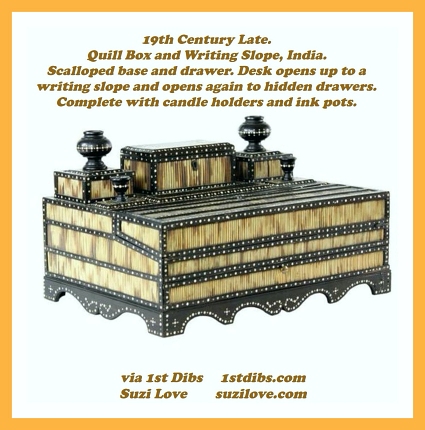
19th Century Late. Quill Box and Writing Slope, India. Scalloped base and drawer. Desk opens up to a writing slope and opens again to hidden drawers. Complete with candle holders and ink pots. The type of inkstand that households woulds have in Jane Austen’s times for writing letters and keeping track of estate matters. Many of these exotic and decorative items were brought to England by gentlemen doing their Grand Tour through Europe and Asia. via 1st Dibs Auctions ~ 1stdibs.com

19th Century Late. Quill Box and Writing Slope, India. Scalloped base and drawer. Desk opens up to a writing slope and opens again to hidden drawers. Complete with candle holders and ink pots. via suzilove.com and 1st Dibs Auctions 1stdibs.com

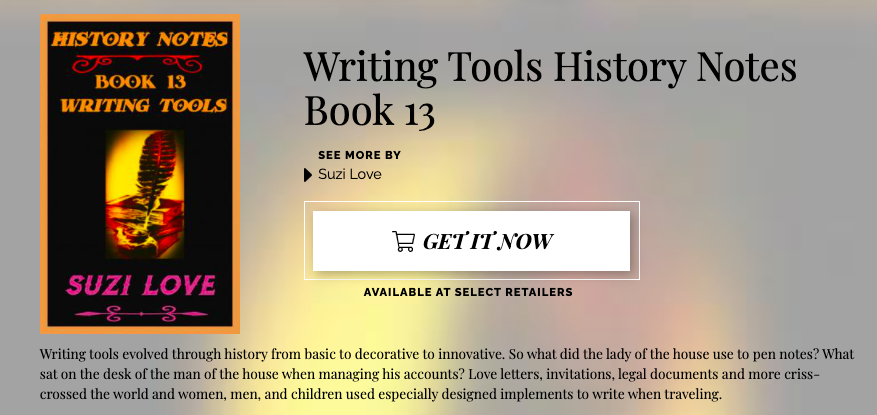
HN_13_D2D_Writing Tools books2read.com/SuziLoveWritingTools
Posted in 1800s, Box Or Container, Decorative Item, England, Europe, Grand Tour, History, household, Regency Era, Suzi Love Images, Writing Tools | Tagged 1800s Or 19th Century, 1st Dibs Auctions, antiques, Box Or Container, decorative, Grand Tour, household, Victorian Era, Writing Tools

How did people travel in Bridgerton’s and Jane Austen’s Years? What did they take to make themselves comfortable? #Bridgerton #JaneAusten #GeorgianEra #RegencyEra #VictorianEra

Suzi Love Posted on June 17, 2025 by Suzi LoveJune 14, 2025
HN_10_Travel and Luggage By Suzi Love History Notes Book 10. How did people travel in Jane Austen's times. In past centuries? What did they take with them to make their long journeys easier? Travel by road, ship, canal, or railway all took a long time and had dangers so people learned to prepare. And then, in the nineteenth century, road improvements, inventions, and scientific developments made travel more pleasurable. books2read.com/SuziLoveTravel

HN_10_D2D_RetailerBuyLink_HN_10.books2read.com/SuziLoveTravel
D2D_RetailerBuyLink_HN_10. books2read.com/SuziLoveTravel
Posted in 1700s, 1800s, Australia, Box Or Container, Carriage, cartoon, Decorative Item, Edwardian Era, England, Europe, Food and Drink, Georgian Era, Grand Tour, History, History Notes, Jane Austen, medical, Regency Era, Romantic Era, sewing, Suzi Love Books, Suzi Love Images, travel, U.S.A, Victorian Era, Writing Tools | Tagged Book 10, Box Or Container, carriages, drinks, fashion accessories, Food, Georgian era, History Notes, Jane Austen, medical, Regency Era, sewing, Suzi Love Books, travel, Victorian Era, Writing Tools

Post navigation

← Previous Post
Next Post→

SUBSCRIBE TO SUZI LOVE'S NEWSLETTER.

Recent Posts

  • 1840-1880 ca. Burgundy and White Silk Jacket, Russian. #RomanticEra #Fashion #Russia
  • 1810 Pantaloons and Double-Breasted Cutaway Coat As Worn by Gentleman in Jane Austen years. #RegencyFashion #JaneAusten #pantaloons
  • 1820 ca. High-Waisted Cream Pelisse, Or Coat, as fashionable in Bridgerton times. #Bridgerton #RegencyFashion #Pelisse #Coat
  • 1812 Man’s Overcoat With Layered Capes as worn by men of Jane Austen’s acquaintance. #RegencyFashion #JaneAusten #HistoricalFashion
  • 1816 White short length dancing dress as worn by the Bridgertons and Jane Austen. Multiple frills above hem and a black bodice. #Bridgerton #RegencyEra #JaneAusten #HistoricalFashion

Recent Comments

  1. Suzi Love on Book Hooks: Brent looked at Lillian. ‘Is she correct? You’ve been lonely.’#RegencyRomance #HistRom #ReadARegency #EroticRomance
  2. Jana Richards on Book Hooks: Brent looked at Lillian. ‘Is she correct? You’ve been lonely.’#RegencyRomance #HistRom #ReadARegency #EroticRomance
  3. Lisabet Sarai on Book Hooks: Brent looked at Lillian. ‘Is she correct? You’ve been lonely.’#RegencyRomance #HistRom #ReadARegency #EroticRomance
  4. James DiBenedetto on Book Hooks: Brent looked at Lillian. ‘Is she correct? You’ve been lonely.’#RegencyRomance #HistRom #ReadARegency #EroticRomance
  5. Suzi Love on Book Hooks: ‘Why are you eager for me to risk a repeat of my miserable marriage?’ Lady Lillian asked. #RegencyRomance #HistRom #ReadARegency #EroticRomance

Login

  • Log in

Archives

  • July 2026
  • June 2026
  • May 2026
  • April 2026
  • March 2026
  • February 2026
  • January 2026
  • December 2025
  • November 2025
  • October 2025
  • September 2025
  • August 2025
  • July 2025
  • June 2025
  • May 2025
  • April 2025
  • March 2025
  • February 2025
  • January 2025
  • December 2024
  • November 2024
  • October 2024
  • September 2024
  • August 2024
  • July 2024
  • June 2024
  • May 2024
  • April 2024
  • March 2024
  • February 2024
  • January 2024
  • November 2023
  • October 2023
  • September 2023
  • August 2023
  • July 2023
  • April 2023
  • March 2023
  • February 2023
  • June 2022
  • April 2022

Categories

  • 1700s
  • 1700s Mens fashion
  • 1700s Womens Fashion
  • 1800s
  • 1800s Mens Fashions
  • 1800s women's fashion
  • 1900s
  • art
  • Australia
  • Bath
  • bedroom fashion
  • Book Hooks
  • Box Or Container
  • Bridgerton
  • Bus Trips
  • Canada
  • Carriage
  • cartoon
  • Celebrity
  • Chatelaine
  • children
  • Children
  • Christmas
  • Coat or Pelisse Or Redingote
  • Contemporary
  • Corset
  • Couple
  • Customs & Manners
  • dancing
  • December Scandal
  • Decorative Item
  • Dress Or Robe
  • Easter
  • Edwardian Era
  • Embracing Scandal
  • England
  • Ester In Images
  • Europe
  • Events
  • Fashion
  • fashion accessories
  • Food and Drink
  • Four Times A Virgin
  • France
  • furniture
  • Georgian Era
  • Georgian Fashion
  • Google Books
  • Grand Tour
  • Group
  • hats
  • History
  • History Events
  • History Notes
  • History Of Christmases Past
  • household
  • Hygiene
  • Irresistible Aristocrats
  • Jane Austen
  • Keanu Reeves
  • Kellys Justice
  • Legal
  • London
  • Love After Waterloo
  • Loving Lady Katharine
  • medical
  • military
  • money
  • mourning
  • Music
  • Outback Arrival
  • pants
  • Pastimes
  • peerage
  • People
  • Petunia and Pearl Diver
  • Places
  • Pleasure House Ball
  • postal
  • Queensland
  • Quotations
  • Regency Era
  • Regency Fashion
  • Regency Life Series
  • Reticule or Bag
  • riding
  • Romantic Era
  • Royalty
  • Russia
  • Scandalous Siblings Series
  • Scenting Scandal
  • Self Publishing
  • sewing
  • Shirt
  • shoes
  • Shopping
  • South Pacific
  • Spencer
  • sports
  • Suit
  • Sunday Snippet
  • Suzi Love
  • Suzi Love Books
  • Suzi Love Images
  • Suzi Love Writing
  • Swain Cove
  • THe Viscount's Pleasure House
  • travel
  • U.S.A
  • underclothing
  • Vest or Waistcoat
  • Victorian Era
  • Victorian Fashion
  • weapons
  • weddings
  • Writing Tools

1800s men fashion 1800s women's fashion antiques Bridgerton British history Cartoons Corset cravat decorative Dress Or Gown England europe fashion accessories Fashion Plate France Georgian era Georgian Fashion gloves google books Hats And Hair historical romance History Notes household Jane Austen jewelry Journal des Dames et des Modes London Metropolitan Museum NYC pants Redingote Or Pelisse Or Coat Regency Era Regency Fashion Regency London reticule or bag riding sewing shawls Shoes Suzi Love Books Suzi Love Images Tailcoat The Repository Of Arts underclothing Vest or Waistcoat Writing Tools

©2026 - Suzi Love - Weaver Xtreme Theme Privacy Policy
↑