19th Century Second Half. Paper Mache Easter Egg, Russian.#Easter Resurrection of Christ, Cathedral of Christ the Savior. via Hermitage Museum, Russia. hermitagemuseum.org



19th Century Second Half. Paper Mache Easter Egg, Russian.#Easter Resurrection of Christ, Cathedral of Christ the Savior. via Hermitage Museum, Russia. hermitagemuseum.org
17th – 20th Centuries Luggage For Travel.


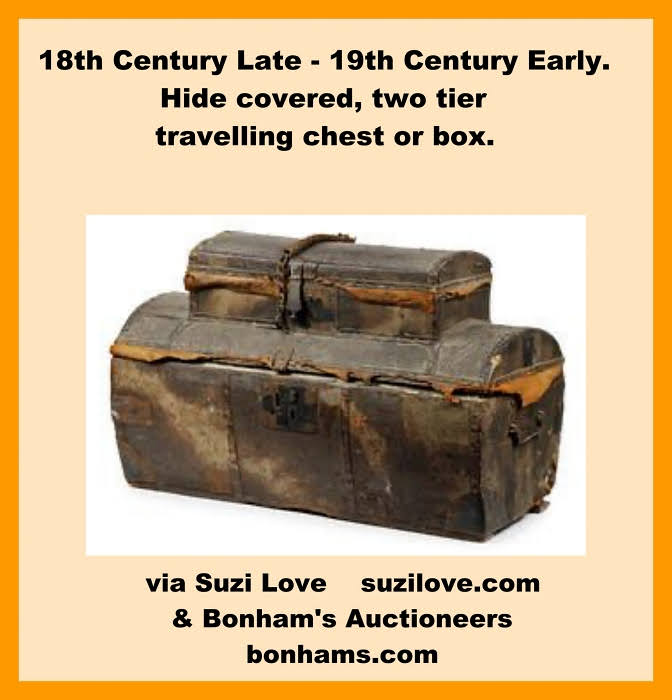


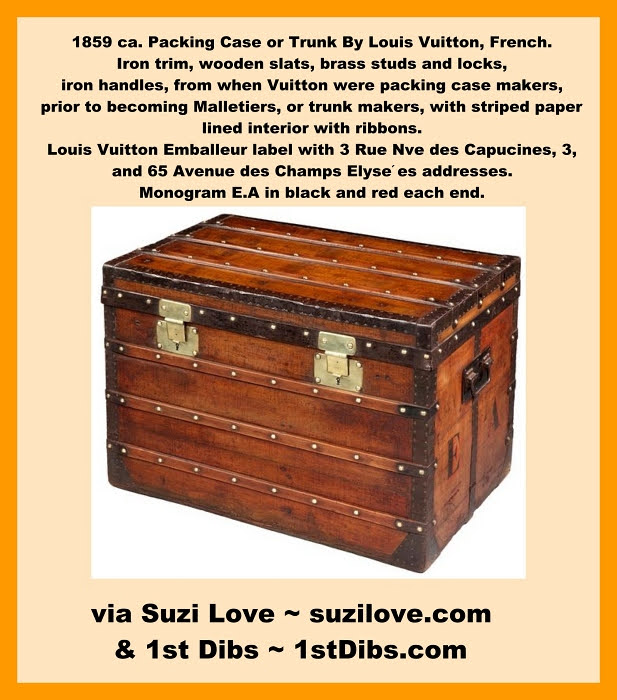


For many centuries, road travel was the main way of getting from place to place, but roads were notoriously rutted and badly maintained, especially in Britain. The Romans laid down the roads but they very poorly maintained through the 17th and 18th Centuries. It wasn’t until the 19th Century that improvements were made and rose travel opened up.
Roman Road Construction. Roman roads were constructed in layers. Rubble, slabs of stone, pebbles and gravel, smooth paving stones. Average width of road was 15 to 18 feet.

The dreadful condition of British roads caused great apprehension to all classes of travelers. Making a journey anywhere in the country was a big undertaking and often a gentleman composed his last will and testament before his departure. Traveling in vehicles was only possible during the day or on the nights with very bright moonlight with few vehicles attempting road travel in winter and any travel on a Sunday was frowned upon.
From: 1815 Journal of Tour of Great Britain by a French Tourist via Google Books (PD-180) ‘The roads very narrow, crooked, and dirty, continually up and down. The horses we get are by no means good, and draw us with difficulty at the rate of five miles an hour. We change carriages as well as horses at every post house. They are on four wheels, light and easy, and large enough for three persons. The post boy sits on a cross bar of wood between the front springs, or rather rests against it. This is safer, and more convenient both for men and horse, but does not look well and, as far as we have seen, English post horses and postillions do not seem to deserve their reputation.’
If you’ve read Jane Austen you’ll know that it was improper for a woman to travel alone, which meant that well-bred women were dependent on male relations to accompany them or else they had to take a maid in the carriage with her and be accompanied by a driver and footmen, which of course added to the cost of carriage travel. Any woman traveling by herself on a mail coach would be subject to speculation and probably malicious gossip.
Mail coaches raced across these roads trying to stick to a time table but there were numerous accidents on roads that were often flooded, covered in snow, or up such steep hills that passengers had to alight and either push the coach or walk ups the hill.

1790 Turnpike Gates In The Vicinity Of London, U.K.
Tolls were collected on many roads in Britain but, because the turnpikes were mainly on land belonging to the nobility, money collected went into their personal coffers and very little went to road maintenance. This caused a continual push in parliament to make those who owned the land and collected the money responsible for repairing their roads, but these pleas fell on deaf ears as the lords in who sat in parliament had no interest in spending money to better travel for the common people.
Description of Stage Coach Travel in England. via 1815 Journal Tour of Great Britain.
“The gentlemen-coachmen, with half-a dozen great coats about them,—immense capes,—a large nosegay at the button-hole,—high mounted on an elevated seat,—with squared elbows,—a prodigious whip, beautiful horses, four in hand, drive in a file to Salthill, a place about twenty miles from London, and return, stopping in the way at the several public-houses and gin-shops where stage-coachmen are in the habit of stopping for a dram, and for parcels and passengers on the top of the others as many as seventeen persons. These carriages are not suspended, but rest on steel springs, of a flattened oval shape, less easy than the old mode of leathern braces on springs. Some of these stage coaches carry their baggage below the level of the axletree.”

1825 Observations on the Management of Turnpikes by John Loudon Mc Adam. Via Google Books (PD-150)
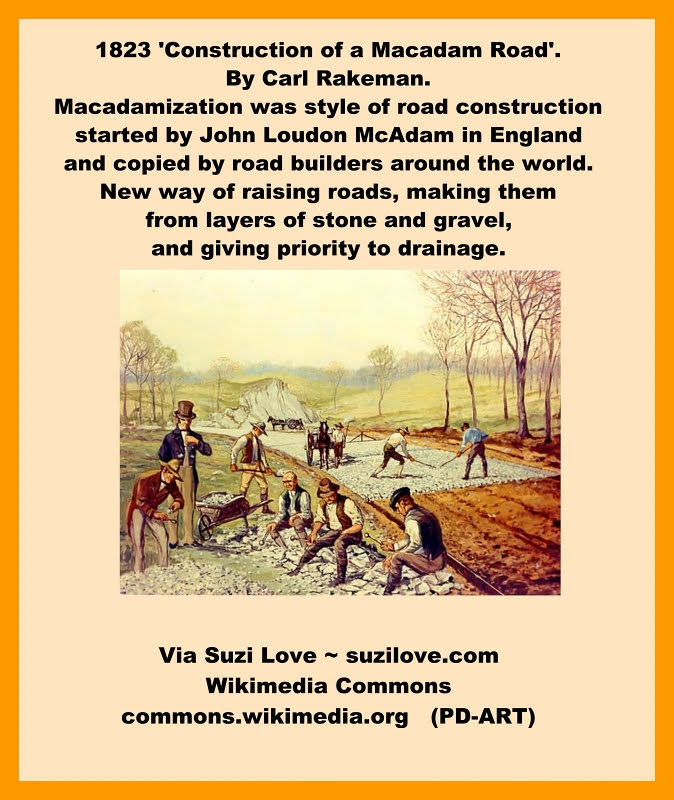
John Loudon McAdam, born Ayr, Scotland. (1756 -1836) He acted as a magistrate and assumed other civic roles including one as as trustee of the Ayrshire Turnpike in 1783, where he developed an interest in road construction and engineering, eventually becoming general surveyor for the Bristol Corporation in 1804. He wrote papers on the benefits of raising roads, making them from layers of stone and gravel, and giving priority to drainage. However, no roads were made this way until McAdam was put in charge of remaking the Bristol Turnpike in 1816, when he put his theories into practice and demonstrated macadamization, known as macadam. He made him numerous enemies on the Turnpike Trusts, who preferred to keep the money made from tolls rather than ploughing it back into road improvements but Macadam was soon in widespread use.
John Loudon McAdam (1756 – 1836), Scottish engineer and road-builder who started a new way of raising roads called ‘macadamization’. Via Wikimedia Commons.

1825 John McAdam Observation of English Roads. “In a Country like England, inhabited by an ‘ intelligent people, well educated, active, and enterprising, where every hint at improvement is eagerly caught at and prosecuted with spirit, it is only possible to account for the apathy respecting Roads, and the want of exertion in prosecuting the means given for improvement, by showing that a strong counteracting principle exists in the defects of the Road Laws, and that although much want of encouragement has arisen from the prejudices of old practitioners— the great obstacle to success remains in the zealous opposition of those who profit by mismanagement in various ways.”
McAdam Report on Bristol District Roads, March, 1815.
McAdam informed the Road Trusts that smooth roads were the most useful and lasted longer because carriages do little damage to a smooth road because the horses exert themselves less and the carriages do not rock and roll.
Unfortunately for travelers in the late 1700s and early 1800s, the smoothness of a road surface depended on the preparation and distribution of the road building materials used and was therefore entirely in the hands of each individual road-maker. In 1816, Mc Adam reported to the Bristol District the difference in revenue if roads were built of good material, regularly maintained, and if the finances of Turnpike Trusts were under someone’s control.
1823 ‘Construction of a Macadam Road’ by Carl Rakeman. Via Wikimedia Commons.
Travel on these roads was also dangerous as highwaymen stopped and robbed anyone who came along. Male or female made no difference to highwaymen in Britain, nor to the bushrangers in Australia or the gangs on American roads, as they robbed indiscriminately and often with violence.
By the end of the 18th Century, however, travel as a pleasurable pursuit came into vogue and numerous guides were written for traveling all over the British Isles as well as on the continent.
The 1812 ‘Tour Of Dr. Syntax’ was an ironic look at the new obsession of travel and travel guides. Before he set off for the Lake District, Dr. Syntax said to his wife, “You well know what my pen can do, and I’ll employ my pencil too: I’ll ride and write, and sketch and print and thus create a real mint: I’ll prose it here, I’ll verse it there and picturesque it everywhere. I’ll do what all have done before; I think I shall and somewhat more.”
Georgian and Regency travelers were envious of aristocrats, even if they were of the nobility themselves, and loved to view all the British Great Houses.
A gentleman and his wife would even drive up to the front door of a mansion house and demand to be given a tour of the house. If they weren’t admitted, they would write in their journals of the inhospitable nature of the people on a particular estate. Thomas Pennant, William Mavor, and others, loved to write about these bad experiences and have them published. Paterson’s British Itinerary, a travel guide had 17 editions between 1785-1832 – it outlined the roads used by the stage and mail coaches, the tolls, the bridges, etc.
This new touring craze created an industry of hospitality that encompassed more than simple mail coach trips from place to place, and more than a noble family traveling from their country seat to the Metropolis of London for parliamentary sittings. Inns had to improve the quality of the linens and meals if they wanted to attract the wealthier traveling class. Before that, many travelers carried their own linen, crockery, glasses, and utensils, as they didn’t trust the hygiene or standards of country inns.
Travel became something written about by poets with many sonnets written to the beauty of places like the Lake District in England, or the pyramids in Egypt. Inns became cleaner and more respectable so they could welcome travelers of the upper classes. This also meant that women could travel more as roads were slowly improved from rutted tracks that were only suitable for horse riding to roads that family coaches could travel along, though these roads were still narrow and subject to extremes of weather, such as flooding. The race was on to travel from places like London to Edinburgh in the fastest possible time.
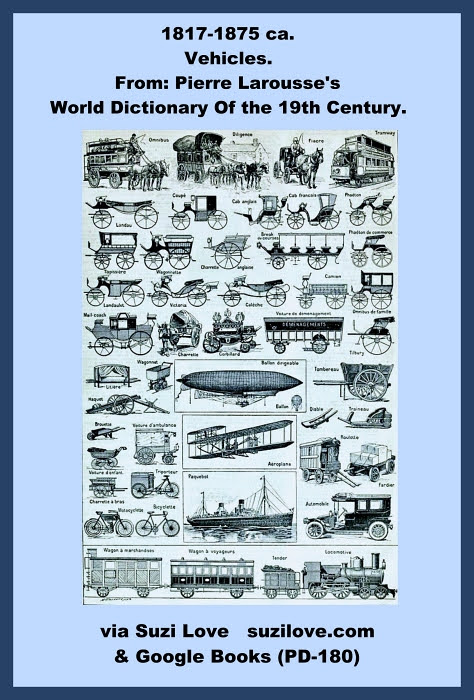
1817-1875 ca. Vehicles. From: Pierre Larousse’s World Dictionary Of the 19th Century.
1920-1922 ca. Automobiles.

1860 ca. Gilt Chatelaine With Etui. Hanging chatelaine with seven carbochons, gilt tools inside etui, or small container, of scissors, bodkin, knife, stiletto, pencil case, combination tweezers and ear spoon and ivory aid memoire, or notepad. via Needle’s Work Antiques. needleworkantiques.com
Definition Chatelaine: The word Chatelaine is French and means the keeper of the keys. Chatelaine” derives from the Latin word for castle. In Medieval times, the chatelaine was in charge of the day-to-day running of the castle. Women in charge of households dangled long chains from their waists to keep essentials within easy reach e.g. keys, notebook and pen, watch, sewing items, vinaigrette or perfume, or magnifying glass. Early chatelaine were simple essentials. Later chatelaine were decorative and expensive. books2read.com/SuziLoveChatelaines


In Jane Austen’s times craftsmen created boxes and containers of precious metals, leather, silks, and decorated them with jewels. Boxes, Cases, Etui, Necessaire and everything else that was used to carry essential items for travel, sewing, medicine, writing, and toiletries. Containers were engraved to make exquisite and expensive items as well as practical carrying cases. books2read.com/suziloveBoxesCases


1880 ca. Travelling Inkwell, English. Red Leather and Heart Shaped. via Ruby Lane Antiques. rubylane.com


1887 Front View. Wedding Corset, American. Cotton twill, silk thread embroidery. Fully boned wedding corset with front hooks and back lacing. Every boning channel is flossed top and bottom. Via Chicago History Museum, U.S.A. digitalcollection.chicagohistory.org https://books2read.com/SuziLoveCorsetBook20



19th Century Late Mechanical Tantalus, French. Ormolu, Bronze, Crystal, and Gilt with a lock and key to open. Earlier versions of this type of small drinks cabinet would have been used in most households during Jane Austen’s times, unless the householders were teetotalers. via 1st Dibs Auctions 1stdibs.com
Tantalus: A small wooden cabinet containing drink decanters. The box has a lock and key to keep unauthorised people from drinking the contents e.g. servants and younger sons, yet still allowing the decanters of drinks to be on show. The word, Tantalus, is a reference to the unsatisfied temptations of the Greek mythological character Tantalus. Patented in the UK in 1881 by George Betjemann, a cabinet maker from the Netherlands, whose workshop was on Pentonville Road, London from the 1830s.

From 1850 Hints To Horsekeepers By Henry William Herbert via Google Books (PD150)
Why Every Lady should learn to ride: EVERY lady should learn to ride; not at a mature age, when her frame has become exhausted by a sedentary life and consequent ill health; nor even when, her school-days being over, she is thought to have leisure for wholesome exercise; but in childhood, when her will is strong and her body obedient to it. Particularly in our large cities, too little care is given to the physical culture of young girls. Their minds are engaged, not often with energetic mental work, but with idle thought for dress and show, while no other exercise is taken than a measured daily walk, and occasional dancing and waltzing.
‘Where household labor is disdained, and no opportunity can be afforded for floriculture or any other agreeable out-door occupation, there is no substitute so good as horseback riding. But for the country girl it becomes indispensable. Not her health, perhaps, but her happiness demands it. No woman ever rides so well as one who from childhood has loved her pet colt. She has chased him, perhaps, for hours around a ‘ten-acre lot:’ and when, his frisky mood over, she has been able to take him coaxingly by the inane and lead him to a mounting place, great was the triumph of her wild ride. And no training or care can give the freedom and skill of this youthful practise.
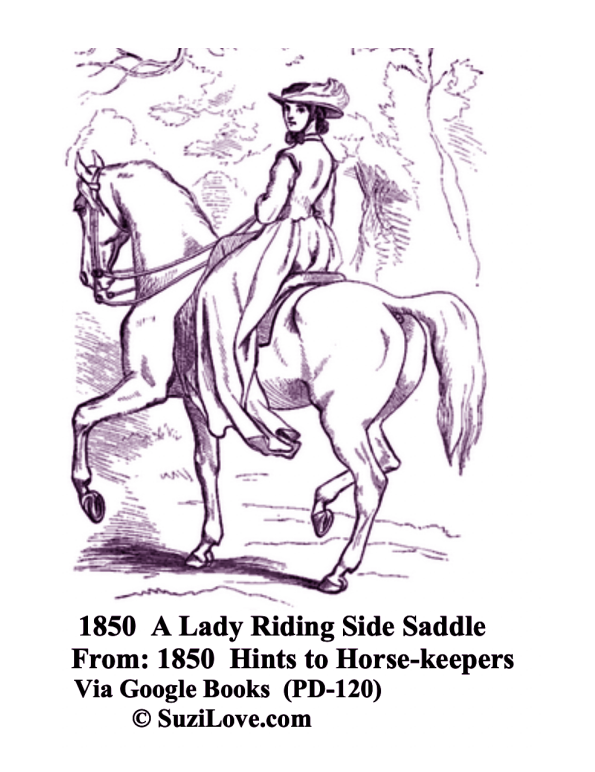
RIDING CLOTHING
Few ladies know how to dress for horse exercise. A head dress should shade form the sun but fit well enough that it needs no adjustment, as the hands are needed for the reins. The Whip, an essential element of the lady’s riding outfit, should be stiff and substantial, without being heavy.
The hair should be arranged in the firmest manner possible. If suited to the style of the lady, it may be plaited at the back and looped across, in a manner which will support the hat and present a very comely appearance. Or it may be found pleasanter to turn all of the back hair to the top of the head, where a high hat is used. All loose arrangements of the hair, except short curb, when they are natural, should be avoided. But few hair-pins should be used, and those long and firmly woven into the hair. The recent fashions of wearing the plumes or feathers of the ostrich, the cock, the pheasant, the peacock, and the kingfisher, in the riding hats of young ladies, are highly to be commended.
Ladies habits are usually made too long and become cumbersome. A foot longer than an ordinary skirt will be sufficient if the material is suitable. Light Cloth will be found the most appropriate for the skirt, if the color be becoming and sufficiently dark. The fashion of a waistcoat of light material for summer, revived from the fashion of the last century, is a decided improvement, and so is the over-jacket, of cloth or seal-skin, for rough weather. It is the duty of every woman to dress in as becoming and attractive a manner as possible; there is no reason why pretty young girls should not indulge in picturesque riding costume so long as it is appropriate.
Many ladies entirely spoil the set of the skirts by retaining the usual impedimenta of petticoats. The best dressed horsewomen wear nothing more than a flannel chemise with long, colored sleeves, under their trousers. If ladies prefer, a quilted skirt, not too full, may be worn. It should be lined with silk or glazed muslin, and will be found no impediment. Long boots are a great comfort and protection in riding long distances.
All ladies who desire that riding should be to them a healthful exercise, must take great care that their dress be perfectly easy in every part, particularly over the chest and around the ribs. Let the boots be easy, and their gloves, which should be leather gauntlets, large and soft, and all elastic bands very loose.
Ladies’ trousers should be of the same material and color as the habit, and if full, flowing like a Turk’s and fastened with an elastic band round the ankle, they will not be distinguished from the skirt. In this costume, which may be made amply warm by the folds of the trousers, plaited like a highlander’s kilt, fastened with an elastic band at the waist, a lady can sit down in a manner impossible for one encumbered by two or three short petticoats. It is the chest and back which require double folds of protection during, and after, strong exercise.
LADY MOUNTING A HORSE
The lady in mounting should be assisted by two persons, one to hold the horse, standing directly in front of him, and holding by the check pieces of the bridle, above the bit, and the other to assist her to her seat.
Having taken the reins and whip in the right hand, she will stand with her face towards the horse’s head, and with her right hand on the left pommel or the saddle. In the left hand she will hold her skirt, in such a manner as to enable her to raise it clear of the ground. The gentleman will stand, facing her, and opposite to the horse’s shoulder, with his left hand holding by his mane, this steadies the horse when the lady springs. The gentleman will now stoop and take the lady’s left foot, which has been raised fifteen inches from the ground, in his right hand, clasping it firmly under the instep. The skirt having been raised to clear the foot, is now dropped, and the lady places her left hand on the gentleman’s right shoulder, giving a spring to straighten the left knee.
During this spring the gentleman will simply keep his hand still, supporting the lady’s weight, but not raising her until the knee is fairly straightened, when he may lift her to the required height, but without trying to push her over on to the saddle. She will find her seat more easily without such assistance, which would often tend to throw her over the horse, rather than on his back. Being seated with her right hand still on the pommel, the lady will, with her left hand, adjust the folds of her skirt. She will then remove her hand from the pommel, and place her right knee over it; when the gentleman will place her foot in the stirrup, and then aid her in taking proper hold of the reins and whip. When this is accomplished, the attendant at the horse’s head steps out of the way, and the lady assumes the control. Fortunately, the operation is less tedious than its description.
A lady dismounts with perfect ease. After the groom has taken his place in front of the horse and secured him, by releasing her hold upon the bridle and stirrup and lifting her right leg over the pommel, which she now holds with the right hand, while the left, on the shoulder, or in the hand of her gallant, affords her sufficient support in slipping to the ground.
THE SEAT IN THE SIDESADDLE.
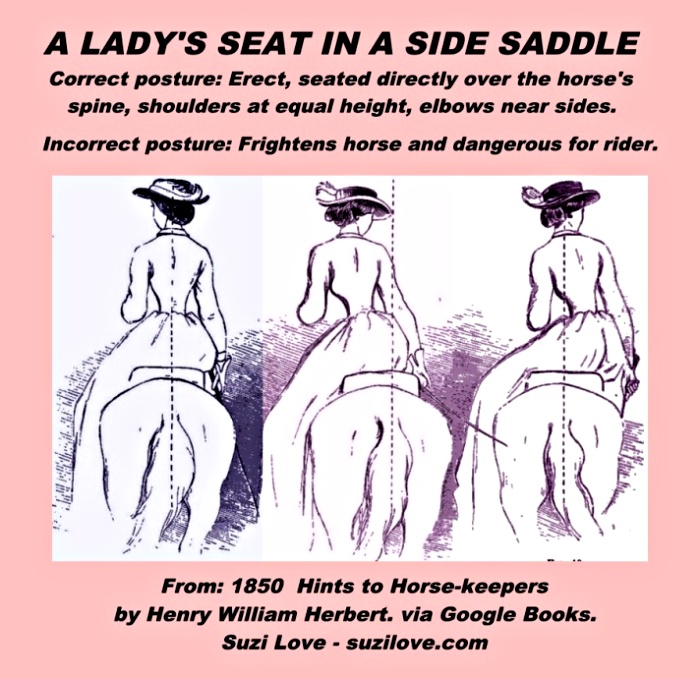
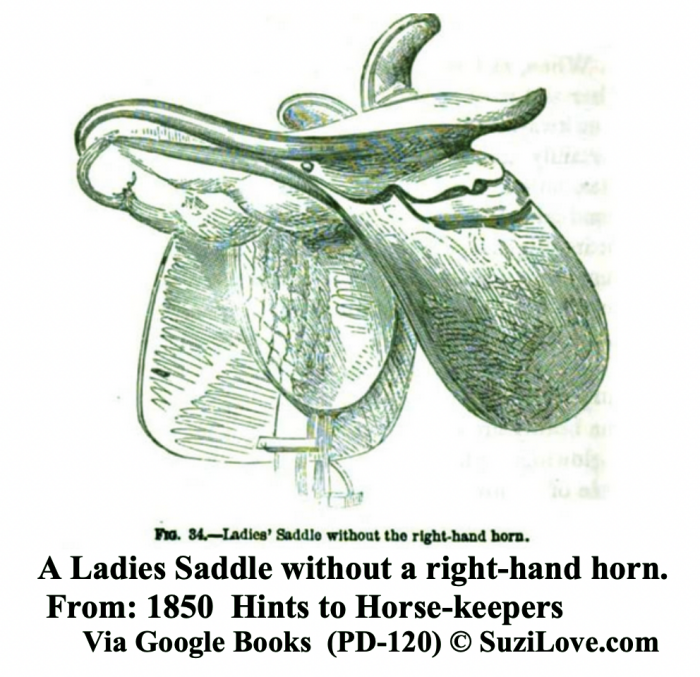
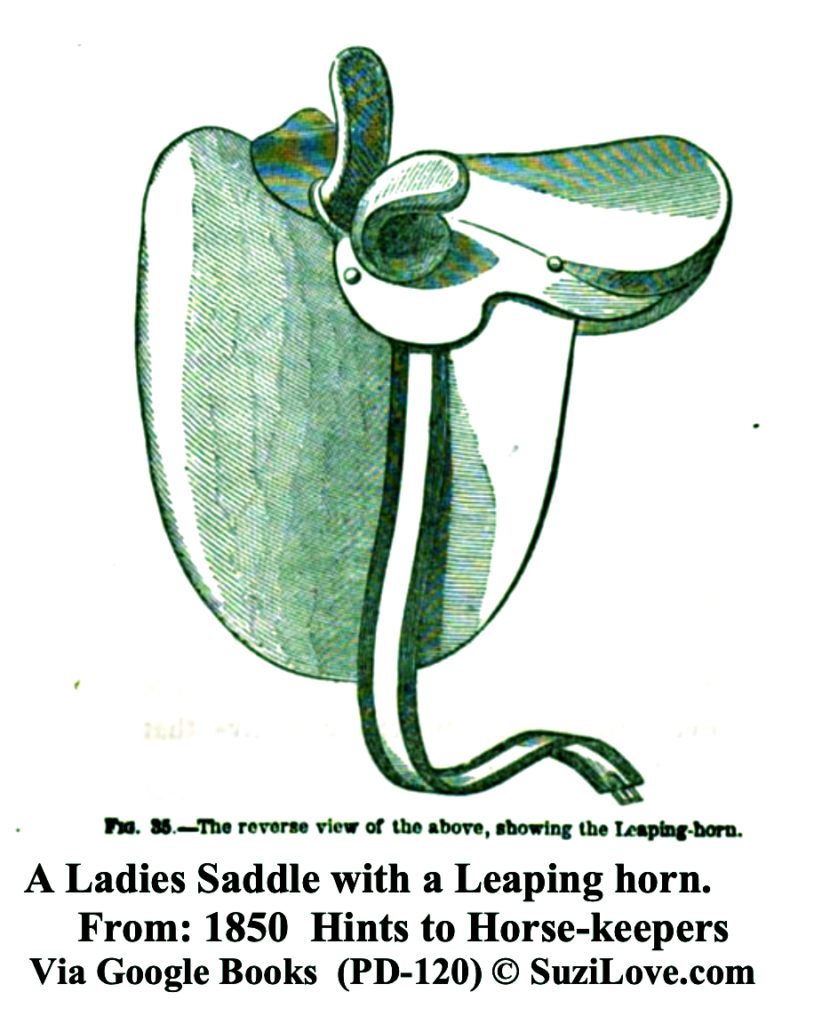
The lady should, by exercises similar to those recommended for gentlemen, endeavor to acquire a perfect independence of the rein-hold in the security of her seat She should be able to lean far to the right or to the left, or lie back on the horse’s haunches, or forward on his neck, and to regain her position without disturbing her seat in the saddle, and without holding by the reins. With the use of the leaping-horn it will be more easy for her to attain perfection, in this respect, than it will be for the man, who must depend in a great measure on the clip of his legs. The rider should be erect, directly over the horse’s spine, the shoulders at an equal height. and the elbows near the sides.
Ladies, particularly those with very small hands, will often find it burdensome to hold their reins both in one hand, as is universally taught in our riding-schools. The best way for a lady is, if her hand be light, to knot up the snaffle and let it rest within her reach, in case of accident to the other rein. Or, if her touch be not delicate enough for the curb, let her hold it lightly and depend on the snaffle. The Whip and the Left Heel are valuable aids to a lady in the saddle. By a proper use of them she is enabled to retain a much freer hold upon her reins. Particularly in stopping and turning they are invaluable. Also, in starting.
ACCIDENTS.
Ladies, of course, should never ride horses which are in any manner vicious. But the best animals are not faultless, nor the most sure-footed always reliable. The lady should therefore be prepared for critical situations. Remember that with a long skirt about her feet, and with little experience in such exercise, it is always unsafe for lady to leap from her saddle. She may disengage herself quickly, but carefully. In a runaway, her place is close down in the saddle, holding the four reins low on either side, and giving an alternate tension to the curb and snaffle, steadying her horse in the road and saving her strength to force him to run long after he would gladly stop.

Have you read Suzi Love’s Books? Romance, Mystery, Military and History. Regency, historical and contemporary romance. Plus non-fiction history and writing.

The Viscount’s Pleasure House Book 1 Irresistible Aristocrats Disenchanted Viscount tutoring three Regency Ladies. What could go wrong? #Regency Erotic https://books2read.com/suziloveTVPH
Four Times A Virgin Book 2 Irresistible Aristocrats: The countess will do anything to prevent her younger sisters being forced into sordid marriages like hers, even if it means joining forces with the Duke of Stirkton and revealing the horrors of their intertwined pasts. books2read.com/suziloveFTAV
Pleasure House Ball Book 3 Irresistible Aristocrats: Lord Mallory attends his first courtesan’s ball in ten years to appease his concerned friends, though he’d rather stay home and read to his motherless daughters. Though mortified that Brenton unmasks her at a scandalous ball, Lady Lillian Armstrong doesn’t regret their night together. books2read.com/suzilovePHB
Petunia and the Pearl Diver Book 4 Irresistible Aristocrats Series: The pearl diver needs a working girl to rouse his body. Petunia needs money to save her family. A night at a London brothel could be the solution to both problems. But walking away is impossible when one night leaves them craving more…and more. https://books2read.com/suzilovePetPD
Loving Lady Katharine Book 5 Irresistible Atistocrats: When Lady Katharine Montgomery flees London after her scandalous husband was murdered, the Pacific islands of the New Hebrides (Vanuatu) become her haven. Her life changes when Lord Alexander St. John, British ship’s captain and trader, sails into Port Vila. https://books2read.com/suzi
Embracing Scandal Book 1 Scandalous Siblings: Lady Rebecca Jamison saves her family from financial ruin by investing in railways, but when a greedy syndicate murders her friend, Becca is forced to beg assistance from Cayle St. Martin, the new Duke of Sherwyn. https://books2read.com/suziloveES
Scenting Scandal Book 2 Scandalous Siblings Series: Richard, Earl of Winchester, may not know it yet, but he’s Lady Laura Jamison’s perfect match. Lady Laura Jamison believes her extraordinary olfactory senses will sniff out her perfect match, but will Richard prove her theory wrong? https://books2read.com/suziloveSS
December Scandal Book 3 Scandalous Siblings: The Jamison family joins the Duke of Sherwyn and the St. Martin clan at the duke’s country estate, but guest numbers double when early December snowfalls make roads impassable. #HistoricalRomance https://books2read.com/suziloveDS
Love After Waterloo: When Lady Melton and son join antagonistic Captain Belling and the last group of wounded British soldiers evacuating Waterloo, she anticipates hardship and trouble with deserters. Not her relationship with a belligerent Captain. #RegencyRomance #military books2read.com/suziloveLAW
Self Publishing: Absolute Beginner’s Guide.
Information, contacts, and checklists steer you towards professionally produced books. Helps both fiction and non-fiction authors and available in digital and paperback.
Co-Authored by two Australians: multi-published Imogene Nix and best-selling and award winning Suzi Love. http://books2read.com/selfpublishing
History Notes Books 1-28: Do you need more factual and visual information for your historical fiction? Non-fiction Series: Fashion, music and social manners in the 18th and 19th centuries books2read.com/suziloveFashWomen1700s
Regency Life Series Books 1-5: Historic images, historical information, and funny anecdotes give an overview of life in the early 1800s, or the Jane Austen and Bridgerton years. Information for history buffs and pictures to help readers and writers of historical fiction visualize the people and places of the long Regency period. https://books2read.com/suziloveROver
books2read.com/suziloveROver books2read.com/suziloveYGD books2read.com/suziloveOGD
