Want To Know More About Georgian Era Men’s Fashions? Try History Notes Book 2 By Suzi Love. Fashion Men 1700s Late. books2read.com/suziloveFashMen1700 What was fashionable for men in the late 1700s? Extravagant colors and fabrics and outrageous styles. Take a look at their suits, hats, accessories and bedroom fashions.
What was fashionable for men in the late 1700s? Extravagant colors and fabrics and outrageous styles. Take a look at their suits, hats, accessories and bedroom fashions. Strictly speaking, the Georgian Era might include all the years that a ‘King George’ ruled in England, but for the purposes of this book the ‘Georgian Era’ is primarily the late 1700s when mad King George III ruled. His son became Prince Regent in the early 1800s, therefore creating the years known as the Regency, and became George IV on the death of his father.
The Georgian years officially ended with the death of King George IV in 1830.
George I ruled 1714-1727
George II ruled 1727-1760
George III ruled 1760-1820
George IV ruled 1820-1830
HN_2_D2D_Fashion Men 1700s
books2read.com/suziloveFashMen1700
1771 Tattersall’s Horse Training School, London, U.K. via Yale Center for British Art, Paul Mellon Collection.
Tattersall’s was founded in 1766 by Richard Tattersall (1724–1795), the Duke Of Kingston’s stud groom in premises near Hyde Park Corner, London. Two Subscription rooms were designated for members of the Jockey Club and became a meeting place for sporting and betting men. ‘Old Tatt’ conducted sales for the Duke of Kingston’s stud in 1774 and the Prince of Wales, or Prinny, in 1786. The prince often visited Richard Tattersall who was succeeded by his son, Edmund Tattersall (1758–1810), who extended the business to France.
1771 Tattersall’s Horse Training School, London, U.K.. Yale Center for British Art, Paul Mellon CollectionHN_2_D2D_Fashion Men 1700s
books2read.com/suziloveFashMen1700
1810 Stockdale’s Peerage King George William Frederick III. From Stockdale’s Peerage of England, Scotland and Wales. Containing an Account of All the Peers of the United Kingdom . via Google Books Printed for John Stockdale, Piccadilly, London, U.K.
1804 King George III. via Kearsley’s Complete Peerage. Google Books (PD-180)
Our present Most Gracious Sovereign, was born May 24, 1738 and baptized June, 1738, at Norfolk House. Succeeded his father in the titles of Prince of Great Britain, Electoral Prince of Brunswick-Lunenburg, Duke of Edinburgh, Marquis of the Isle of Ely, Earl of Carrick and Eltham, Viscount Launceston, Baron of Renfrew and Snowdon, Lord of the Isles, and Steward of Scotland ; but the Duchy ot Cornwall was merged in the crown. He was, by letters patent, April zr, 1751, created Prince of Wales ; and on the death of his royal grandfather, George II. the crown of Great Britain devolved on his Royal Highness, Oct. z$, 1760, and he was proclaimed the next day with the usual solemnities. His Majesty married, Sept. 8, 1 76 1 , Sophia-Charlotte, Princess of Mecklenburg-Strelit, sister to the present and late Duke, and their Majesties were crowned the 22d of the same month.
By his royal Consort, who was born May 19, 174.4, his Majesty has issue :
1. GEORGE- AUGUSTUS- FREDERICK, Prince of Wales. See Prince of Wales.
2. Frederick, Bishop of Osnaburg, Duke of York ; see Duke of York.
3. William-Henry, Duke of Clarence; see Duke of Clarence,
4. Charlotte-Augusta- Matilda, born Sept. 29, 1766, Lady of the Russian Imperial Order of St. Catherine ; married, May 18, 1797, Frederick-Charles-William, King of Wirtemburg, brother to the Empress of Russia, and relict of the eldest daughter of the Duke of Brunswick, by Augusta, his Majesty King George the third’s eldest sister.
5. Edward, Duke of Kent and Strathern; see Duke of Kent.
6. Sophia-Augusta, born Nov. 8, 1768.
7. Elizabeth, born May 22, 1770.
8. Ernest-Augustus, Duke of Cumberland ; see Duke of Cumberland.
9. Augustus-Frederick, Duke of Sussex ; see Duke of Sussex.
10. Adolphus-Frederick, Duke of Cambridge; sec Duke of Cambridge.
11. Mary, born April 25, 177*.
I2. Sophia, born Nov. 3, 1777. 1
13. Octavius, born Feb. 23, 1779, and died May 3, 1783.
14 Alfred, born Sept 22, 1780, and died Aug. zo, 1782. .
15. Amelia, born Aug. 7, 1783.
PRINCE OF WALES.
GEORGE- AUGUSTUS -FREDERICK, Prince of Great Britain, Prince of Wales, Electoral Prince of Brunswick- Lunenburg, Duke of Cornwall and Rothesay, Earl of Chester and Carrick, Baron of Renfrew, Lord of the Isles, Hereditary Great Steward of Scotland, a Colonel in the Army, and Colonel ef the 10th Regiment of Light Dragoons, Captain-General of the Royal Artillery Company, High Steward o! Plymouth, Knight of the Garter, and F. R. S. Born Aug. 12,1762; and, on the 17th of the same month, his Majesty ordered letters patent for creating him Prince of Wales and Earl of Chester ; and Nov. 1783, his Royal Highness took his seat in the House of Peers ; in 1765, elected a Knight Companion of the Most Noble Order of the Garter, and installed at Windsor, July 25, 1771. Married, April 8, 1795, Caroline-Amelia- Elizabeth, second daughter of the late Duke of Brunswick (born May 17, 1768), by whom he has a daughter, Charlotte-Caroline-Augusta- born Jan 7, 1796. Edward, the Black Prince, was the first Duke of Cornwall, created 1337, in perpetuity to his heirs; by virtue of which the eldest son of the King of England is Duke of Cornwall. The Earldom of Chester is by creation by letters patent 3 1 Henry III. 1247, and has been invariably annexed to the eldest son of the King of England. The titles of Hereditary Steward of Scotland, Duke of Rothesay, Earl of Carrick, and Baron of Renfrew, were titles annexed by B’ belt III. King of Scotland, 1399, to the eldest to the eldest Prince of Scotland, on his birth, and have continued from that period. The title of Prince of Wales was first conferred on the infant son of Edward I 1284, and has never been bestowed but on the heir to the Throne.
DUKE OF YORK. PRINCE FREDERICK, Duka of YORK and ALBANY in Great Britain, and Earl of Ulster in Ireland, Bishop of Osnaburg, Knight of the Garter and Bath, D. C L. F. R. S. and a Field-Marshal, Colonel of trie First Regiment of Foot Guards, Colonel in Chief of the sixtieth (or. Royal American) Regiment of Foot, and of the Royal Dublin Regiment of in.fantiry, Lord Warden of Windsor Forest and Great Park, and Warden and Keeper of the New Forest, Hampshire ; second son of his Majesty. Born Aug. 16, 1763. Created as above Nov. 27, 1784. Married, Sept. 29, 1791, Frederica Charlotte- Ulrica-Catharina, Princess Royal of Prussia (born May 7, 1767), eldest daughter to the late King of Prussia, by his first consort, Elizabeth-Ulrica-Christiana, Princess of Brunswick- Wolfen- buttel, sister to the late Duke.
DUKE OF CLARENCE: PRINCE-WILLIAM-HENRY, Duke of CLARENCE and x ST. ANDREWS in Great Britain, and Earl of Munster in Ireland, Knight of the Garter and Thistle, Admiral of the Red, and Ranger of Bushy Park ; third son of his Majesty. Born Aug. 21, 1765. Created as above, May 16, 1785.
DUKE OF KENT: PRINCE EDWARD, Duke of KENT and STRATHERN Great Britain, Earl of Dublin in Ireland, fourth son of his Majesty, Knight of the Garter and of St. Patrick, Field-Marshal of the Forces, Governor of Gibraltar, Colonel of the First Regiment of Foot, Keeper and Paler 0/ Hampton Court Park. Born Nov. 2, 1767. Created as above, April 23, 1790. Arms.
DUKE OF CUMBERLAND. PRINCE ERNEST-AUGUSTUS, Duke of CUMBERLAND and TlVIOTDALE in Great Britain, Earl of Armagh in Ireland, fifth son of his Majesty, a Knight of the Garter, and D. C. L. Chancellor of the University of Dublin, a General in the Army, and Colonel of the 15th Regiment of Dragoons. Born June 5, 1771. Created as above, April 43, 1799. Arms.
DUKE OF SUSSEX: PRINCE AUGUSTUS-FREDERICK, Duke of SUSSEX, Earl of Inverness in North Britain, Baron Arklow in Ireland, Knight of the Garter. Born Jan. 27, 1773, sixth son of his Majesty. Created as above, Nov. 7, 1801. His Royal Highness married, April 3, 1793, Augusta Murray, second daughter of John Earl of Dunmore, by whom he had Augustus-Frederick, born Jan. 13, 1794; and was re-married Dec 5, 1793, at St. George’s church, Hanover Square, London. This marriage was declared null and void, being in violation of stat. 12 Geo. III. c. 11. which enacts that no descendant of the body of King George II. (other than the issue of princesses married into foreign countries) is capable of contracting. matrimony without the previous consent of the King, signified under the great seal ; and any marriage contracted without such consent is void. And the marriage was accordingly dissolved in August 1794. Arms. — See plate 3.
DUKE OF CAMBRIDGE. PRINCE ADOLPHUS- FREDERICK, Duke of CAMBRIDGE, Earl of Tipperary in Ireland, and Baron of Culloden in North Britain, seventh son of his Majesty. Born Feb. 24, 1 774. Knight of the Garter, a General in the Army, Colonel of the id or Coldstream Regiment of Foot Guards. Created as above, Nov. 27, 1801.
DUKE OF GLOUCESTER: PRINCE WILLIAM-FREDERICK, DUKE of GLOUCESTER and EDINBURGH in Great Britain, Earl of Connaught in Ireland, Knight of the Garter, a General in the Army, Colonel of the third- Regiment of Foot Guards, and Ranger of Bagshot Park and Walk. Born at Rome, Jan.-J5, 1776. Succeeded his father, Prince William-Henry, the, late Duke, Aug. 25,. 1805. His Royal Highness’s father, Prince William-Henry, Duke of Gloucester, was third son of his Royal Highness Frederick- Lewis, Prince of Wales, and brother to his Majesty ; born, Nov. 25, 1743, and by patent Nov. 14, 1764, created Duke of Gloucester and Edinburgh in Great Britain, Earl 0/ Connaught In Ireland, Knight of the Garter, Senior Field-Marshal of his Majesty’s Forces, Colonel of the first Regiment of Foot Guards, Chancellor of the University of Dublin, Ranger and Keeper of Cranbourne Chase, Ranger of Hampton Court Park, Lord Warden and Keeper of the New Forest, Hampshire. His Royal Highness married, Sept. 6, 1766, Maria, Countess Dowager of Waldegrave, widow of James, second Earl of Waldegrave, and daughter of Sir Edward Walpole, Knight of the Bath, and by her (who died Aug. 23, 1807) had issue: (• Sophia-Matilda, born May 29, 1773-; 2. Caroline- Augusta- Maria, born June 24, 1774, died March 14, 1775; 3.Wil liam-Frederick, the present Duke. His Royal Highness died Aug. 25, 1805, and was succeeded by his only son, Prince William-Frederick, the present and second Duke. Anms.
The King’s sons, brothers, uncles, and nephews are Styled Princes of the Blood Royal, and have precedency of all other Dukes, with the title of Royal Highness.
1880 ca. Travelling Inkwell, English. Red Leather and Heart Shaped. via Ruby Lane Antiques. rubylane.com
HN_13_D2D_WritingTools Book 13 What did the lady of the house use to pen notes? What sat on the desk of the man of the house when managing his accounts? #History #Nonfiction #travel books2read.com/SuziLoveWritingTools
Do you need more factual and visual information for your historical fiction? Try History Notes Books 1-28. Non-fiction Series: Fashion, corsets, Regency Era, music and social manners in the 18th and 19th centuries e.g.
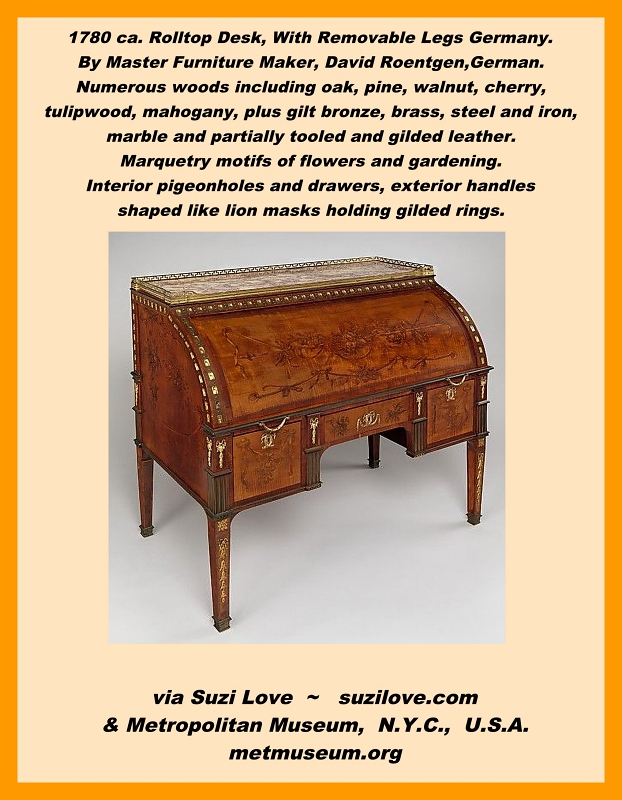
1780 Rolltop Desk, With Removable Legs Germany. By Master Furniture Maker, David Roentgen,German. Numerous woods including oak, pine, walnut, cherry, tulipwood, mahogany, plus gilt bronze, brass, steel and iron, marble and partially tooled and gilded leather. Marquetry motifs of flowers and gardening. Interior pigeonholes and drawers, exterior handles shaped like lion masks holding gilded rings. via Metropolitan Museum, N.Y.C., U.S.A. metmuseum.org
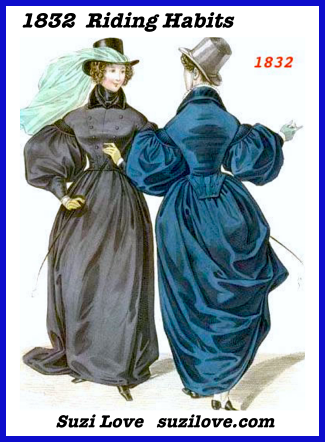
1832 Ladies Riding Habits. Grey and Blue with Bouffant, or puffed, sleeves and matching hats. via La Mode.
Definition Bouffant: Type of sleeve that fits close to the body at the shoulder and the lower edge and is wider in the middle, forming a round shape. Popular in the Romantic Era, or from 1815-1840 ca.
1840 ca. The York To London Royal Mail. By A. Anson Martin. Mailcoach in the village of Bedale, Yorkshire, U.K. Church at the end of the wide country road and thatched cottages behind the coach. Signed and Inscribed ‘(All Right)’. Via British Postal Museum, London, U.K. ~ postal museum.org
The dreadful condition of British roads caused great apprehension to all classes of travelers. Making a journey anywhere in the country was a big undertaking and often a gentleman composed his last will and testament before his departure. Traveling in vehicles was only possible during the day or on the nights with very bright moonlight with few vehicles attempting road travel in winter and any travel on a Sunday was frowned upon. books2read.com/SuziLoveTravel
Description of Stage Coach Travel in England. via 1815 Journal Tour of Great Britain. “The gentlemen coachmen, with half-a dozen great coats about them, immense capes, a large nosegay at the button-hole, high mounted on an elevated seat, with squared elbows, a prodigious whip, beautiful horses, four in hand, drive in a file to Salthill, a place about twenty miles from London, and return, stopping in the way at the several public-houses and gin-shops where stage-coachmen are in the habit of stopping for a dram, and for parcels and passengers on the top of the others as many as seventeen persons. These carriages are not suspended, but rest on steel springs, of a flattened oval shape, less easy than the old mode of leathern braces on springs. Some of these stage coaches carry their baggage below the level of the axletree.”
HN_10_D2D_RetailerBuyLink_Travel and Luggage By Suzi Love History Notes Book 10 #History #travel How did people travel in past centuries? What did they take with them to make their long journeys easier? books2read.com/SuziLoveTravel
1810-1820 ca. Double Breasted Red Hunting Coat, English.
1810-1820 ca. Red Hunting Coat, English. Hunting was both a popular sport and an essential part of social success. Double-breasted tailcoat of woolen superfine, lined with sateen and cotton, M-notch lapels, nine gold buttons with heraldic crest, cuffs with three smaller matching buttons. via Collection from Castle Howard, Yorkshire, U.K. Victoria and Albert Museum, London, UK. Hunting coats, or colors, often red coats called pinks, were worn by hunt masters and hunters. In Bridgerton and Jane Austen times, or the early 1800s, gentlemen wore red coats like this while riding to the hounds.
Historically, hunt members wore ‘colors’ to distinguish between types of hunters and their level of experience. Traditional red coats were worn by huntsmen, masters, former masters, whippers-in, regardless of sex, while other hunt staff members and male members invited by masters wore colors and hunt buttons as a mark of appreciation for their involvement in the organization and running of the hunt. After the Hunting Act in England and Wales, only Masters and Hunt Servants wore red coats or hunt livery. Gentleman subscribers usually wore black coats, with or without hunt buttons and in some countries, women wore colored collars on their black or navy coats to help them stand out from the rest of the field. Some hunts, including most harrier and beagle packs, wear green rather than red jackets, and some hunts wear other colors such as mustard.