14th Century Man’s Purse. Stitched and embossed leather. via Los Angeles County Museum of Art, California, USA. collections.lacma.org
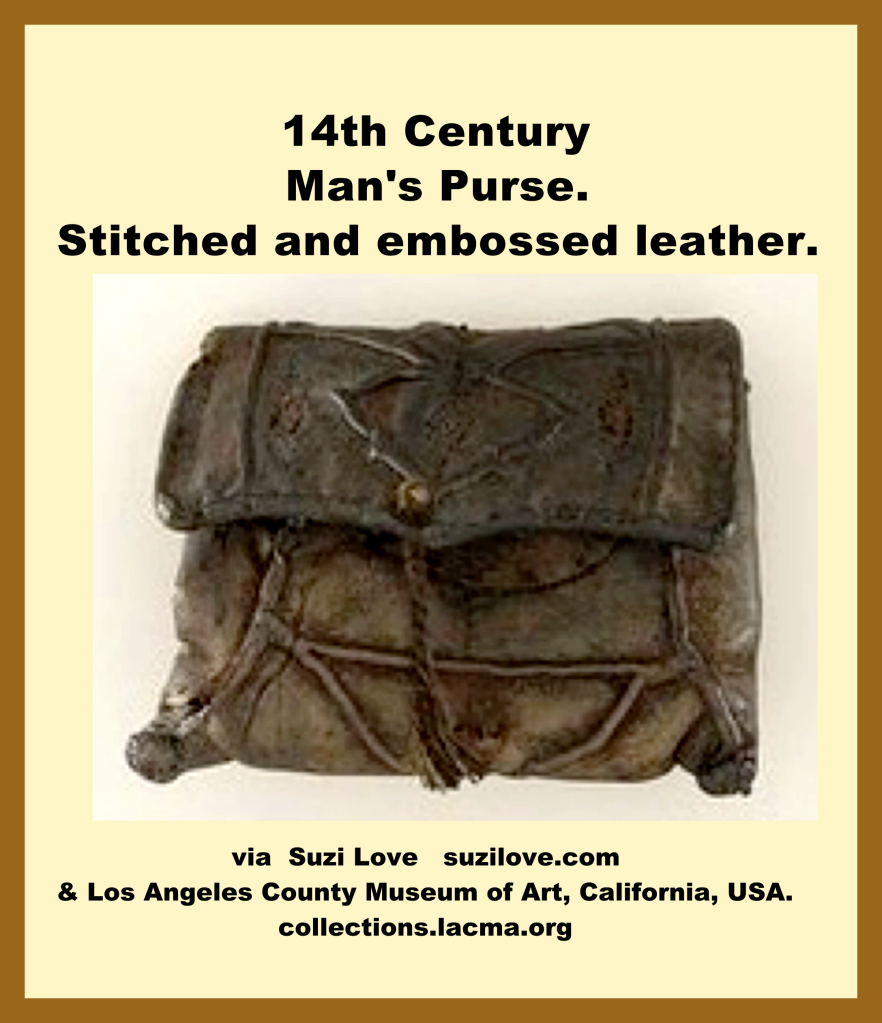


14th Century Man’s Purse. Stitched and embossed leather. via Los Angeles County Museum of Art, California, USA. collections.lacma.org
1801 November 9th Playing Cards. Men and women play cards at round table. Supreme Bon Ton Plate 2. Published by S W Fores. Men and women play cards at round table. Man and woman talk to players. Woman sleeps in upright chair, two others, one with parasol and other fan, walk off arm-in-arm.Men: High-waisted coats, high collars, huge neck-cloths, with pumps or Hessian boots. Women: High-waisted dresses, short sleeves, long trains, very low necklines, short ringlets, two in caps. Via British Museum, London, UK. britishmuseum.org (PD-Art)
In Jane Austen’s times, cartoons posted in the windows of shops were one of the main ways people found news. Common people couldn’t afford newspapers so cartoonists ridiculed the people and the places with cartoons of the daily events happening in London and other cities. The ridiculous fashion trends of the late 1700s and early 1800s were easy targets for satirical cartoons as was the addiction to gambling by women and men alike.


“It is particularly incumbent on those who never change their opinion, to be secure of judging properly at first.” Jane Austen Pride and Prejudice (1813) .#JaneAusten #Regency #Quote


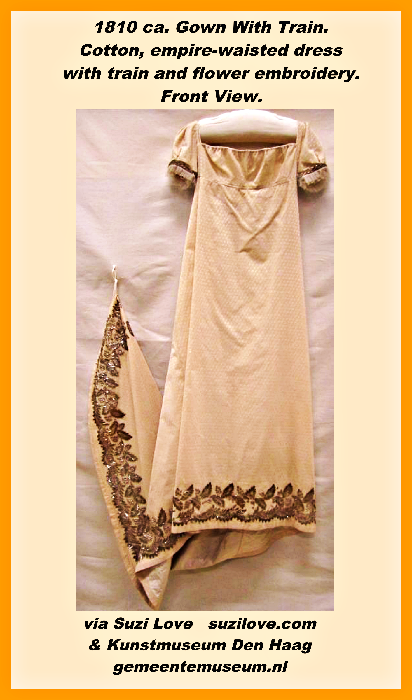
1810 Fawn Cotton Gown, with a train decorated with embroidered flowers. Regency fashion at its prettiest. The style of Empire style, or high-waisted, dress worn by Jane Austen and her contemporaries. via Gemeenteneun Museum Den Haag. Dutch Museum, the Netherlands. http://www.gemeentemuseum.nl

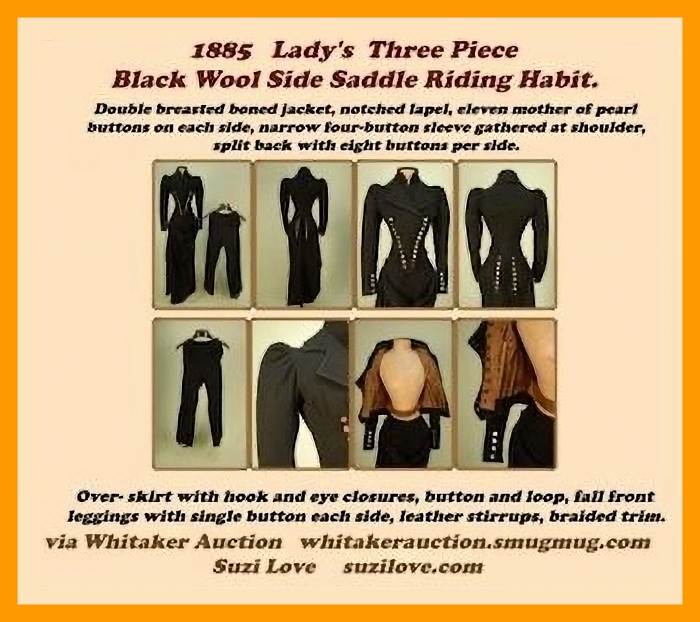
1885 Three Piece Side Saddle Riding Habit. Double breasted boned jacket with notched lapel, mother of pearl buttons, sleeve gathered at shoulder, over- skirt with side hook & eye closures, button and loop, fall front leggings, leather stirrups, braided trim. via suzilove.com Whitaker Auction whitakerauction.smugmug.com

1800s “Admiration”. By Vittorio Reggianini. Oil on canvas. This looks like a typical drawing room scene from Jane Austen’s lifetime, or the early 1800s, or the Regency Era. Via Wikimedia Commons commons.wikimedia.org

1800s Different Degrees Of Nobility In Great Britain and Ireland. FIVE LEVELS.

BENEATH THESE COME THE BARONS: The rank and precedence of Baronets is immediately after the younger sons of Barons, and before all Knights, whether of the Order or Knights. When the Order of Baronets was first instigated, its numbers were limited to 200. Members were carefully selected from the most wealthy and distinguished families of landed gentry. In the reign of the first Charles, it was the stimulus and reward for devoted loyalty. Later, it was often bestowed as an honorary recompense for sufferings and attachment when royalty was unable or unwilling to give solid remuneration. FROM: 1835 Debrett’s Baronetage of England
PRINCES of the BLOOD ROYAL: The Sovereign’s sons, brothers, and uncles are styled Princes of the Blood Royal, and have precedency of all other dukes, with the title of Royal Highness, which title was also, by special warrant, in 1816, conferred on the duke of Gloucester, deceased, and, 6th April 1818, on Prince Leopold of Saxe Cobourg (King of the Belgians). FROM: 1840 Debrett’s Peerage of the UK
1845-1865 ca. Black Faille Evening Slippers, French. Designed By Melnotte for Department Store J. Petit.
Black slippers, which went with anything, were an essential for mid 1800s fashionable ladies. Generally made of satin so dull faille fabric is unusual so possibly for mourning. Label written largely in French of London shop, exclusive agent, plus other fashionable imported Parisian accessories. via Metropolitan Museum, NYC, U.S.A. metmuseum.org


Regency London 1820 The English Metropolis By John Corry Via Google Books (PD-180)
This great metropolis is sixty miles distant from the sea; it is built on the banks of the river Thames; is about seven miles in length, from east to west, but of an irregular breadth, being in some parts two miles, in others three, and at the broadest part four miles. Its three distinct and municipal divisions are, the city of London, the city of Westminster, and the borough of Southwark, which, with their extensive suburbs, cover a space of more than twenty miles in circumference. According to the Population Return of 1811, this metropolis then contained 149,430 houses, including those building and uninhabited; and since that period there have been but few new houses built, so that the real number is probably not more than 150,000.
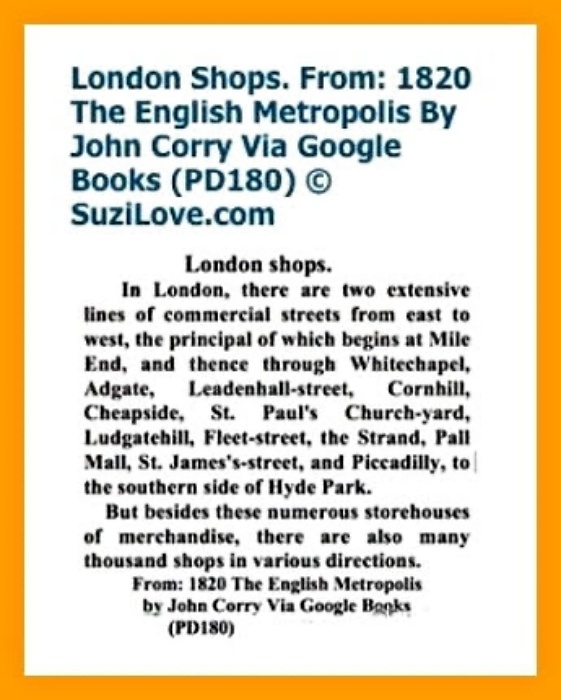
In the year 1801, the population of London was ascertained to be 900,000. The number in 1811, amounted to 1,009,546. Beneath the pavement large arched sewers communicate with the houses by smaller ones, with the street by small openings covered with iron grating, and with the Thames, which contributes much to the cleanliness and health of the inhabitants of this populous place. Houses on each side of these streets are lofty, spacious, and commodious, generally four stories high, and chiefly occupied by tradesmen, whose shops present the most beautiful and perfect productions of nature and art for the general accommodation of man, There are two extensive lines of commercial streets from east to west, the principal of which begins at Mile End, and thence through Whitechapel, Aldgate,Leadenhall-street, Cornhill, Cheapside, St. Paul’s Church-yard,Ludgatehill, Fleet-street, the Strand, Pall Mall, St. James’s-street, and’ Piccadilly, to the southern side of Hyde Park. But besides these numerous storehouses of merchandise, there are also many thousand shops in various directions. Ample supplies of water afforded by the Thames And New River Water-works, are essentially conducive to the health and comfort of the inhabitants.
St. Paul’s Church is the most magnificent. It is situated near the northern bank of the Thames, and when viewed from Blackfriar’s Bridge in the vicinity, presents one of the noblest ornaments of superb architecture ever beheld by the human eye. This beautiful cathedral is built of Portland stone, in the form of a. cross, adorned in the central part by a lofty dome, on the summit of which is a light and elegant lantern, ornamented with Corinthian columns, and surrounded by a balcony. Next to St. Paul’s cathedral for magnificence, and even greater in extent, is that fine monument of gothic architecture Westminster Abbey, or the collegiate church of St. Peter.Among the modern churches that of St. Mary-le-Bone is remarkable for a spacious and stately portico composed of eight columns and two pilasters of Portland stone, in the Corinthian order. This church is built north and south, and the northern front, which is opposite the Regent’s Park.
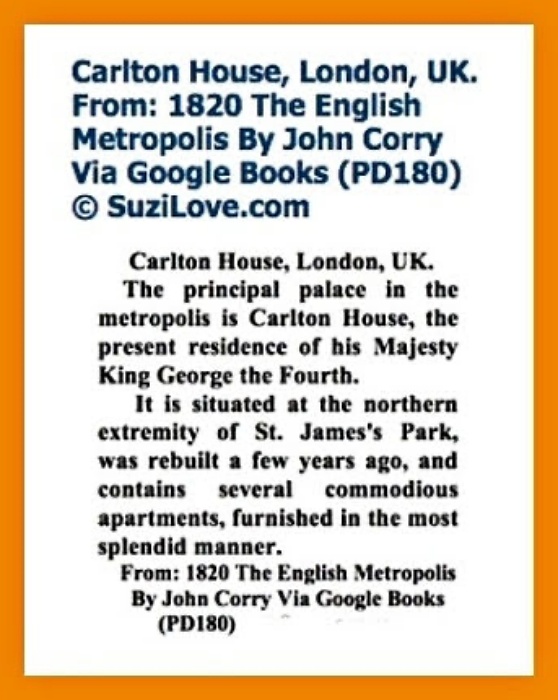
The Tower of London, which has been the scene of many a tragic and affecting event, is the only fortress in the city. It is situated on the northern bank of the Thames, eastward of London Bridge, contains the Jewel Office, Mint, three armouries, and the royal train of artillery. The menagerie, near the west entrance, has for ages been a principal object of attraction to rustic visitors, who on their arrival considered it indispensable to see the lions.








1817 White Percale Dress, French. Dress has layers of decoration above hem, black velvet Spencer, or jacket, wide brimmed straw hat trimmed in blue, neck scarf and walking shoes. Fashion Plate via Journal des Dames et des Modes, or Costume Parisien.
Definition Spencers: Short jackets worn for warmth over the high-waisted Empire style gowns said to have originated when Earl Spencer tore the tails off his coat in a hunting accident. In support of military men fighting wars everywhere, fashions for Spencers leaned towards military style embellishments, such as loops, buttons, and braids. Puffed sleeves over long straight sleeves were also very popular. Jane Austen and her friends and family wore Spencers over their high-waisted dresses.
Definition Empire Style Dress: Named after the First Empire in France. Empire dresses had a low neckline and skirts started directly under the bust and flowed into the classical relaxed wide styles of Greece and Rome. This style of dress is associated with Jane Austen and her contemporaries as a high-waisted dress was worn most days. Cotton, silk or taffeta were the popular fabrics. Only the very wealthy could afford white dress in this style as the cottons were imported from India and had to be carefully cleaned, usually by a lady’s maid.


