19th Century Inkwell and Tomb of the Scipios Grand Tour Souvenir, Italian. The type of Grand Tour souvenir collected by travelers in Jane Austen and Bridgerton Times.
Siena marble with ink wells and pen holder. Lid removes to reveal pair of ink wells and pen holder. Scipios were a family of Roman war heroes and generals. Tomb of Scipios erected around 150 B.C.E and copied many times. 18th-19th Centuries, tomb models were favorites of Grand Tour souvenir hunters. The sort of exotic item a gentleman in Jane Austen’s times might send back to England during his Grand Tour of Europe and Asia. via 1st Dibs Auctions 1stdibs.com
18th Century Mid. Nécessaire, London, England. Wood, shagreen, silk, tortoiseshell with gold mounts, steel. Includes: pen knife, beard trimmer, scissors, bottles, paper cutter, 6 razors, hone, strop. via Metropolitan Museum New York City, U.S.A. metmuseum.org
Definition Shagreen: A type of rawhide, or rough untanned skin, originally made from the back of a horse or a wild donkey. In the 18th century, the skin of a shark or stingray also began to be called shagreen.
1820 Brown Evening Dress Of Figured Silk Muslin With Brown Gauze Trim. An evening dress of tobacco coloured figured silk muslin, warp float, small sprig repeat design. Shallow, round neckline, short puffed sleeves, high, empire-style waistline and long tubular skirt. Bodice has narrow cream lace trim above a band of self fabric edged with cream silk braid and brown silk taffeta piping. Bodice front has brown silk gauze joined on at side seams with 3 van dyke points down sides of centre front. Edges of points bound with silk taffeta and trimmed with ball buttons covered in brown silk floss.
Centre front panel has brown silk cord lacing through 17 handworked eyelets bordered by 2 v-shaped strips of same silk taffeta rouleaus. Self fabric waistband is trimmed with cream braid and piping, with two van dyke points either side of centre back. Bodice laced at back from neck to waistband while gauze overlay from front forms a band tucked over the waist, which extends over skirt to form a narrow peplym, also van dyke pointed and bound with taffeta. Two self fabric epaulettes attached at sleeve seams and trimmed with brown silk passmenterie tassel, at shoulder and with same braid and piping. Short sleeves overlaid with brown silk gauze ruched between rouleaux bands stitched to lining. Cuff bands piped and braided and cut into 8 van dyke points above overlay. Points are trimmed with braid, piping and silk covered ball buttons. Skirt of dress falls to the ground, trained at back, and flounce of satin striped silk gauze falling from corded seam. Bodice lined with cream cotton. Via Powerhouse Museum, Sydney, Australia. collection.maas.museum.
Passementerie: Art of making elaborate trimmings or edgings (in French, passements) of applied braid, gold or silver cord, embroidery, colored silk, or beads for clothing or furnishings.Styles of passementerie include the tassel, fringes, ornamental cords, galloons, pompons, rosettes, and gimps, as well as other forms. Tassels, pompons, and rosettes are point ornaments, and the others are linear ornaments.
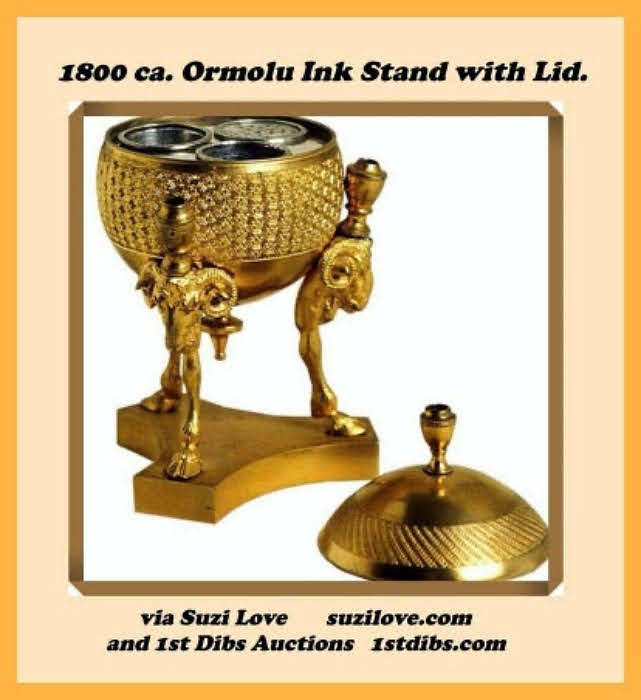
1800 ca. Ormolu Ink Stand with Lid, French. Ormolu ink stand in the shape of a globe surrounded by three rams head pen supports with animal legs and hoofs on a tripartite base. The top is removable revealing a silvered compartment with containers for sand and ink. via 1st Dibs Auctions 1stdibs.com
Definition Ormolu: Gold colored alloy of copper, zinc, and tin used in decoration and for making ornaments. Ormolu is used in mounts i.e ornaments on borders, edges, and as angle guards) for furniture, especially 18th-century furniture, and for other decorative purposes. Its gold colour may be heightened by immersion in dilute sulfuric acid or by burnishing.
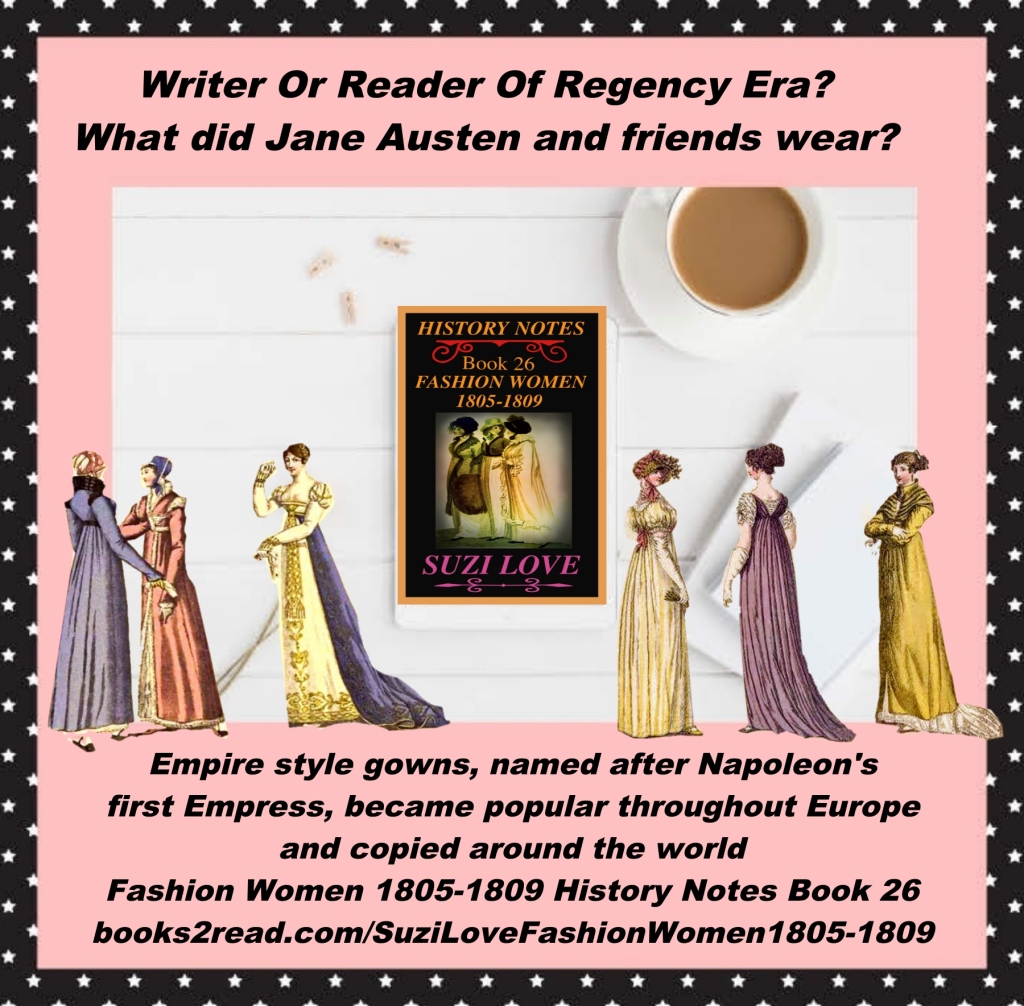
What did Jane Austen and friends wear? Early 1800s fashions were elegant and pretty with high waists and fabrics that were almost transparent. These Empire style gowns, named after Napoleon’s first Empress, became popular throughout Europe, and were then copied around the world. Colorful outwear was added to make an ensemble more attractive and warmer. History Notes Book 26 Fashion Women 1805-1809. https://books2read.com/SuziLoveFashionWomen1805-1809
1805 May Two Ladies In Jane Austen Style Walking Dress and Full Dress, English. White dress with a train under a purple cape, purple reticule or bag, and green parasol. Pink evening full dress with low cut bodice, short sleeves and light draping shawl. via Vernon and Hood at The Lady’s Monthly Museum, London, U.K. Definition Reticule, or Ridicule, or Bag or Purse: Often with a drawstring to pull closed and usually made of cloth or covered cardboard and often decorated with beading or embroidery. A reticule, or purse, or handbag, was usually carried by a woman during the Regency period to carry all their daily necessities. Earlier, women used pockets that tied at the waistline and were hidden in the folds of their skirts. Empire style, or early 1800s, high-waisted dresses made it impossible to either sewn in a pocket or to tie on a pocket. So women began carrying small, decorated bags called Reticules, or ridicules, which generally pulled close at the top with a drawstring.
1830 ca. Rosewood and Inlaid Brass Inkstand, England. Each side has cut-glass inkwells with brass inlaid tops and pen trays, so ideal for a partners desk. via 1st Dibs Auctions 1stdibs.com
What Sort Of Pianoforte or Piano Was Played By Jane Austen and Contemporaries? Pianos, pianofortes and more. History Notes Book 7 Music Pianos books2read.com/suziloveMusicPiano
Definition Pianoforte or Piano: ‘Stringed keyboard instrument with a hammer action, as opposed to the jack and quill action of the harpsichord. Capable of gradations of soft and loud, the piano became the central instrument of music pedagogy and amateur study. By the end of the nineteenth century, no middle-class household of any stature in Europe or North America was without one.’ Definition via the Metropolitan Museum, NYC.
Around 1700, the Pianoforte, or Piano, was invented in Italy by Bartolomeo Cristofori, who created a hammer action keyboard instrument on which a musician could make changes in loudness by changing the force with which the keys were struck. He called his instrument “gravicembalo col piano e forte”, or, (harpsichord with soft and loud). Cristofori’s long name was later shortened to fortepiano or pianoforte, and finally just piano.
Musical Instruments were so important in most of the more affluent households in history that large industries grew all around the world to manufacture instruments, musical accessories, and to print sheet music. Pianos, pianofortes, harpsichords, and organs were found everywhere and were often the focus of a family gathering. By the end of the 18th Century, the pianoforte, or piano, was the leading instrument of Western music.
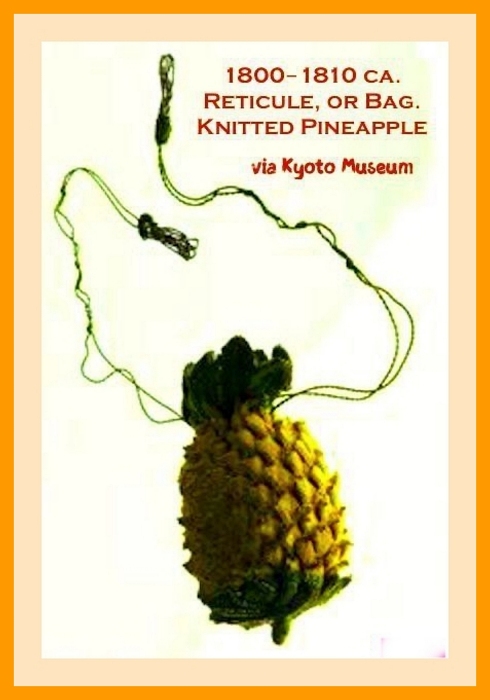
1800-1810 ca. Pineapple Reticule, or Bag. A knitted pineapple with long strings. In Jane Austen’s times, pineapples were a luxury imported item that most people in Great Britain had never seen, let alone tasted. When more pineapples were imported from hotter countries, or English gardeners started to grow some, pineapples became a much desired novelty and an exotic experience. Pineapple motifs appeared on dresses, furniture, household goods etc. Knitting pineapple reticules was part of this obsession with pineapples. via Kyoto Museum, Japan.
Definition Ridicule, Reticule, Indispensable, or Handbag: From the late 1700s, pockets could no longer be sewn into gowns, as skirts fell from just under the bust and were full and flowing. Instead, women began carrying small bags, known at first as ridicules and later as reticules, to keep necessary items on their person e.g. handkerchiefs, coins, vinaigrettes, calling cards, glasses etc. http://books2read.com/suziloveReticules
1800-1810 ca. Reticule, or Bag. A knitted pineapple with long strings. via Kyoto Museum, Japan.
In the early nineteenth century, reticules started to look like future handbags as they were often made from rigid card or molded mâché or card into a variety of shapes. Early bags were circular and with a drawstring but as women wanted their reticules to look individual they could be made with two halves and a hinged metal closure or with concertina sides. Materials varied from silk, cotton and string and shapes were round, hexagonal or lozenge shapes with shell shaped bags becoming very popular during the Regency and Romantic Eras.
1800s magazines were written for well bred women who could read, so they gave plenty of ideas for how ladies could make and embellish reticules for their own use and as pretty gifts. Needlework was highly encouraged as a pastime for a lady so bags were frequently embroidered or decorated with beading. By the 1820s, reticules became more like our modern handbags using soft leather gathered at the top or hard leather with a rigid fastener and metal chain for carrying.
I love Pinterest for keeping thousands of historical images in some sort of order. And I love using Pinterest Boards as inspiration for my romance books. What about you? Do you use Pinterest for planning something, or just for fun? Need more hints for what to do with your boards and pins? Take a look at these fascinating articles on Pinterest. if you want even more Pinterest information and tips for becoming a power user, check out my Suzi Love Pinterest Boards