1813 Yellow Redingote Or Coat, French. Hooded coat with gorgeous white trim, yellow boots, yellow velvet bonnet with a white plume. Jane Austen and her female family and friends wore fashions like these. Fashion Plate via Journal des Dames et des Modes, or Costume Parisien.
Redingote, or Pelisse, or Walking Dress, or Promenade Dress: Going by many names, this is a coat copied from men’s overcoats but worn by both men and women. Generally, opens down the front, worn for warmth over a dress or coat and breeches, and has a military look with front vertical buttoning or decoration. Called a Redingote in French periodicals but English magazines called them by many other names: pelisse, carriage dress, walking dress, promenade costume.
19th Century Brass Travelling Inkwell and Quill Holder, Turkey. Carried by scribes as they travelled from one settlement to another and carried these held in their belts. Would have come from Turkey. The type of inkwell that travellers in Jane Austen’s times might have carried for writing letters when away from home. Many of these exotic and decorative items were brought to England by gentlemen doing their Grand Tour through Europe and Asia.via Ruby Lane Antiques.
19th Century Brass Travelling Inkwell and Quill Holder. Carried by scribes as they travelled from one settlement to another and carried these in their belts. Would have come from Turkey. via suzilove.com and Ruby Lane Antiques. rubylane.com
HN_13_D2D_WritingTools Book 13 What did the lady of the house use to pen notes? What sat on the desk of the man of the house when managing his accounts? #History #Nonfiction #travel books2read.com/SuziLoveWritingTools
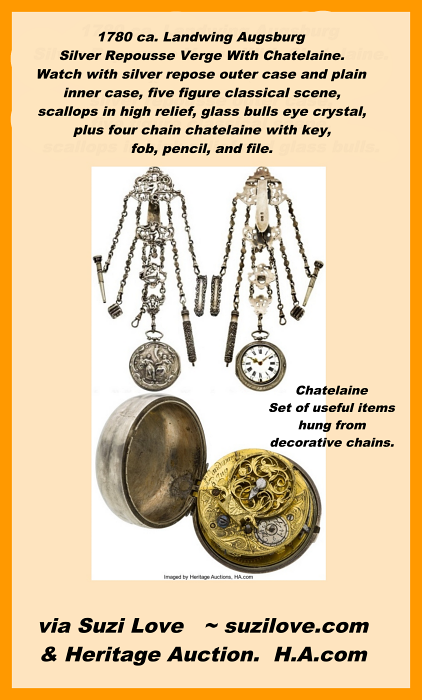
1780 Watch on a Chatelaine, Germany. Silver Repousse Verge With four chain chatelaine. via Heritage Auction H.A.com.
Definition Chatelaine: The word Chatelaine is French and means the keeper of the keys. Chatelaine” derives from the Latin word for castle. In Medieval times, the chatelaine was in charge of the day-to-day running of the castle. What did a chatelaine do? Most important task was keeper of the keys. Also ordered supplies, did bookkeeping, supervised servants, taught castle children, and organized guests. books2read.com/SuziLoveChatelaines
By 1700’s, a metal jeweled ornament hung from pockets, attached to belts, or by hooks into skirt waistbands
During 1800’s, women wore large collections of tools hung from chains
Young girls sewed and did needlework and needed to carry sewing notions eg scissors, thimbles
Worn by women of all classes, from workers to nobility
Varied depending on class and finances.
Made of silver, brass, steel, leather, or fabric
During 19th century, fashionable dresses often had no waist and nowhere to hang chatelaines
Chatelaines became decorative brooches
Often given as a wedding present from a husband to bride
Later became fashion accessories.
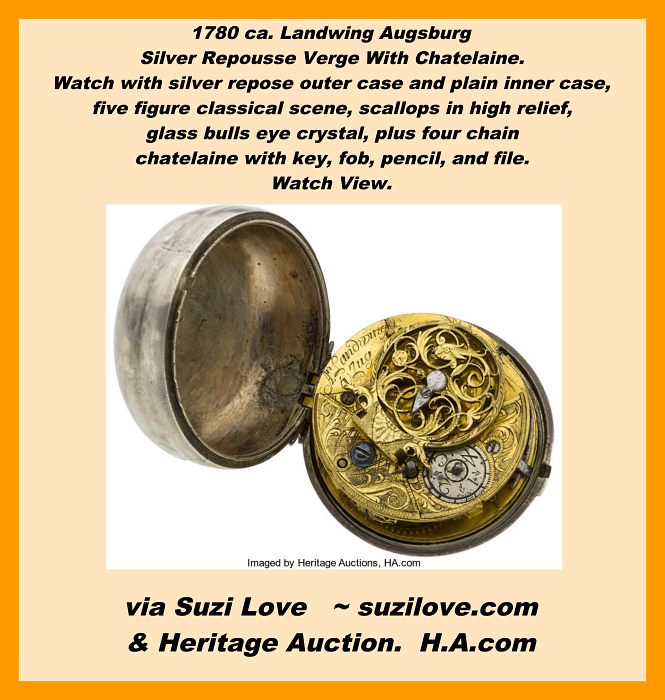
1780 ca. Watch. Landwing Augsburg
Silver Repousse Verge With Chatelaine. Watch with silver repose outer case and plain inner case, five figure classical scene, scallops in high relief, glass bulls eye crystal, plus four chain chatelaine with key, fob, pencil, and file. via Heritage Auctions
Chatelaine: Set of useful items hung from decorative chains.Chatelaines and Chains History Notes Book 9 By Suzi Love. #regency Women in charge of houses wore long chains holding important household items around their waist e.g. keys, pen, notebook, sewing. books2read.com/SuziLoveChatelaines
1810-1820 ca. Pantaloons, Probably Military, British. The type of pants worn by men in Jane Austen’s times when wars were being fought all over the world, especially in Europe. Machine-knitted white cotton decorated with cream silk braid on sides and fronts as seen on Hussar uniforms. Cut to fit the leg and button bottom at waist with three buttons. Front fall buttons over five buttoned fly, two horizontal pockets at front below waistband and fob pocket in waistband. Four metal buttons for braces, two front and two back. Cotton ‘puff’ centre back waist and two linen tapes for waist adjustment. via Victoria and Albert Museum, London, UK. collections.vam.ac.uk.
Pair of men’s pantaloon trousers made of machine-knitted white cotton and decorated with cream silk braid applied down the sides and on the fronts. This imitates the hussar uniforms of the period and appeared on fashionable men’s dress. The pantaloons are cut to fit the leg and button at the bottom with three buttons. The pantaloons fasten at the front with front falls buttoning over a five buttoned fly. There are two horizontal pockets at the front below the waistband and a fob pocket in the waistband. There are four metal buttons for braces, two at the front and two at the back. These probably are original. There is a cotton ‘puff’ at the centre back waist and two linen tapes for waist adjustment.
Pantaloons also brought the glamour of military uniform into men’s fashionable dress, especially when teamed with Hessian boots. Uniforms worn by the various armies during the Napoleonic Wars (1793-1815) were often very colourful and lavishly adorned with braid and tassels. It is hardly surprising that some of these attractive trimmings should have infiltrated fashion, particularly when nationalistic feelings ran high. Civilian pantaloons were often ornamented with military-style braid that was applied in a vertical band of topside Russia braiding. They were not, however, generally decorated on the front, which suggests that this pair was for military use. The silk braid is applied in the form of an Austrian knot, which was a popular motif on pantaloons of the light cavalry such as the hussars and light dragoons.
HN_23_D2D_Fashion Men 1800-1819. https://books2read.com/SuziLoveFashionMen1800-1819
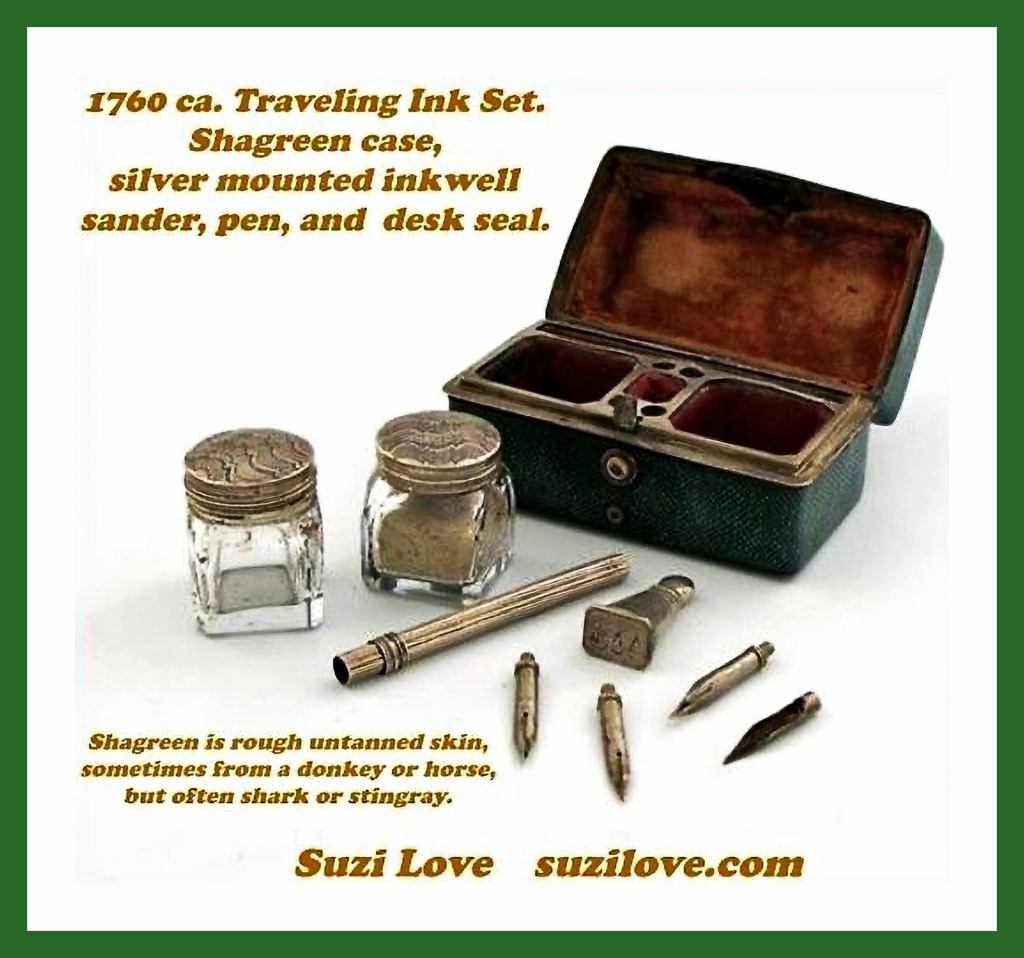
1760 ca. Traveling Ink Set. Rectangular Shagreen case with hinged cover which opens to reveal an unmarked silver mounted inkwell and sander, a pen, and a desk seal.
Definition Shagreen: Type of rough untanned skin, sometimes made from a donkey or a horse, but often from a shark or a stingray.
1760 ca. Traveling Ink Set. Rectangular Shagreen case with hinged cover which opens to reveal an unmarked silver mounted inkwell and sander, a pen, and a desk seal. Shagreen is a type of rough untanned skin, sometimes made from a donkey or a horse, but often from a shark or a stingray.D2D_RetailerBuyLink_HN_10. books2read.com/SuziLoveTravel
1800 North Side Of Cavendish Square, London, U.K. By Thomas Malton (1748-1804) British. Aquatint of the north side of the square. (PD-Art)
1800 North Side Of Cavendish Square, London, U.K. By Thomas Malton (1748-1804) British. Aquatint of the north side of the square. (PD-Art)RL_1_D2D_Regency Overview RetailerLinks
https://books2read.com/suziloveROver
1801 November 9th Playing Cards. Men and women play cards at round table. Supreme Bon Ton Plate 2. Published by S W Fores. Men and women play cards at round table. Man and woman talk to players. Woman sleeps in upright chair, two others, one with parasol and other fan, walk off arm-in-arm.Men: High-waisted coats, high collars, huge neck-cloths, with pumps or Hessian boots. Women: High-waisted dresses, short sleeves, long trains, very low necklines, short ringlets, two in caps. Via British Museum, London, UK. britishmuseum.org (PD-Art)
In Jane Austen’s times, cartoons posted in the windows of shops were one of the main ways people found news. Common people couldn’t afford newspapers so cartoonists ridiculed the people and the places with cartoons of the daily events happening in London and other cities. The ridiculous fashion trends of the late 1700s and early 1800s were easy targets for satirical cartoons as was the addiction to gambling by women and men alike.
Light-Hearted look at an Older Lady’s Life In Jane Austen’s Times, or early 1800s. An easy to read overview of what an older lady did, wore, and how she lived in the early 19th Century. Information for history buffs and pictures for readers and writers of historical fiction. Older Lady’s Day, Regency Life Series, Book 5, by Suzi Love. books2read.com/suziloveOLD
The older lady’s day usually started with her toilette in her bedroom, where her maid helped her dress for the day and styled her hair. After that, she would join her family downstairs for breakfast unless she preferred a tray with either tea or hot chocolate in her bedroom as she prepared for her busy day. Her day would be made up of speaking with the housekeeper and the cook about the week’s menus, assuring that the servants were all available that day and no one was ill, and checking the list of foods needed. She would also enquire if the laundry was up to date and that they had enough good linen to make up all the beds before extended family members and guests arrived. If she was in the country and hosting a weekend house party, she would assign rooms to the guests on her lists and query that all was in readiness for their arrival.