Christmas pudding originated as a 14th century porridge called ‘frumenty’ , made of beef and mutton with raisins, currants, prunes, wines and spices. Often more like soup, it was eaten as a fasting meal in preparation for Christmas festivities. By 1595, frumenty changed into a plum pudding thickened with eggs, breadcrumbs, dried fruit and flavoured with beer and spirits. It became the customary Christmas dessert around 1650, but in 1664 the Puritans banned it as a bad custom. In 1714, King George I re-established it as part of the Christmas meal, having tasted and enjoyed Plum Pudding.
“In December, the principal household duty lies in preparing for the creature comforts of those near and dear to us, so as to meet old Christmas with a happy face, a contented mind, and a full larder; and in stoning the plums, washing the currants, cutting the citron, beating the eggs, and mixing the pudding, a housewife is not unworthily greeting the genial season of all good things.” Via 1861 Beeton’s Book of Household Management.
The Sunday closest to St. Andrew’s Day was Stirring-up Sunday, and the day to prepare the family’s Christmas pudding. The eldest member of the household or a visitor would give the first stir and charms were stirred into the pudding. A ring meant a coming marriage, a button was bachelorhood, a thimble meant spinsterhood, and a sixpence was good luck. Puddings were steamed in a pudding bag and stored in a cool place until Christmas Day.
Our modern Christmas tree tradition probably began in Germany in the 18th century, though some argue that Martin Luther began the tradition in the 16th century. An evergreen fir tree was used to celebrate winter festivals (pagan and Christian) for thousands of years. Nobody is really sure when Fir trees were first used as Christmas trees but it probably began 1000 years ago in Northern Europe. Many early Christmas Trees seem to have been hung upside down from the ceiling using chains.
The English phrase “Christmas tree”, first recorded in 1835, came from the German words Tannenbaum (fir tree) or Weinachtenbaum (Christmas tree). The Christmas tree is often explained as a Christianization of pagan tradition and ritual surrounding the Winter Solstice, which included the use of evergreen boughs, and an adaptation of pagan tree worship. At first, a figure of the Baby Jesus was put on the top of the tree. Over time it changed to an angel or fairy that told the shepherds about Jesus, or a star like the Wisemen saw.
Christian tradition associates the holly tree with the crown of thorns, and says that its leaves were white until stained red by the blood of Christ. Along with a Christmas tree, the interior of homes were decorated with plants, garlands, and evergreen foliage and in Victorian times, Christmas trees were decorated with candles to represent stars.
The early Germans conceived of the world as a great tree whose roots were hidden deep under the earth, but whose top, flourishing in the midst of Walhalla, the old German paradise, nourished the she-goat upon whose milk fallen heroes restored themselves. Yggdnafil was the name of this tree, and its memory was still green long after Christianity had been introduced into Germany, when much of its symbolic character was transferred to the Christmas-tree. At first fitted up during the Twelve Nights in honor of Berchta, the goddess of spring, it was subsequently transferred to the birthday of Christ, who, as the God-man, is become the “resurrection and the life.”
Queen Victoria saw a Christmas tree as a girl in 1832. The little princess wrote excitedly in her diary that her Aunt Sophia had set up two “trees hung with lights and sugar ornaments. All the presents being placed around the tree.” In 1841, Prince Albert, Queen Victoria’s German husband, arranged for a fir tree to be brought from Germany and decorated. By 1850, Victoria and Albert had Christmas trees erected in the British Royal Palaces and their children started the tradition of gathering around the tree.
‘The Christmas-tree is doubtless of German origin. Though in its present form it is comparatively of recent date, yet its pagan prototype enjoyed a very high antiquity.’ From 1873 Harper’s Bazaar, America.
A print of the royal family gathered about the Christmas tree at Windsor Castle appeared in the Illustrated London News in 1848, then in Godey’s Lady’s Book in 1850, and was reprinted again ten years later. The six-foot fir sits on a table, each tier laden with a dozen or more lighted wax tapers. An angel with outstretched arms poses at the top. Gilt gingerbread ornaments and tiny baskets filled with sweets hang by ribbons from the branches. Clustered around the base of the tree are dolls and soldiers and toys.
Christmas trees did exist in America before Queen Victoria made them famous, but mainly only amongst migrant groups from Europe. The writer of an 1825 article in The Saturday Evening Post mentions seeing trees in the windows of many houses in Philadelphia, a city with a large German population. He wrote, Their “green boughs laden with fruit, richer than the golden apples of the Hesperides, or the sparkling diamonds that clustered on the branches in the wonderful cave of Aladdin.” Gilded apples and nuts hung from the branches as did marzipan ornaments, sugar cakes, miniature mince pies, spicy cookies cut from molds in the shape of stars, birds, fish, butterflies, and flowers. A woman visiting German friends in Boston in 1832 wrote about their unusual tree hung with gilded eggshell cups filled with candies.
Not until the mid-nineteenth century did Christmas trees start spreading to homes with no known German connection. But once Queen Victoria approved of the custom of a Christmas tree, the practice spread throughout England and America and, to a lesser extent, to other parts of the world, through magazine pictures and articles. Upper-class Victorian Englishmen loved to imitate the royal family, and other nations copied the custom. Late in the century, larger floor-to-ceiling trees replaced the tabletop size.
19th Century Typical Meals and Table Settings for the Family and For Guests. This is typical of the food that would have been served at Jane Austen’s meal times. Historic food from 1860s Mrs. Beeton’s Household Management.
1800spical Modern Table Settings.1800s Typical China For Serving Dinner and Dessert. Dinner Plates, Soup Tureen, Covered Cheese Dish, Jug, Dessert plates and Serving Dish. From: 1860s Mrs. Beeton’s Book of Household Management. via Google Books (PD-150)RL_5_D2D_RetailerBuyLink_RL_5_
https://books2read.com/suziloveOLD
Reticule Or Bag: Purse, often with a drawstring to pull closed and usually made of cloth or covered cardboard and often decorated with beading or embroidery. Carried by a woman during the Regency period to carry all their daily necessities. in the place of pockets.
Spencer: Short jacket, cropped at the waist, worn over a dress, or gown. Delicate and regency dresses provided so little protection from the cold, so over garments were essential for warmth, modesty and good health.
Pelisse Or redingote Or Walking Dress: Coat worn over clothing of both sexes for warmth and protection from the elements.
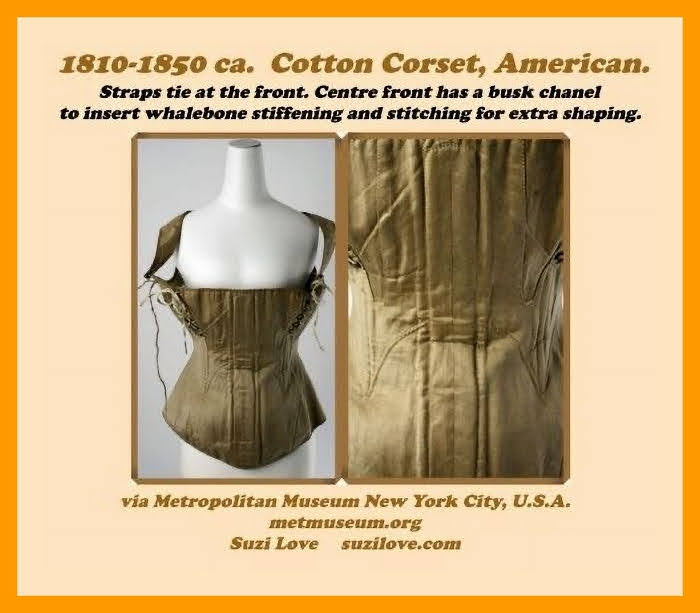
1810-1850 ca. Cotton Corset With Whalebone Busk, American. Straps tie at the front. Center front has a busk Chanel to insert a whalebone to keep the corset stiff and in place. There is extra stitching on the corset to give more shape and extra reinforcing to keep the corset upright and the dress worn over it smooth and flat. Marking stamped on the lining, ‘Jane Laney’ and Mrs. Bishop, Corset Maker, 108 Hudson St., New. York, USA. via Metropolitan Museum New York City, U.S.A. metmuseum.org
Surviving stays, or corsets as they became to be called in the nineteenth century, show that both longline and shorter corsets were worn and that they were made of cotton, silk and sateen. A lot of these corsets were front fastening, plus many were laced at both the front and the back so our aristocratic fictional heroines could indeed dress and undress themselves without the assistance of a maid.
Definition Busk: Central panel in a corset to give it extra shape. Made from wood, bone which was usually whalebone, ivory, and in the latter 1800s from metal.
1800s Typical Breakfast and Tea China, England. Tea cups, Bread and Butter plates, Teapot, Butter Dish, Coffee Cups, Tea Set, Milk Jug, Water Jug, Bread Dish, Sardine Dish, Bacon Dish, Marmalade Jar and Breakfast Cups. From: 1860 Mrs. Isabella Beeton’s Book of Household Management. These are the sort of salads that Jane Austen’s family would have eaten to accompany main dishes during the early 1800s, or Regency Era.
Travel and Luggage By Suzi Love History Notes Book 10. How did people travel in Jane Austen’s times. In past centuries? What did they take with them to make their long journeys easier? Travel by road, ship, canal, or railway all took a long time and had dangers so people learned to prepare. And then, in the nineteenth century, road improvements, inventions, and scientific developments made travel more pleasurable. books2read.com/SuziLoveTravel
What salads were served in Jane Austen and the Bridgerton households? Salads “Persons in health, who feel a craving for salad, may indulge in the enjoyment of it to a great extent with perfect impunity, if not with positive benefit. Oil, when mixed in salad, appears to render the raw vegetables and herbs more digestible. Vinegar likewise promotes the digestion of lettuce, celery, and beet-root.
“Endive is very wholesome, strengthening, and easy of digestion; but when strong seasoning is added to it, it becomes an epicurean sauce. — Mayo.”
Recipe for a Winter Salad, by the late Rev. Sydney Smith. Two large potatoes, passed through kitchen sieve, Unwonted softness to the salad give, Of mordent mustard add a single spoon; To add a double quantity of salt; Three times the spoon with oil of Lucca crown, And once with vinegar, procured from town. True flavor needs it, and your poet begs The pounded yellow of two well-boiled eggs. Let onion atoms lurk within the bowl, And, scarce suspected, animate the whole; And, lastly, on the flavored compound toss A magic teaspoon of anchovy sauce. Then, though green turtle fail, though venison’s tough, And ham and turkey are not boiled enough, Serenely full the Epicure may say,- Fate cannot harm me—I have dined to-day!
The Spanish proverb says four persons are wanted to make a good salad: a spendthrift for oil, a miser for vinegar, a counsellor for salt, and a madman to stir all up.
1859 Hints for the Table by John Timbs.
1800s Typical Salads: Cucumber, Beetroot and Potato, Macedone Salad, Tomato Salad, Jellied Russian and Italian Salads, Prawn Salad, Egg and Lettuce, Lobster Salad and Salad Dumas. From: Mrs. Beeton’s Book of Household Management. via Google Books (PD-150)
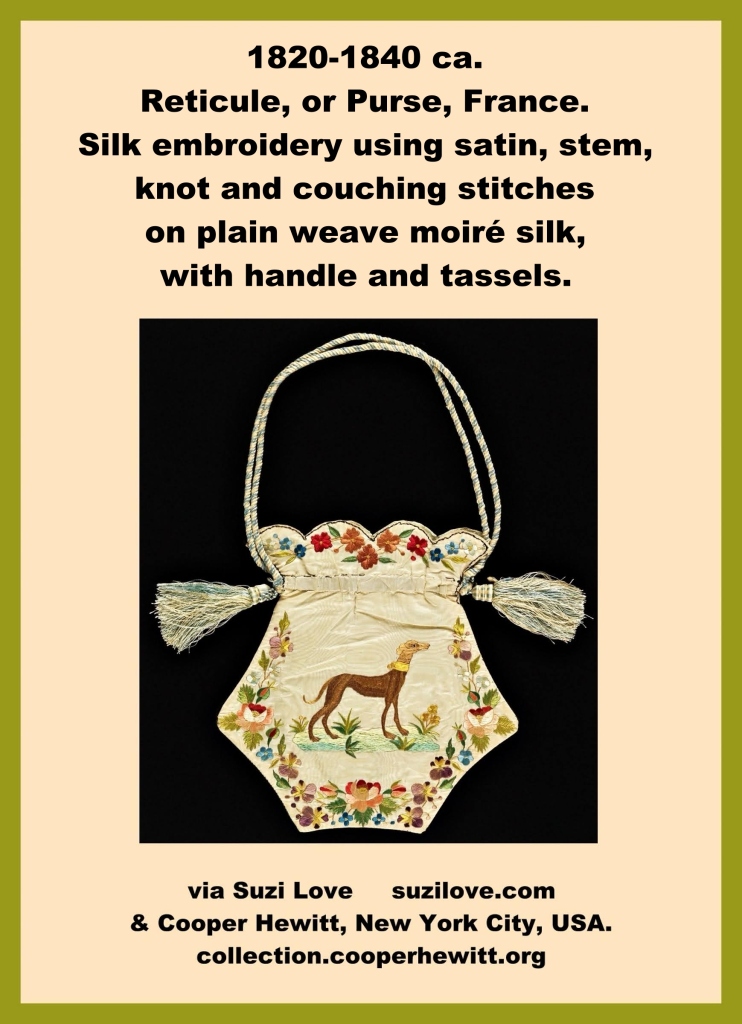
1820-1840 ca. Reticule, Or Purse, France. Bag of plain weave white moiré silk embroidered in colored silks using satin, stem, knot and couching stitches. Shape is five-sided, flat, with a scalloped top. Borders of flower wreaths. Embroidered on one side with a greyhound and with a long-tailed bird on the other. Worked as two separate panels, joined. Lined in pale blue taffeta. Blue and white silk cord. via Cooper Hewitt, New York City, USA. collection.cooperhewitt.org
Definition Reticule: Bag or purse, often with a drawstring to pull closed and usually made of cloth or covered cardboard and often decorated with beading or embroidery. A reticule, or purse, or handbag, was usually carried by a woman during the Regency period to carry all their daily necessities. Earlier, women used pockets that tied at the waistline and were hidden in the folds of their skirts. Empire style, or early 1800s, high-waisted dresses made it impossible to either sewn in a pocket or to tie on a pocket. So women began carrying small, decorated bags called Reticules, or ridicules, which generally pulled close at the top with a drawstring. http://books2read.com/suziloveReticules
Michael Brandon nodded. “Yes, I’m related to Lord Brandon, Frederick, who disappeared four years ago.” He faced the sick man. “We searched everywhere for you. Men scoured the streets of London for weeks after you disappeared, and then we widened our search. Ports, inns, the countryside, anywhere you might have gone. Or anywhere that you might have been taken if you’d been kidnapped and held for ransom.”
Michael groaned. “Three years of nothing. Not a sign. The police declared you a missing person, most likely deceased, and told us to wait out the seven years until we could officially declare you dead.” He swiped at his eyes, brushing aside the gathering tears. He took Frederick’s hand. “But we never gave up hope. None of us, and especially not mother.”
Tears trickled down Michael’s cheek and he brushed them aside impatiently. He didn’t care that everyone saw his raw grief. He only cared that his brother, if this shell of a man truly was his previously vibrant brother, heard his words and understood the truth in them. The heartache and sorrow that they’d all carried for years. The pain they’d suffered thinking they might never set eyes on Frederick again.
“Your mother …” His words caught as a sob escaped him, echoing the continuing sobbing from Melissa behind him. “Your mother died a year ago, but her last words were a desperate plea for me to keep looking for you. To find you, and to bring you home.”
Michael watched tears trickle and run over the creases on the aged face before him, and he knew. This was Frederick, his constant companion during hundreds of childish escapades.
https://books2read.com/suziloveDS December Scandal, Book 3 Scandalous Siblings.
DS_December Scandal Book 3 Scandalous Siblings #HistoricalRomance Michael Brandon travels to introduce the woman he loves to family but is shocked when his missing brother arrives. https://books2read.com/suziloveDS
DS_December Scandal D2D_RetailerLinkhttps://books2read.com/suziloveDS