1806 Nankin Riding Habit, French. Red scarf, green gloves, riding boots, straw hat decorated with taffeta. The type of outfit Jane Austen and her friends would have worn if they went horse riding. Nankeen Or Nankin Fabric: Durable, buff colored cloth, made of Chinese cotton which is naturally brownish yellow. Originally brought from Nanking.
Fashion Women 1800 By Suzi Love History Notes Book 12 #Regency #Fashion Love gorgeous historical women’s fashions? Take a look at what women wore and carried in 1800 in Europe and around the world. books2read.com/SuziLoveFashionWomen1800
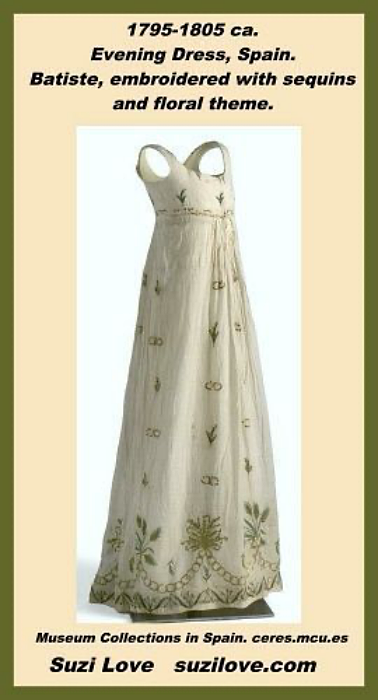
Women’s dress changed dramatically after 1785. The rich fabrics and complicated, formal shapes of the late 18th century gave way to simple, light fabrics that draped easily. These new gowns achieved something of the effect of the simple tunics shown on classical Greek and Roman statues and vases. Inspired in part by the statuary of ancient Greece and Rome, the new fashion was epitomised by light cotton gowns falling around the body in an unstructured way, held around the high waist with a simple sash and accompanied by a soft shawl draped around exposed shoulders. This style was ideal for the Indian imports like Kashmiri shawls and Bengali muslin, as used in this embroidered gown. Championed by such influential figures as Emma Hamilton in England and Madame Récamier in France, the so-called ‘Empire’ style catapulted Indian muslin into the forefront of fashion.
Empire Dress: Owes its name, physical emancipation, popularity, and even its sexiness to France. In this English example, French style is slavishly followed in the gown’s high waist and modish stripes.
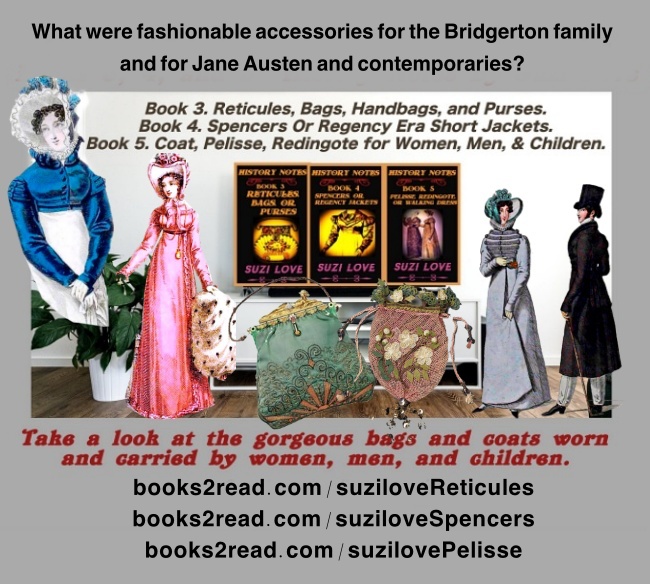
Empire style, or early 1800s, high-waisted dresses made it impossible to either sewn in a pocket or to tie on a pocket. So women began carrying small, decorated bags called Reticules, or ridicules, which generally pulled close at the top with a drawstring.
Inspired in part by the statuary of ancient Greece and Rome, the new fashion was epitomised by light cotton gowns falling around the body in an unstructured way, held around the high waist with a simple sash and accompanied by a soft shawl draped around exposed shoulders. This style was ideal for the Indian imports like Kashmiri shawls and Bengali muslin, as used in this embroidered gown. Championed by such influential figures as Emma Hamilton in England and Madame Récamier in France, the so-called ‘Empire’ style catapulted Indian muslin into the forefront of fashion.
1819 Typical Gentleman’s Outfit, French. The type of outfit worn by Jane Austen’s male family and friends. Brown cutaway coat with extra long tails, white trousers, high white cravat, heeled black boots with spurs, gloves, black top hat and a cane. Fashion Plate via Journal des Dames et des Modes, or Costume Parisien.
Trousers: The word Trouser came into usage in the late 1600’s, so we’ve had trousers around for a long time. But at first, they were mostly for lower classes. Revolutionary France started a trend for sans-culottes, which meant trousers or pantaloons instead of culottes, or knee breeches, which were associated with the aristocracy. The styles of the revolution moved across to England and were taken up by those who either sided with revolutionary ideals or who took them up as part of a protest against the establishment set. Early on, trousers were generally a bit looser than pantaloons or breeches and ended at the ankles, often with side slits to get the foot through or straps under the foot straps to keep the trousers in place.
‘How dare you.’ Lady Lillian spat the words at the Earl of Mallory and gave him her fiercest glare. ‘You shouldn’t have interfered like that. If those gentlemen recognize you, they might work out who I am, which is exactly what you wanted to avoid.’ She huffed. ‘Besides, I instigated that kiss.’
‘Why would you do such a brazen thing? Risk your good name and your life in such an impulsive manner.’
She sighed, all her anger deflating. ‘My good name evaporated when Geoffrey’s sexual preferences became known after his death. The men he mixed with kept his secrets when he was alive, and possibly even liked whips and ropes as much as Geoffrey, but dead men can’t reveal their secrets so they felt safe to expose him, while distancing themselves from those activities.’
‘But why would they risk incriminating themselves?’
‘I learned later that two girls had died, a day apart and in different areas of London, but both had been physically tormented and their bodies were left in parks in Mayfair. Government officials were sent to investigate after a minister’s wife and children stumbled upon one of them, and there was a push to find the culprit and to close down any houses of ill repute in respectable neighborhoods.’
‘I read about the murders, but surely they don’t think Geoffrey had anything to do with that. He wasn’t the most respected man and nor was he a decent husband, but I cannot imagine him killing women.’
‘The enquiry cleared Geoffrey, but as those houses were places that Geoffrey and his cohorts visited, his so-called friends decided to toss out Geoffrey’s name and draw the scrutiny away from them.’
Brent took her hands and shook them lightly. ‘Why didn’t you tell me?’
She shrugged. ‘Geoffrey was dead and I simply wanted to forget all the sordidness and start afresh.’ She waved a hand at the guests, whose conversations had become bawdier and louder the more punch was consumed and, as inhibitions were drowned in liquor, both women and men had stripped away clothing and were well on their way to public sex. ‘Here, I can reclaim myself, because everyone indulges in excesses and they don’t judge each other badly because they’ve let down their guards for an evening.
1815 March Brown Promenade Dress, English. High-waisted dress with decorative hem, white sleeves, white fichu, blue scarf, brown hat decorated with flowers. Jane Austen and her contemporaries would have worn this style of outdoor walking outfit and flowered hat. Fashion Plate via The Lady’s Magazine Or Entertaining Companion for the Fair Sex.
Definition Redingote: Woman’s long, fitted coat often worn open in front to show off the dress underneath. Sometimes cut away in front. Originally made with several capes and trimmed with large buttons. French word developed from English words, riding coat. reefer. Single- or double-breasted, fitted, tailored, over-all coat usually made from sturdy fabric.
Definition Fichu: A piece of lace, muslin, or other cloth worn about the neck and cleavage to preserve a lady’s modesty. From French word meaning neckerchief.
19th Century Late Mechanical Tantalus, French. Ormolu, Bronze, Crystal, and Gilt with a lock and key to open. Earlier versions of this type of small drinks cabinet would have been used in most households during Jane Austen’s times, unless the householders were teetotalers. via 1st Dibs Auctions 1stdibs.com
Tantalus: A small wooden cabinet containing drink decanters. The box has a lock and key to keep unauthorised people from drinking the contents e.g. servants and younger sons, yet still allowing the decanters of drinks to be on show. The word, Tantalus, is a reference to the unsatisfied temptations of the Greek mythological character Tantalus. Patented in the UK in 1881 by George Betjemann, a cabinet maker from the Netherlands, whose workshop was on Pentonville Road, London from the 1830s.
George Bryan “Beau” Brummell (June 7th 1778 – March 30th 1840) Arbiter of men’s fashion and friend of the Prince Regent, the future King George IV. Established mode of dress for men that rejected overly ornate fashions for understated but perfectly fitted and tailored clothing. Look based on dark coats, full-length trousers rather than knee breeches and stockings, with immaculate shirt linen and an elaborately knotted cravat. 1855 Engraving of Beau Brummell from an article in Harper’s New Monthly Magazine.
1807 Game of Billiards By Louis Leopold Boilly, French. Ladies playing billiards as they did in Jane Austen’s time. via Heritage Museum, Russia ~ heritagemuseum.org
What did an older lady do in the Bridgerton family’s and Jane Austen’s times, or the early 1800s. An easy to read overview of what an older lady did, wore, and how she lived in the early 19th Century. Information for history buffs and pictures for readers and writers of historical fiction. Older Lady’s Day, Regency Life Series, Book 5, by Suzi Love. books2read.com/suziloveOLD
Through historic images, historical information, and funny anecdotes, it shows how an older lady in Jane Austen’s times fills her day, where she goes, and with whom she spends her time. This light-hearted look at the longer Regency years is an easy to read overview of what people did and wore, and where they worked and played. There is plenty of information to interest history buffs, and lots of pictures to help readers and writers of historical fiction visualize the people and places from the last years of the 18th Century until Queen Victoria took the throne.
“Be warned, my lord,” the woman said. “I shall return. Tomorrow. Early. Very early. And if you refuse to speak with me, I’ll haunt your house until you are prepared to listen to me.”
Justin Tremayne, Viscount Hawkesbury, felt the air suck out of the room. Movements ceased, breaths held, no one spoke. Every person in the room, including the courtesans, was aware of the reason he’d spent four years debasing himself before the wealthiest members of the ton.
The reason he forced himself to get out of bed each day, to place one foot in front of the other and go through the rituals, the pretense of living a normal life. Why he arranged wild bedroom antics for women and men that he barely knew and certainly didn’t like or respect. His guilt festered like an open wound and the pain never lessened. His obsession was to locate his mother and two sisters, to bring them home, and try to make amends for his absence at the time his deranged father had evicted them.
Unable to reply, he shook his head, robbed of coherent thought, unable to believe her declaration. Unable to convince himself it wasn’t another misery-causing lie. Unable to gather the energy to conclude his night’s business. Nothing mattered above the bait she dangled before his nose, the thing he yearned for more than any other—to bring his family back to him. This tiny despot had forced him into negotiating with her.
“Bart, Thomas. I ask you to leave me to my visitor. Then I’m off to find my bed.”