19th Century Brass Travelling Inkwell and Quill Holder, Turkey. Carried by scribes as they travelled from one settlement to another and carried these held in their belts. Would have come from Turkey. The type of inkwell that travellers in Jane Austen’s times might have carried for writing letters when away from home. Many of these exotic and decorative items were brought to England by gentlemen doing their Grand Tour through Europe and Asia.via Ruby Lane Antiques.
19th Century Brass Travelling Inkwell and Quill Holder. Carried by scribes as they travelled from one settlement to another and carried these in their belts. Would have come from Turkey. via suzilove.com and Ruby Lane Antiques. rubylane.com
HN_13_D2D_WritingTools Book 13 What did the lady of the house use to pen notes? What sat on the desk of the man of the house when managing his accounts? #History #Nonfiction #travel books2read.com/SuziLoveWritingTools
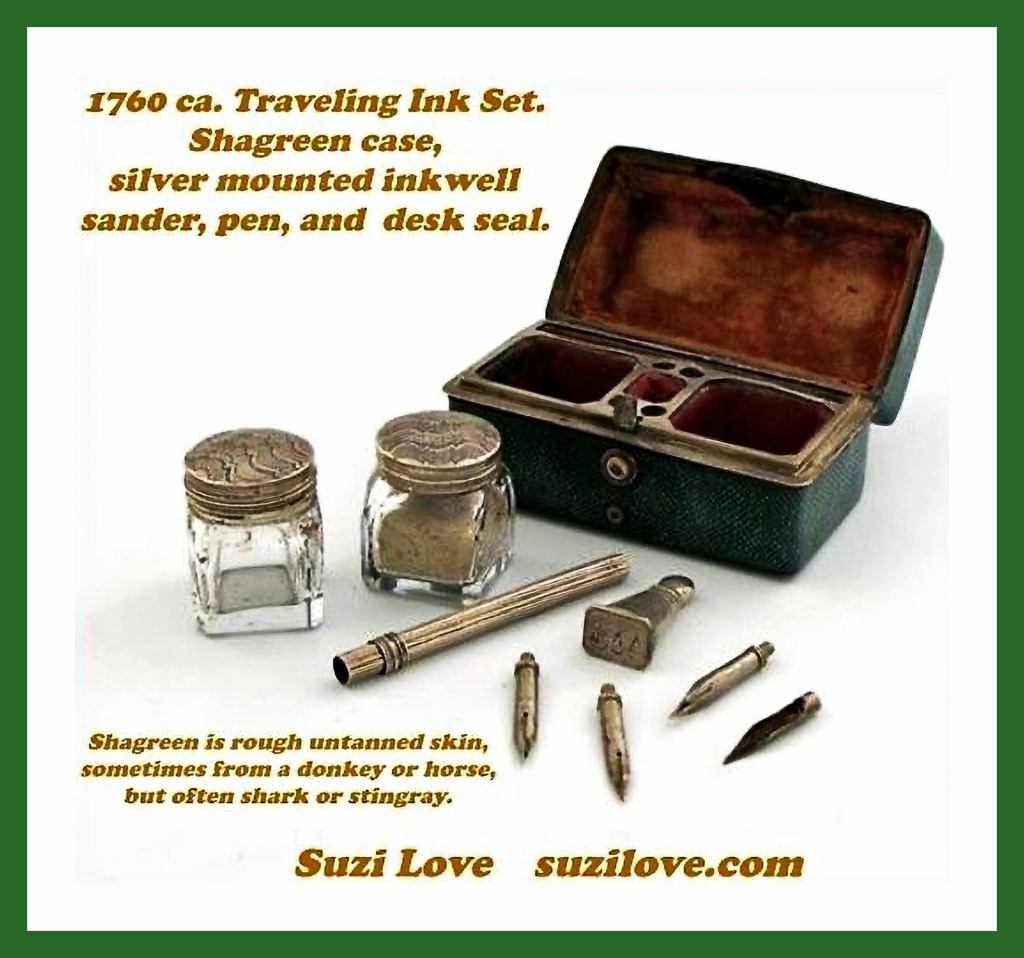
1760 ca. Traveling Ink Set. Rectangular Shagreen case with hinged cover which opens to reveal an unmarked silver mounted inkwell and sander, a pen, and a desk seal.
Definition Shagreen: Type of rough untanned skin, sometimes made from a donkey or a horse, but often from a shark or a stingray.
1760 ca. Traveling Ink Set. Rectangular Shagreen case with hinged cover which opens to reveal an unmarked silver mounted inkwell and sander, a pen, and a desk seal. Shagreen is a type of rough untanned skin, sometimes made from a donkey or a horse, but often from a shark or a stingray.D2D_RetailerBuyLink_HN_10. books2read.com/SuziLoveTravel
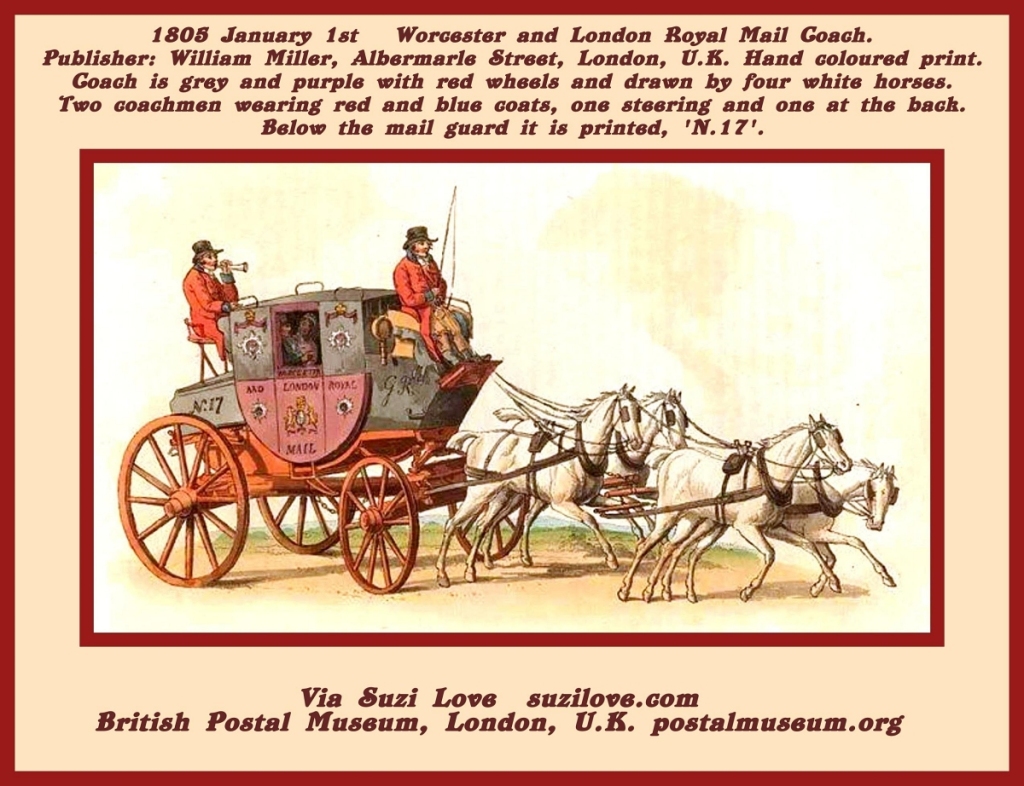
11805 January 1st Worcester and London Royal Mail Coach. The sort of mail coach that Jane Austen and famioy would have either ridden in or sent mail through. Publisher: William Miller, Albermarle Street, London, U.K. Hand colored print. Coach is grey and purple with red wheels and drawn by four white horses. Below the mail guard it is printed, ‘N.17’. Via British Postal Museum, London, U.K. postalmuseum.org
1805 January 1st Worcester and London Royal Mail Coach. Publisher: William Miller, Albermarle Street, London, U.K. Hand colored print. Coach is grey and purple with red wheels and drawn by four white horses. Below the mail guard it is printed, ‘N.17’. Via Suzi Love suzilove.com British Postal Museum, London, U.K. postalmuseum.orgD2D_RetailerBuyLink_HN_10. books2read.com/SuziLoveTravel
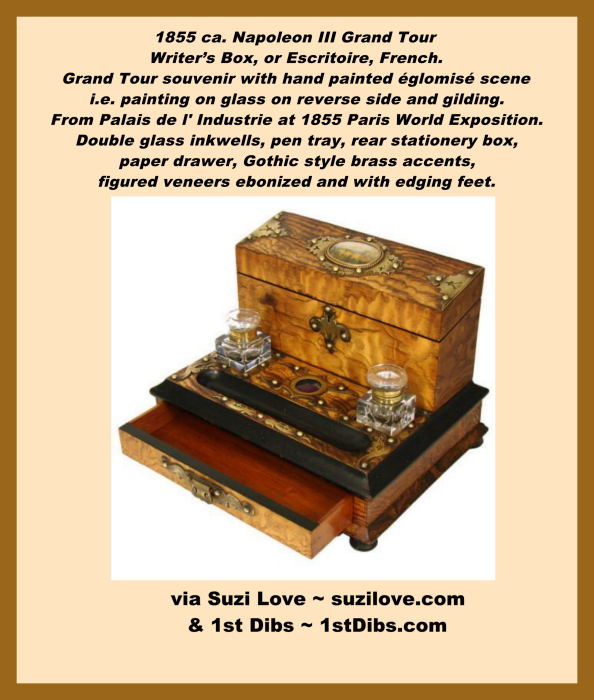
1855 ca. Napoleon III Grand Tour Influenced Travel Writer’s Box, Or Ecritoire, French. Double inkwell with rear stationery box, Gothic style brass accents and Grand Tour souvenir hand painted eglomise scene, the Palais de l’ Industrie from the 1855 Paris World Exposition! Figured veneers, ebonized edging, feet and pen tray and brass or bronze accents. via 1st Dibs 1stdibs.com
HN_13_D2D_WritingTools Book 13 What did the lady of the house use to pen notes? What sat on the desk of the man of the house when managing his accounts? #History #Nonfiction #travel books2read.com/SuziLoveWritingTools
19th Century Leather Travel Trunk, English. #JaneAusten #RegencyEra #travel
The trunk is made of wood and covered with woven canvas. It has leather corners and straps and handles for securing and lifting. The lock plate cover is marked ‘Finnigan’s London’, 18 New Bond Street, London, UK, and there is a Maker’s Brand and a Maker’s Label. There are four removable linen trays with cloth straps and handles. The trunk measures 13 inches high, 20 inches deep, and 36 inches wide.
19th Century Leather Trunk, English. 19th Century Leather Trunk, English. 19th Century Leather Trunk, English. 19th Century Leather Trunk, English. 19th Century Leather Trunk, English. 19th Century Leather Trunk, English. 19th Century Leather Trunk, English. 19th Century Leather Trunk, English.
19th Century Leather Trunk English Wood covered with woven canvas1. 19th Century Leather Trunk, English. Wood covered with woven canvas, leather corners, and lock plate cover marked Finnigan’s London. via Live Auctioneers . liveauctioneers.com
1750 ca. Spanish colonial ‘escritorio’, or writing desk, Columbia. Bone and mother of pearl inlay, hand etched sgraffito and original hand forged iron hinges. Interior has checkerboard drop front and ten compartments, each with original 18th century drawer pulls. Facade over-layed in mother of pearl with hand etched city-scapes, cathedrals, geometric patterns and foliate motifs. Interior has hand carved and gilt wood columns. Via Live Auctions ~ liveauctioneers.com
1830 Hatchetts, the White Horse Cellar, Piccadilly, London, UK. By James Pollard. Denver Art Museum.
The dreadful condition of British roads caused great apprehension to all classes of travelers. Making a journey anywhere in the country was a big undertaking and often a gentleman composed his last will and testament before his departure. Traveling in vehicles was only possible during the day or on the nights with very bright moonlight with few vehicles attempting road travel in winter and any travel on a Sunday was frowned upon. books2read.com/SuziLoveTravel
Description of Stage Coach Travel in England. via 1815 Journal Tour of Great Britain. “The gentlemen coachmen, with half-a dozen great coats about them, immense capes, a large nosegay at the button-hole, high mounted on an elevated seat, with squared elbows, a prodigious whip, beautiful horses, four in hand, drive in a file to Salthill, a place about twenty miles from London, and return, stopping in the way at the several public-houses and gin-shops where stage-coachmen are in the habit of stopping for a dram, and for parcels and passengers on the top of the others as many as seventeen persons. These carriages are not suspended, but rest on steel springs, of a flattened oval shape, less easy than the old mode of leathern braces on springs. Some of these stage coaches carry their baggage below the level of the axletree.”
1830 Hatchetts, the White Horse Cellar, Piccadilly, London, UK. By James Pollard. Denver Art Museum. HN_10_D2D_RetailerBuyLink_Travel and Luggage By Suzi Love History Notes Book 10 #History #travel How did people travel in past centuries? What did they take with them to make their long journeys easier? books2read.com/SuziLoveTravel
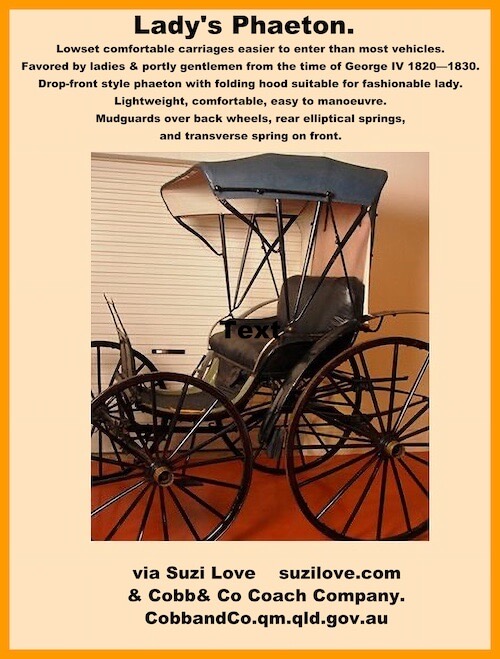
1800s Early A Lady’s Phaeton. Drop-front phaeton with folding hood suitable for a fashionable lady as lightweight, comfortable and easy to manoeuvre. Mudguards over the back wheels, rear elliptical springs and transverse elliptical spring fitted to the front. via Cobb and Co. Museum, Toowoomba, Australia.
Definition Carriage Lady’s Phaeton: Low set comfortable carriages easier to enter than most vehicles. Favored by ladies and portly gentlemen from the time of George IV 1820-1830.
Definition Phaeton: Open, four-wheeled, doorless carriage, popular in the 18th and 19th centuries. One or two seats, usually a folding or falling top, and owner-driven. The type of carriage liked by young ladies in Jane Austen’s times as the lady could drive herself, The most spectacular phaeton was the English four-wheeled high-flyer was the top phaeton, with body of a light seat for two resting on two sets of springs and reached by a ladder.
1843 Mail Coach now runs over ground in a little over four hours. Via 1843 The Chace, the Turf, and the Road by Nimrod via Google Books (PD-150)
1843 Coach now runs over ground in a little over four hours. Via 1843 The Chace, the Turf, and the Road by Nimrod via Google Books (PD-150)
D2D_RetailerBuyLink_HN_10. books2read.com/SuziLoveTravel