1843 Mail Coach now runs over ground in a little over four hours. Via 1843 The Chace, the Turf, and the Road by Nimrod via Google Books (PD-150)



1843 Mail Coach now runs over ground in a little over four hours. Via 1843 The Chace, the Turf, and the Road by Nimrod via Google Books (PD-150)
1813 The Theatre. From Poetical Sketches of Scarborough By Thomas Rowlandson. Aquatint was added by John Bluck and Joseph Stadler. The sketches by Green were made as souvenirs and not intended for publication. Via Wikimedia Commons commons.wikimedia.org (PD-ART)


1820 ca. Collection of Reticules, or Purses. Silk silver gauze, netting, fine crochet. Bags have drawstrings, chains and tassels. via Ruby Lane Auctions. #RegencyFashion #JaneAusten #British
Definition Of A Reticule; Bag or purse, often with a drawstring to pull closed and usually made of cloth or covered cardboard and often decorated with beading or embroidery. A reticule, or purse, or handbag, was usually carried by a woman during the Regency period to carry all their daily necessities. Earlier, women used pockets that tied at the waistline and were hidden in the folds of their skirts. Empire style, or early 1800s, high-waisted dresses made it impossible to either sewn in a pocket or to tie on a pocket, so women began carrying small, decorated bags called Reticules, or ridicules, which generally pulled close at the top with a drawstring. These Reticules, or bags, were the forerunners of our modern day purses.



‘Omnibuses, under the name of carrosses a cinq sous, were started in Paris in 1662. Seven vehicles to carry eight passengers each, all inside, were built, and on March 18th, 1662, they began running. The first one was timed to start at seven o’clock in the morning, but an hour or two earlier a huge crowd had assembled to witness the inauguration ceremony, which was performed l)y two Commissaires of the Chatelet, attired in their official robes. Accompanying them were four guards of the Grand Prevot, twenty men of the City Archers, and a troop of cavalry. ‘
In 1828, George Shillibeer, a London coach builder, visited Paris where he was impressed by the efficiency of the new horse-drawn bus service. The following year, he started a single horse-drawn omnibus connecting Paddington and Regent’s Park to the City of London. Passengers were picked up and set down anywhere along the route and fares were paid on board, in contrast to short-stage coaches which had to be booked in advance.
This new omnibus was pulled by three horses and carried 22 passengers who sat inside and were protected from the weather. Fares were sixpence and one shilling, less than a hackney cab or short-stage coach, but still too expensive for the lower classes.

In 1832, the London City monopoly of hackney carriages was removed, so horse buses expanded and within two years there were 620 licensed horse buses in London. By the Great Exhibition in 1851, London’s increase in visitors meant this number doubled and the number of routes increased to 150. By 1856, several bus operators were taken over by the new London General Omnibus Company until, with 600 omnibuses, they were the largest bus company in the world. In 1833, the first real steam omnibuses, the ‘Era’ and ‘Autopsy’ were invented by Walter Hancock, of Stratford, and started on the London roads. The ‘Era’ was the better omnibus of the two, and the most flattering things were said and predicted of it. Enthusiasts declared that omnibuses of this type would enable passengers to be carried at a cheaper rate and greater speed. The ‘Era’ ran from Paddington to the Bank, the same route as the horse-drawn omnibuses, and carried fourteen passengers, the fare being sixpence all the way. It travelled at the rate of ten miles an hour. Travel on these roads was also dangerous as highwaymen stopped and robbed anyone who came along. Male or female made no difference to highwaymen in Britain, nor to the bushrangers in Australia or the gangs on American roads, as they robbed indiscriminately and often with violence.
By the end of the 18th Century, however, travel as a pleasurable pursuit came into vogue and numerous guides were written for traveling all over the British Isles as well as on the continent. The 1812 ‘Tour Of Dr. Syntax’ was an ironic look at the new obsession of travel and travel guides. Before he set off for the Lake District, Dr. Syntax said to his wife, “You well know what my pen can do, and I’ll employ my pencil too: I’ll ride and write, and sketch and print and thus create a real mint: I’ll prose it here, I’ll verse it there and picturesque it everywhere. I’ll do what all have done before; I think I shall and somewhat more.” Georgian and Regency travelers were envious of aristocrats, even if they were of the nobility themselves, and loved to view all the British Great Houses.
A gentleman and his wife would even drive up to the front door of a mansion house and demand to be given a tour of the house. If they weren’t admitted, they would write in their journals of the inhospitable nature of the people on a particular estate. Thomas Pennant, William Mavor, and others, loved to write about these bad experiences and have them published. Paterson’s British Itinerary, a travel guide had 17 editions between 1785-1832 – it outlined the roads used by the stage and mail coaches, the tolls, the bridges, etc. This new touring craze created an industry of hospitality that encompassed more than simple mail coach trips from place to place, and more than a noble family traveling from their country seat to the Metropolis of London for parliamentary sittings. Inns had to improve the quality of the linens and meals if they wanted to attract the wealthier traveling class. Before that, many travelers carried their own linen, crockery, glasses, and utensils, as they didn’t trust the hygiene or standards of country inns.
Travel became something written about by poets with many sonnets written to the beauty of places like the Lake District in England, or the pyramids in Egypt. Inns became cleaner and more respectable so they could welcome travelers of the upper classes. This also meant that women could travel more as roads were slowly improved from rutted tracks that were only suitable for horse riding to roads that family coaches could travel along, though these roads were still narrow and subject to extremes of weather, such as flooding. The race was on to travel from places like London to Edinburgh in the fastest possible time.

1800-1850 ca. Reticule, Or Bag. Brown bag with monogram and drawstring, British. The Bridgerton family and Jane Austen and their female contemporaries would have sewn, gifted and used a bag similar to this. via Snowshill Manor, National Trust, U.K. nationaltrustimages.org.uk
Definition Reticule: Bag or purse, often with a drawstring to pull closed and usually made of cloth or covered cardboard and often decorated with beading or embroidery. A reticule, or purse, or handbag, was usually carried by a woman during the Regency period to carry all their daily necessities. Earlier, women used pockets that tied at the waistline and were hidden in the folds of their skirts. Empire style, or early 1800s, high-waisted dresses made it impossible to either sewn in a pocket or to tie on a pocket. So women began carrying small, decorated bags called Reticules, or ridicules, which generally pulled close at the top with a drawstring.


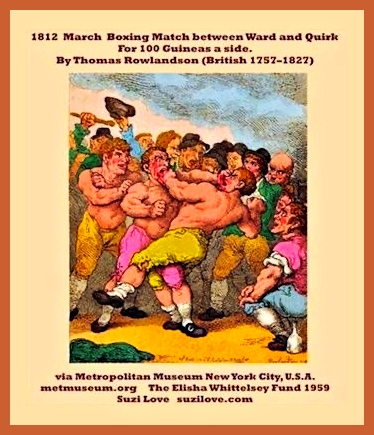
1812 March 1st Boxing Match between Ward and Quirk for 100 Guineas a side. By Thomas Rowlandson, British. via The Metropolitan Museum, New York City, U.S.A. metmuseum.org

What did the Bridgerton ladies and Jane Austen use to carry her personal items? Ridicule, Reticule, Or Handbag? Call them what you like: purses, bags, handbags, reticules, ridicules, clutches, or pocket replacements. They all did the same job and they changed greatly with the prevailing fashions of time. books2read.com/suziloveReticules
Definition Of A Reticule; Bag or purse, often with a drawstring to pull closed and usually made of cloth or covered cardboard and often decorated with beading or embroidery. A reticule, or purse, or handbag, was usually carried by a woman during the Regency period to carry all their daily necessities. Earlier, women used pockets that tied at the waistline and were hidden in the folds of their skirts. Empire style, or early 1800s, high-waisted dresses made it impossible to either sewn in a pocket or to tie on a pocket, so women began carrying small, decorated bags called Reticules, or ridicules, which generally pulled close at the top with a drawstring. These Reticules, or bags, were the forerunners of our modern day purses.
The term ‘ridicule’ derived from the Latin ‘ridiculum’ and first used in France during the 17th century and meant subjecting something or someone to mockery. As women’s tiny bags were mocked, or ridiculed, for being a useless fashion accessory carried outside when they were first used in the late 1700s, it’s likely this is how the name ‘ridicule’ started. The later term ‘reticule’ derived from the Latin reticulum, meaning ‘netted bag’ and was applied when bags became larger and often made from netting. In the late 1700s and early 1800s, they were also known as indispensables as they carried all the personal items a lady needed upon her person every day. They were easily made by ladies, easy to carry and became an indispensable fashion accessory.
In the early nineteenth century, reticules started to look like future handbags as they were often made from rigid card or molded mâché or card into a variety of shapes. Early bags were circular and with a drawstring but as women wanted their reticules to look individual they could be made with two halves and a hinged metal closure or with concertina sides. Materials varied from silk, cotton and string and shapes were round, hexagonal or lozenge shapes with shell shaped bags becoming very popular during the Regency and Romantic Eras.
1800s magazines were written for well bred women who could read, so they gave plenty of ideas for how ladies could make and embellish reticules for their own use and as pretty gifts. Needlework was highly encouraged as a pastime for a lady so bags were frequently embroidered or decorated with beading. By the 1820s, reticules became more like our modern handbags using soft leather gathered at the top or hard leather with a rigid fastener and metal chain for carrying.
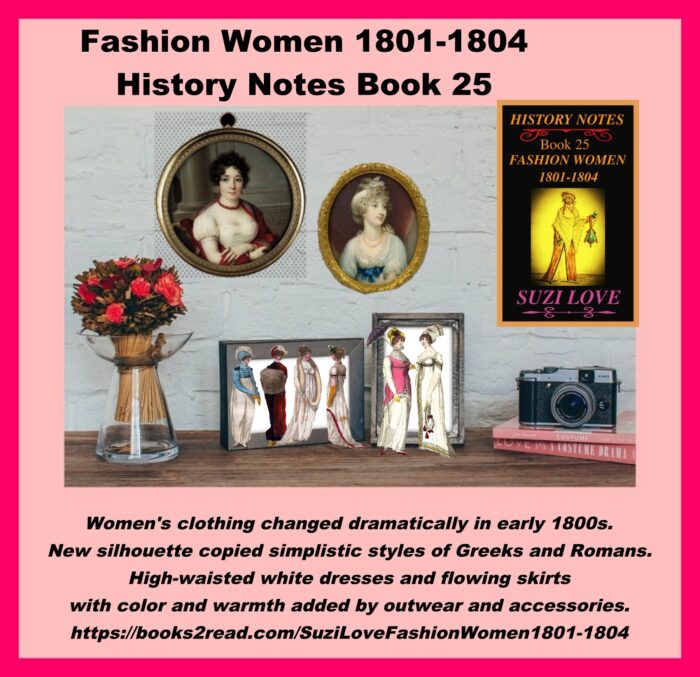
Writer Or Reader Of Regency Era?What did Jane Austen and friends wear? Women’s clothing changed dramatically in early 1800s. New silhouette copied simplistic styles of Greeks and Romans. High-waisted white dresses and flowing skirts with color and warmth added by outerwear and accessories. Fashion Women 1801-1804 History Notes Book 25 https://books2read.com/SuziLoveFashionWomen1801-1804
Definition Empire Style Dress: High-waisted white gowns defined women’s fashion during the Regency Era. ‘Empire’ is the name given to the period when Napoleon Bonaparte built his French Empire. High-waisted, loose gowns were adopted by the aristocracy as a symbol of turning away from the elaborate clothing worn in the 1700s. This sort of high-waisted dress would have been worn by Jane Austen and her contemporaries in England.
Definition Shawls: The shawl started off in India as a fine wool garment for men that could be worn as a scarf, turban or as a mantle: the word comes from the Persian shäl. Originally imported from the East, European Kashmir shawls were made first in Norwich and Edinburgh in Britain in the late 18th century. Shawls were an essential item in the early 1800s to cover the thin gowns women wore. They were made of muslin, gauze, silk, wool, and velvet, though cashmere shawls were the softest and most prized.


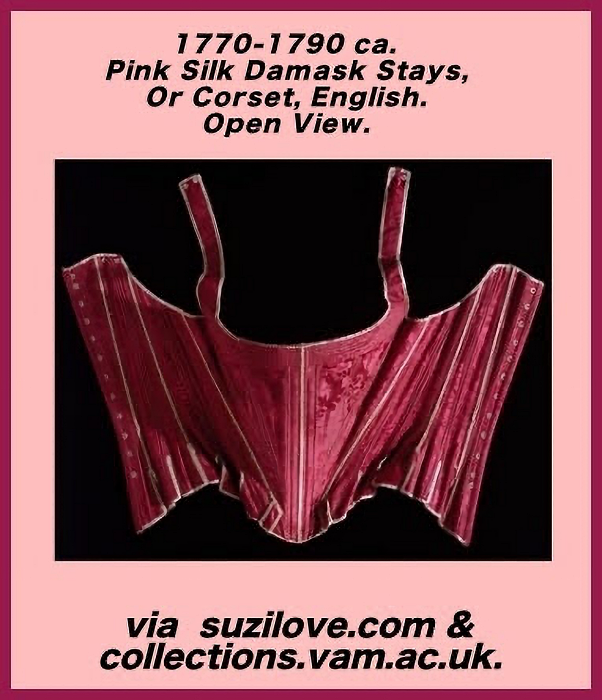
1770-1790 ca. Stays, or Corset, English. Pink silk damask, lined with linen, reinforced with whalebone, fingers spread over hips. via Victoria and Albert Museum, London, UK. collections.vam.ac.uk. https://books2read.com/SuziLoveCorsetBook15



1700s Late Pair of Pattens, English. Iron supports underneath leather and wood. via Victoria and Albert Museum, London, UK. collections.vam.ac.uk.
Definition Pattens: Under shoes that strapped onto shoes and worn outdoors and to lift shoes and dresses out the mud. People in Jane Austen’s lifetime would have used these to protect the hems of dresses and legs of men’s pants, plus protect delicate shoes.
Fashion Women Late 1700s History Notes Book 1.
What was fashionable for women in the late 1700s? Extravagant colors and fabrics and outrageous styles were all seen in these flamboyant fashions. Take a look at their dresses, suits, hats, shoes and bedroom fashions. books2read.com/suziloveFashWomen1700s

