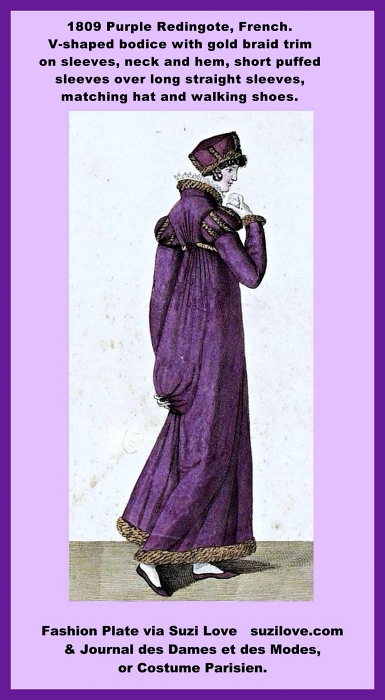
1809 Purple Redingote, Or Coat, French. V-shaped bodice with gold braid trim on sleeves, neck and hem, short puffed sleeves over long straight sleeves, matching hat and walking shoes. Fashion Plate via Journal des Dames et des Modes, or Costume Parisien.
Definition Redingote Or Pelisse: Long fitted outdoor coat worn over other garments for warmth. French word developed from English words, riding coat. Redingotes or Pelisses were needed to cover the flimsy dresses made of lightweight fabrics of the Regency years to provide warmth and some protection from windy conditions when gowns might lift and cause modesty issues. Jane Austen and her contemporaries often walked to places and so would have needed the warmth of a Pelisse or coat in the cold British winters.
1826 An Affair Of Honor Decided With Pistols In Hyde Park London, U.K. A Regency Gentleman’s Life. From The English Spy By Robert Cruikshank. By the Regency Era, dueling was outlawed, yet duels still happened because the courts were made up of peers who were reluctant to charge another peer with murder as a result of a duel. Gentlemen considered a duel a matter of honor and death was preferable to being labeled a coward.
Duels had a code of honor and were fought not so much to kill the opponent as to gain satisfaction and restore honor by demonstrating a willingness to risk your life. Originally dueling was only for the male members of nobility but then extended to all members of the upper classes. At first, duels were fought with swords but by the Regency Era, duels with pistols were more common. Some duels were also fought between women.
Favorite dueling grounds near London included Hampstead Heath, Chalk Farm and the common land that extended south of the Thames over modern Battersea, Putney and Wimbledon. The windmill there was a popular landmark beneath which duelists often agreed to meet. These locations were convenient for their proximity to the city, yet also sufficiently remote to avoid interruption and in the event of a fatality, attractively close to potential getaway routes on the roads out of London.
1826 An Affair Of Honor Decided With Pistols In Hyde Park London, U.K. A Regency Gentleman’s Life. From The English Spy By Robert Cruikshank.
Reticule Or Bag: Purse, often with a drawstring to pull closed and usually made of cloth or covered cardboard and often decorated with beading or embroidery. Carried by a woman during the Regency period to carry all their daily necessities. in the place of pockets.
Spencer: Short jacket, cropped at the waist, worn over a dress, or gown. Delicate and regency dresses provided so little protection from the cold, so over garments were essential for warmth, modesty and good health.
Pelisse Or redingote Or Walking Dress: Coat worn over clothing of both sexes for warmth and protection from the elements.
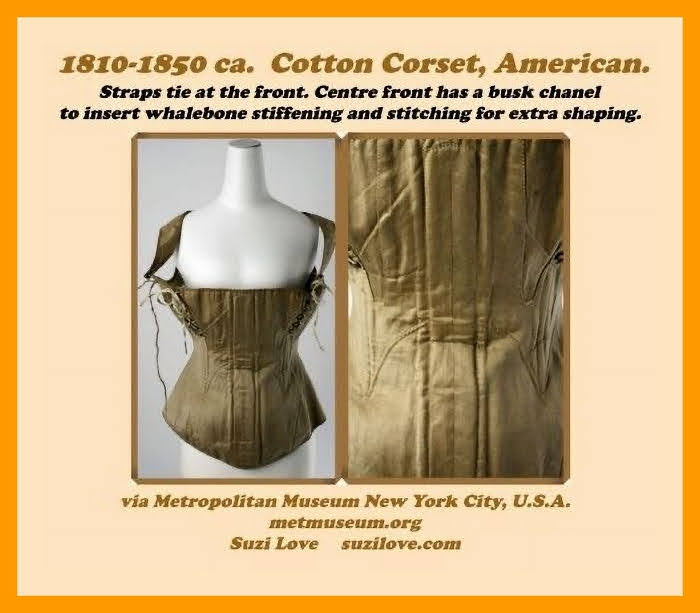
1810-1850 ca. Cotton Corset With Whalebone Busk, American. Straps tie at the front. Center front has a busk Chanel to insert a whalebone to keep the corset stiff and in place. There is extra stitching on the corset to give more shape and extra reinforcing to keep the corset upright and the dress worn over it smooth and flat. Marking stamped on the lining, ‘Jane Laney’ and Mrs. Bishop, Corset Maker, 108 Hudson St., New. York, USA. via Metropolitan Museum New York City, U.S.A. metmuseum.org
Surviving stays, or corsets as they became to be called in the nineteenth century, show that both longline and shorter corsets were worn and that they were made of cotton, silk and sateen. A lot of these corsets were front fastening, plus many were laced at both the front and the back so our aristocratic fictional heroines could indeed dress and undress themselves without the assistance of a maid.
Definition Busk: Central panel in a corset to give it extra shape. Made from wood, bone which was usually whalebone, ivory, and in the latter 1800s from metal.
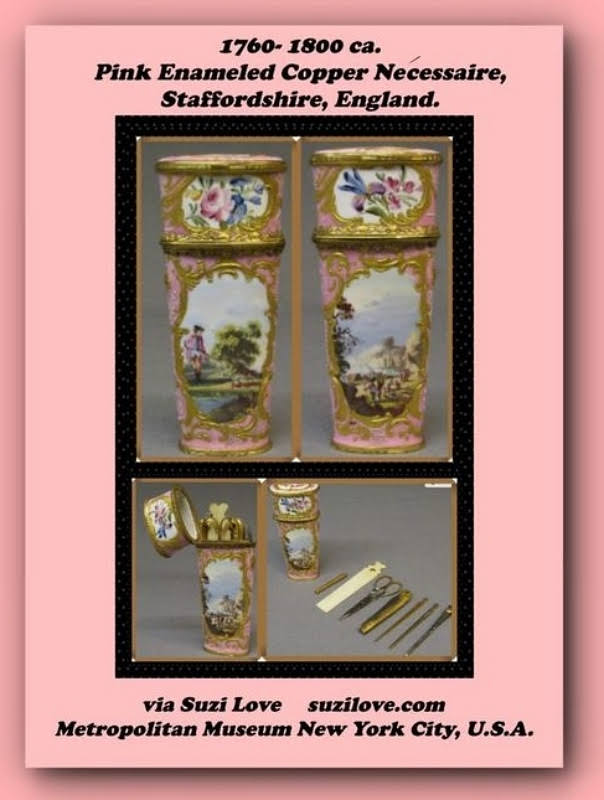
1760-1800 ca. Pink Enamel and Copper Necessaire Or Etui, Staffordshire, England. Dimensions: 3 3/4 x 1 5/8 in. (9.5 x 4.1 cm) Credit: Pierpont Morgan, 1917 via Metropolitan Museum, N.Y.C., U.S.A. metmuseum.org
Definition Necessaire Or Etui: Small toiletry, writing, or sewing containers were called Necessaire or Etui: Tiny boxes or containers were carried in large castles or sprawling manor houses so a lady or gentleman had their essentials with them all day. They were also important when traveling by coach, trains, or on ships where space was always limited. A necessaire or Etui was easily carried in a bag, reticule, or pocket so essentials were on hand for personal grooming, to repair a ripped hem, replace a button, to embroider, or to write a note or letter.
1800s Typical Breakfast and Tea China, England. Tea cups, Bread and Butter plates, Teapot, Butter Dish, Coffee Cups, Tea Set, Milk Jug, Water Jug, Bread Dish, Sardine Dish, Bacon Dish, Marmalade Jar and Breakfast Cups. From: 1860 Mrs. Isabella Beeton’s Book of Household Management. These are the sort of salads that Jane Austen’s family would have eaten to accompany main dishes during the early 1800s, or Regency Era.
Travel and Luggage By Suzi Love History Notes Book 10. How did people travel in Jane Austen’s times. In past centuries? What did they take with them to make their long journeys easier? Travel by road, ship, canal, or railway all took a long time and had dangers so people learned to prepare. And then, in the nineteenth century, road improvements, inventions, and scientific developments made travel more pleasurable. books2read.com/SuziLoveTravel
“There is nothing I would not do for those who are really my friends. I have no notion of loving people by halves, it is not my nature.” Jane Austen ~ Northanger Abbey (1817) #JaneAusten #RegencyEra #Quotation
What salads were served in Jane Austen and the Bridgerton households? Salads “Persons in health, who feel a craving for salad, may indulge in the enjoyment of it to a great extent with perfect impunity, if not with positive benefit. Oil, when mixed in salad, appears to render the raw vegetables and herbs more digestible. Vinegar likewise promotes the digestion of lettuce, celery, and beet-root.
“Endive is very wholesome, strengthening, and easy of digestion; but when strong seasoning is added to it, it becomes an epicurean sauce. — Mayo.”
Recipe for a Winter Salad, by the late Rev. Sydney Smith. Two large potatoes, passed through kitchen sieve, Unwonted softness to the salad give, Of mordent mustard add a single spoon; To add a double quantity of salt; Three times the spoon with oil of Lucca crown, And once with vinegar, procured from town. True flavor needs it, and your poet begs The pounded yellow of two well-boiled eggs. Let onion atoms lurk within the bowl, And, scarce suspected, animate the whole; And, lastly, on the flavored compound toss A magic teaspoon of anchovy sauce. Then, though green turtle fail, though venison’s tough, And ham and turkey are not boiled enough, Serenely full the Epicure may say,- Fate cannot harm me—I have dined to-day!
The Spanish proverb says four persons are wanted to make a good salad: a spendthrift for oil, a miser for vinegar, a counsellor for salt, and a madman to stir all up.
1859 Hints for the Table by John Timbs.
1800s Typical Salads: Cucumber, Beetroot and Potato, Macedone Salad, Tomato Salad, Jellied Russian and Italian Salads, Prawn Salad, Egg and Lettuce, Lobster Salad and Salad Dumas. From: Mrs. Beeton’s Book of Household Management. via Google Books (PD-150)