↓
 

Suzi Love

Making history fun, one year at a time.

Header_
  • Home
  • Newsletter
  • Pre order form
  • Shop
    • Cart
    • Checkout
    • My account
    • Refund and Returns Policy
  • Blog
  • BOOKS
    • History Events
    • Kelly’s Justice
    • Outback Arrival
    • Irresistible Aristocrats
    • History Notes
    • Scandalous Siblings
    • Love After Waterloo
    • Regency Life Series
  • Privacy Policy
  • EVENTS
Home » British history » Page 4 << 1 2 3 4 5 6 … 12 13 >>

Tag Archives: British history

Post navigation

← Previous Post
Next Post→
Grosvenor_Brick row houses around Grosvenor Square, London.

Grosvenor Square, London, U.K. #BritishHistory #London #RegencyEra #GrosvenorSquare #QueenVictoria

Suzi Love Posted on March 17, 2026 by Suzi LoveJanuary 29, 2026

As some of my historical romance books are set in a house in Grosvenor Square, its history fascinates me. How about you? Do you love the history associated with Grosvenor Square?  The Jamison family in Embracing Scandal and Scenting Scandal live in Grosvenor Square.

Grosvenor Square - Pronounced ˈɡrovna’, is a large garden square in the exclusive Mayfair district and the centrepiece of the Mayfair property of the Duke of Westminster and takes its name from their surname, “Grosvenor”.

In 1710, Sir Richard Grosvenor obtained a licence to develop Grosvenor Square and the surrounding streets and development started around 1721. Grosvenor Square became one of the most fashionable residential addresses in London from its construction until the Second World War, with numerous leading members of the aristocracy in residence. The early houses had five or seven bays, basement, three main stories, and an attic. Colen Campbell produced a design for a palatial east side to the square featuring thirty Corinthian columns but this was not carried out and in the end most of the houses were built to individual designs. There were mews behind all four sides. Many houses were rebuilt later and acquired an extra storey. Number 23 (later 26) was rebuilt in 1773–74 for the 11th Earl of Derby by Robert Adam and shows how grandeur of effect and sophisticated planning might be achieved on a confined site. It was demolished and rebuilt again in the 1860s.

  • 1761 – Sir Richard Grosvenor, the 7th Baronet, was created Baron Grosvenor of Eaton in the County of Chester
  • 1784 – Became Viscount Belgrave and Earl Grosvenor under George III.  
  • 1831- At coronation of William IV, Robert Grosvenor, the 2nd Earl Grosvenor, became Marquess of Westminster
  • 1874 – Queen Victoria created the title  Duke of Westminster and bestowed it upon Hugh Grosvenor, 3rd Marquess of Westminster.
  • Current title holder is Gerald Grosvenor, 6th Duke of Westminster and his seat is at Eaton Hall, Cheshire The Dukedom and Marquessate are in the Peerage of the United Kingdom The rest are in the Peerage of Great Britain. The courtesy title of the eldest son and heir to the Duke is Earl Grosvenor.

Nearly all of the older houses were demolished during the 20th century and replaced with blocks of flats in a neo-Georgian style, hotels and embassies. The central garden was originally reserved for the occupants of the houses but is now a public park managed by The Royal Parks. Grosvenor Square. Grosvenor Square has been the traditional home of the official American presence in London since John Adams established the first American mission to the Court of St. James’s in 1785. Adams lived, from 1785 to 1788, in the house which still stands on the corner of Brook and Duke Streets. During World War II, Eisenhower established a military headquarters at 20 Grosvenor Square, and during this time the square was nicknamed “Eisenhower Platz”.

The former American Embassy of 1938–1960 on the square was purchased by the Canadian government and renamed Macdonald House. In 1960, a modern USA Embassy was built on the western side of Grosvenor Square and caused controversy in the mainly Georgian and neo-Georgian area. In 2008, the United States Government chose a site for a new embassy in the Nine Elms area, south of the River Thames with with relocation completed by 2016 or 2017. In October, 2009, English Heritage granted Grade II listed status to the building which means new owners will not be allowed to change the facade.

Grosvenor Square in Literature In Little Dorrit by Charles Dickens the Barnacles are said to live at “four Mews Street Grosvenor” which “was not absolutely Grosvenor Square itself but it was very near it”. Caroline Bingley makes a comment regarding the local dance in Pride and Prejudice ”We are a long way from Grosvenor Square, are we not, Mr Darcy”. It appears in the title of several novels including The Lonely Lady of Grosvenor Square by Mrs. Henry De La Pasture (1907) and The House in Grosvenor Square by Linore Rose Burkard (2009) In Oscar Wilde’s play Lady Windermere’s Fan, the Duchess of Berwick says, “I think on the whole that Grosvenor Square would be a more healthy place to reside in. There are lots of vulgar people live in Grosvenor Square, but at any rate there are no horrid kangaroos crawling about.”

Grosvenor_Bow Windows on a corner in Grosvenor Square.
Grosvenor_Brick row houses around Grosvenor Square, London.
Grosvenor Square via 1834 Mogg’s Strangers’ Guide To London. Via Google Books.
Grosvenor 1813 Grosvenor Square, North Side. Via Rudolph Ackermann’s The Repository Of Arts. 

Grosvenor_Brick row houses around Grosvenor Square, London.
Grosvenor_Modern Day Grosvenor Square park.
Grosvenor_1750 Grosvenor Square, Looking East.
Grosvenor 1800 ca. North Side of Grosvenor Square.
Grosvenor_22-23 Grosvenor Square. Setting for my Scandalous Siblings Series. 

Grosvenor_22 Grosvenor Square, London.
18th Century Grosvenor Grosvenor_ Square, East Side, Mayfair, London.
Grosvenor Square, Mayfair, London, U.K. #BritishHistory #London #RegencyEra #GrosvenorSquare #QueenVictoria https://books2read.com/suziloveSS Share on X
SS_D2D_ https://books2read.com/suziloveSS
Posted in 1700s, 1800s, 1900s, London, Regency Era, Suzi Love Images | Tagged art, British history, household, London, Regency London, Suzi Love Books, Suzi Love Images, Suzi Love Research, travel

1811 Black Half-Mourning Dress With High White Neck Ruffle as worn in Jane Austen’s years. #JaneAusten #RegencyFashion #Mourning

Suzi Love Posted on March 14, 2026 by Suzi LoveAugust 13, 2026

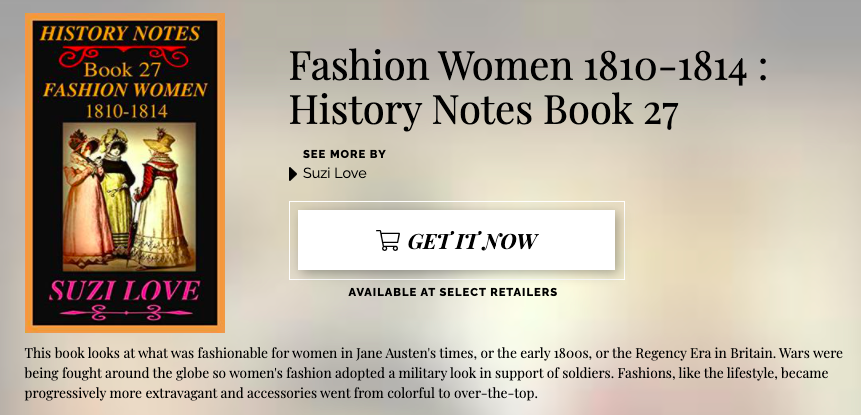
1811 Half-Mourning Dress, French. Black dress, high white neck ruffle, black hat with white trim and white shoes. Jane Austen and her family would have worn this type of outfit when mourning a relative or friend. However, as black dresses, black tunics, and black lace shawls were popular throughout the Regency years, it is often hard to decide what was definitely made for mourning and what was simply fashionable wear. Fashion Plate via Journal des Dames et des Modes, or Costume Parisien.

In November, 1810, Princess Amelia, youngest daughter of George III, died. At the end of 1810 full mourning of complete black would have been worn but by the beginning of 1811, half mourning would still have been to respect the loss of a royal family member. Half-mourning allowed touches of silver, grey, mauve and white to be added to a mostly black outfit and would be worn after the period of full mourning was ended, times depending on the relationship to the deceased person. Garments and accessories could either be trimmed with black, jet jewelry worn, black ribbons added, or a layer of black net or gauze added to a dress or hat. 

Definition Half or Slight Mourning: Allowed touches of grey and white to be added to full, or deep, mourning ensembles. Some lustre, or shine, was allowed in fabrics and accessories. After a time, mauve or deep purple could also be worn. https://books2read.com/SuziLoveFashion1810-1814

1811 Half-Mourning Dress, French. Black dress, high white neck ruffle, black hat with white trim and white shoes. Fashion Plate via Journal des Dames et des Modes, or Costume Parisien.
1811 Black Half-Mourning Dress With High White Neck Ruffle as worn in Jane Austen’s years. #JaneAusten #RegencyFashion #Mourning https://books2read.com/SuziLoveFashion1810-1814
Post On X
HN_27_D2D_FashWomen1810-1814
https://books2read.com/SuziLoveFashion1810-1814

Posted in 1800s women's fashion, Dress Or Robe, Europe, fashion accessories, France, hats, Jane Austen, mourning, Regency Era, Regency Fashion, shoes, Suzi Love Images | Tagged 1800s women's fashion, British history, Dress Or Gown, fashion accessories, Fashion Plate, gloves, Hats And Hair, Jane Austen, Journal des Dames et des Modes, mourning, Regency Fashion, Shoes

19th Century Mid. Dance Card or Aide de Memoire With Timepiece. #RomanticEra #VictorianEra #Dance #writingtool #antique

Suzi Love Posted on March 7, 2026 by Suzi LoveJanuary 28, 2026

19th Century Mid Dance Card or Aide de Memoire. Jeweled and enameled gold dance card with concealed timepiece. Lid with a blue enamel with rose-cut diamonds floral wreath, opening to compartment with watch dial, pencil, and notebook. via Sotheby’s Auctions. sothebys.com

19th Century Mid Dance Card or Aide de Memoire. Jeweled and enameled gold dance card with concealed timepiece. Lid with a blue enamel with rose-cut diamonds floral wreath, opening to compartment with watch dial, pencil, and notebook. via Sotheby’s Auctions. sothebys.com
19th Century Mid. Dance Card or Aide de Memoire With Timepiece. #RomanticEra #VictorianEra #Dance #writingtool #antique books2read.com/SuziLoveWritingTools Share on X
HN_13_D2D_Writing Tools books2read.com/SuziLoveWritingTools
Posted in 1800s, Box Or Container, dancing, Decorative Item, Europe, History, household, Pastimes, Regency Era, Romantic Era, Suzi Love Images, Victorian Era, Writing Tools | Tagged 1800s women's fashion, antiques, Box Or Container, British history, dancing, Sothebys Auctions, watch, Writing Tools

George, Prince of Wales, later George IV, portrait by Mather Byles Brown. #RegencyEra #art #BritishHistory #BritishRoyalty

Suzi Love Posted on March 4, 2026 by Suzi LoveFebruary 17, 2026

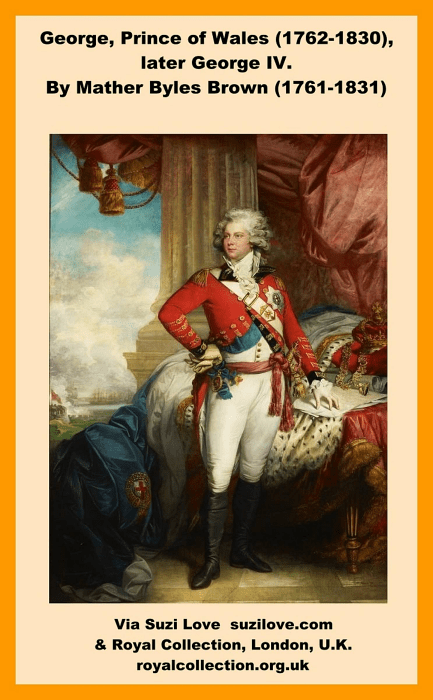
George, Prince of Wales (1762-1830), later George IV. By Mather Byles Brown (1761-1831) via Royal Collection, London, U.K.

The decision to make Prince George the Regent took a lot of political debate. After nearly two and a half months of political wrangling, the British government agreed to grant the title of Prince Regent on George. The Act of Parliament was finally passed by a commission in the House of Lords on February 5th 1811 and the Prince was formally sworn in as Regent at Carlton House the next day. He continued to rule as Regent until 1820 when, on his father’s death, he assumed the title George IV and reigned until his own death in 1830.

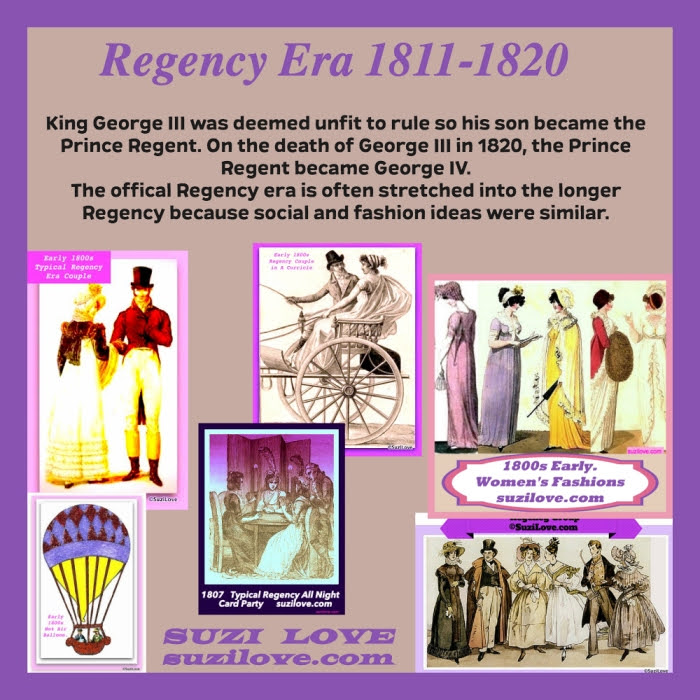
The British Regency was the period from 1811-1820. King George III was deemed mad and unfit to rule so his son became his proxy, the Prince Regent, or Prinny to his close friends. This was the situation when Jane Austen was alive. The Regency Era was famous for its beautiful clothing as well as the magnificent buildings erected and furnished in the ‘Regency Style’ under orders from the extravagant Prince Regent.
 

George, Prince of Wales (1762-1830), later George IV. By Mather Byles Brown (1761-1831) via Royal Collection, London, U.K.
George, Prince of Wales, later George IV, portrait by Mather Byles Brown. #RegencyEra #art #BritishHistory #BritishRoyalty https://books2read.com/suziloveROver Share on X
RL_1_D2D_Regency Overview RetailerLinks.https://books2read.com/suziloveROver
RL_1_D2D_Regency Overview RetailerLinks https://books2read.com/suziloveROver
Posted in 1800s Mens Fashions, art, England, Georgian Era, History, Jane Austen, London, pants, peerage, Regency Era, Royalty, shoes, Suzi Love Images | Tagged 1800s men fashion, art, British history, Jane Austen, Regency Era, Regency Fashion, Regency Men, Regency Royalty, Royal Collection London, Royalty, Suzi Love Images

Regency Era Overview: Images, information, funny anecdotes give overview of Jane Austen’s and Bridgerton’s times. #Bridgerton #RegencyEra #JaneAusten #BritishHistory

Suzi Love Posted on February 24, 2026 by Suzi LoveJanuary 25, 2026

Regency Era Overview: Images, information, funny anecdotes give overview of Jane Austen’s and Bridgerton’s times. #Bridgerton #RegencyEra #JaneAusten #BritishHistory https://books2read.com/suziloveROver

Continue reading →
Posted in 1800s, 1800s Mens Fashions, Bridgerton, Carriage, cartoon, Coat or Pelisse Or Redingote, Customs & Manners, Decorative Item, England, fashion accessories, Food and Drink, hats, History, household, Jane Austen, pants, Pastimes, peerage, Regency Era, Regency Fashion, Regency Life Series, riding, shoes, sports, Suit, Suzi Love Books, travel, underclothing, Vest or Waistcoat, weapons | Tagged 1800s men fashion, 1800s women's fashion, Book 1, Bridgerton, British history, fashion accessories, Fashion Plate, gloves, Hats And Hair, Jane Austen, King George IV, peerage, Regency Era, Regency Fashion, Regency Life, Regency Life Series, Regency London, Regency Men, Regency Overview, Regency People, Regency Royalty, Regency Women, Shoes, Suzi Love Books

1811 January Three Women In Jane Austen Style Evening Dresses With Fashion Accessories. #RegencyFashion #BritishHistory #JaneAusten

Suzi Love Posted on February 20, 2026 by Suzi LoveJanuary 24, 2026

1811 January Evening Dresses, English. Standing Figure: French frock with half train of black imperial gauze worn over a slip of white sarsnet or satin, ornamented with a Vandyke border of white velvet or thread lace. White velvet hat ornamented with two curled ostrich feathers, with a silver or beaded band. White kid gloves and shoes. Sitting Figure: Grecian robe of silver grey crape worn over a white satin under-dress, ornamented at the hem and each side with a light and tasteful border of black bugles. Stomacher edged with black beads, corresponding with those which finish the bosom and sleeves. Earrings, necklace, and bracelets of jet. Hair in waved curls on each side of the face, divided in front of the forehead with a full plait and barrel comb of jet. White satin slippers with black jet clasps or bugle rosettes. White kid gloves and a fan of silver-frosted crape. Back-ground figure: Dress of black Venetian velvet with short Circassian sleeve, gathered in a knot of white beads or pearl, bosom and stomacher to correspond, pearl necklace, ear-rings, and bracelets. Belt of white velvet with mother-of-pearl clasps. Convent veil of white cobweb net confined with a pearl crescent, à la Diana. Sandal slippers and gloves of white kid and fan of carved ivory. Fashion Plate via Rudolph Ackermann’s ‘The Repository’ of Arts.

Definition Evening Dress: Minute distinctions between ball, dinner, evening and opera gowns meant different quality of fabrics and designs. A Ball Gown differed from an evening dress as expensive silk fabrics were usually worn, light or heavy, decorated with lace, embroidery or beading, with low-cut bodice, short or no sleeves, and full skirts. In the early 1800s, white cotton dresses were considered suitable for many evening events, but not for balls. And definitely not for an evening event in a palace. White dresses with white embroidery for evening were considered fashionable and exclusive as only the wealthy could afford them.

1811 January Evening Dresses, English. Standing Figure: French frock with half train of black imperial gauze worn over a slip of white sarsnet or satin, ornamented with a Vandyke border of white velvet or thread lace. White velvet hat ornamented with two curled ostrich feathers, with a silver or beaded band. White kid gloves and shoes. Sitting Figure: Grecian robe of silver grey crape worn over a white satin under-dress, ornamented at the hem and each side with a light and tasteful border of black bugles. Stomacher edged with black beads, corresponding with those which finish the bosom and sleeves. Earrings, necklace, and bracelets of jet. Hair in waved curls on each side of the face, divided in front of the forehead with a full plait and barrel comb of jet. White satin slippers with black jet clasps or bugle rosettes. White kid gloves and a fan of silver-frosted crape. Back-ground figure: Dress of black Venetian velvet with short Circassian sleeve, gathered in a knot of white beads or pearl, bosom and stomacher to correspond, pearl necklace, ear-rings, and bracelets. Belt of white velvet with mother-of-pearl clasps. Convent veil of white cobweb net confined with a pearl crescent, à la Diana. Sandal slippers and gloves of white kid and fan of carved ivory. Fashion Plate via Rudolph Ackermann's 'The Repository' of Arts.
1811 January Three Women In Jane Austen Style Evening Dresses With Fashion Accessories. #RegencyFashion #BritishHistory #JaneAusten books2read.com/SuziLoveFashion1810-1814 Share on X
HN_27_D2D_FashWomen1810-1814
https://books2read.com/SuziLoveFashion1810-1814
27_D2D_FashWomen1810-1814
Posted in 1800s women's fashion, Dress Or Robe, England, fashion accessories, hats, Jane Austen, London, Regency Era, Regency Fashion, sewing, shoes, Suzi Love Images | Tagged 1800s women's fashion, British history, Dress Or Gown, fans, fashion accessories, Fashion Plate, feathers or aigrette, gloves, Hats And Hair, Jane Austen, Regency Fashion, sewing, shawls, Shoes, The Repository Of Arts

1826 Cartoon: The Cyprian’s Ball At the Argyll Rooms. From A Regency Gentleman’s Life. #RegencyEra #Cartoon #BritishHistory

Suzi Love Posted on February 13, 2026 by Suzi LoveJanuary 25, 2026

1826 The Cyprian’s Ball At the Argyll Rooms. A Regency Gentleman’s Life. From The English Spy By Robert Cruikshank.

Cyprians: High-class prostitutes who dressed well and were interesting and entertaining. They were often under the protection of a wealthy gentleman for a time and were gifted clothing, jewelry and temporary housing. Called a multitude of names, none of which were flattering. Ladybird, lady of easy virtue, impure, fashionable impure, soiled doves, Covent Garden nun, Drury Lane vestal, left-handed wife, short-heeled wench, three-penny upright, woman of pleasure.

1826 The Cyprian's Ball At the Argyll Rooms. A Regency Gentleman's Life. From The English Spy By Robert Cruikshank.
1826 The Cyprian’s Ball At the Argyll Rooms. A Regency Gentleman’s Life. From The English Spy By Robert Cruikshank.
1826 The Cyprian's Ball At the Argyll Rooms. #2 A Regency Gentleman's Life. From The English Spy By Robert Cruikshank.
1826 The Cyprian’s Ball At the Argyll Rooms. #2 A Regency Gentleman’s Life. From The English Spy By Robert Cruikshank.
1826 Cartoon: The Cyprian's Ball At the Argyll Rooms. From A Regency Gentleman's Life. #RegencyEra #BritishHistory #Cartoon #England books2read.com/suziloveYGD Share on X
RL_2_D2D_RetailerBuyLink_RL_2
RL_2_D2D_RetailerBuyLink_RL_2 https://books2read.com/suziloveYGD

Posted in 1800s, 1800s Mens Fashions, 1800s women's fashion, cartoon, Customs & Manners, dancing, England, Google Books, London, Music, peerage, Regency Era, Suzi Love Images | Tagged 1800s men fashion, 1800s women's fashion, British history, Cartoons, dancing, drink, England, Food, google books, Regency Fashion, Regency London, Regency Men

1552 Onwards Covent Garden, London, England. #BritishHistory #London #CoventGarden

Suzi Love Posted on February 12, 2026 by Suzi LoveJanuary 30, 2026

Covent  Garden is within the London boroughs of Westminster and Camden, and the parliamentary constituencies of Cities of London and Westminster and Holborn and St Pancras. The district is divided by the main thoroughfare of Long Acre, north of which is given over to independent shops centred on Neal’s Yard and Seven Dials, while the south contains the central square with its street performers and most of the elegant buildings, theatres and entertainment facilities, including the Theatre Royal, Drury Lane, and the London Transport Museum.

In 1552, the land was seized by Henry VIII and granted to the Earls of Bedford. The 4th Earl  commissioned Inigo Jones to build fine houses to attract wealthy tenants. It was the first modern square in London, with Italian arcades and a flat, open space or piazza with low railings. This layout was copied in other new estates in London.

1555 John Russell, 1st Earl Of Bedford. By a follower of John Bettes. Given land of Covent Garden by Herny VIII after the dissolution of the Monasteries.
1650 The piazza of Covent Garden about 1650, as engraved by Wenceslaus Hollar. Courtesy University of Toronto.
1721-1789 ca. St. Paul's Church, Covent Garden, London, U.K. From between two arches of the plaza. Watercolor with grey wash. By Thomas Sandy. Via Suzi Love suzilove.com & British Museum, London, UK. britishmuseum.org
1721-1789 ca. St. Paul’s Church, Covent Garden, London, U.K. From between two arches of the plaza. Watercolor with grey wash. By Thomas Sandy. Via British Museum, London, UK. britishmuseum.org
1800s Early Covent Garden Market, London, U.K.

In 1654, an open-air fruit and vegetable market grew on the south side of the fashionable square but over time the market and the surrounding area fell into disrepute. Taverns, theatres, coffee-houses and brothels opened up, the gentry moved away, and rakes, wits and playwrights moved in.

By the 18th century Covent Garden had become a well-known red-light district, attracting notable prostitutes such as Betty Careless and Jane Douglas. Descriptions of the prostitutes and where to find them were provided by Harris’s List of Covent Garden Ladies, the “essential guide and accessory for any serious gentleman of pleasure”. 

Covent Garden’s market was always disorderly, the buildings in bad shape, and overcrowded with stalls, donkeys, carts, and peddlers. The small number of passageways into the piazza were small and with bottle necks of carts moving goods and market sellers fighting for right of way. The markets supplied fruits and vegetables, mostly homegrown but with imported goods increasing. Many sellers missed paying tolls for selling in the piazza or refused to pay them so the owner, the Earl of Bedford, took many people to court for not paying tolls. He realized the markets were in such poor condition that he couldn’t charge sellers until he improved them. In 1830, a new market hall was built with sections dividing the kind of goods sold which did improve things, but the markets remained chaotic. By 1890, people were again complaining about the narrow streets and congestion.

Covent Garden’s flower girls attracted attention by shouting:

“Two bundles a penny, primroses!”

“Sweet violets, penny a bunch!”

In 1851, Henry Mayhew wrote London Labour and the London Poor describing two types of flower girl. The young girls, or waifs, sold flowers to feed the family. The other type of flower girl stayed out late, doubled as prostitutes, and had bad reputations.

In 1913, Herbrand Russell, 11th Duke of Bedford agreed to sell the Covent Garden Estate for £2 million to the MP and land speculator Harry Mallaby-Deeley, who sold his option in 1918 to the Beecham family for £250,000.

1809 View Of the New Covent Garden Theatre, London. From Hart Street, showing the King's entrance. Watercolor drawn by James Winston. via British Museum.
1809 View Of the New Covent Garden Theatre, London. From Hart Street, showing the King’s entrance. Watercolor drawn by James Winston. via British Museum.
1811 Bird’s Eye View of Covent Garden Market, London, UK. Main fruit, flower and vegetable market in London in early 19th century. Began here in 1656 with few temporary stalls in back garden of home of Earl of Bedford. Charles II granted market lease and in 1678 bought by Adam Piggot and others who built permanent stalls. By 1811, smelly, dirty, and overcrowded. Engraver J. Bluck. After Augustus Charles Pugin and Thomas Rowlandson published by Ackermann. Via Suzi Love suzilove.com & British Museum, London, UK. britishmuseum.org
1811 Bird’s Eye View of Covent Garden Market, London, UK. Main fruit, flower and vegetable market in London in early 19th century. Began here in 1656 with few temporary stalls in back garden of home of Earl of Bedford. Charles II granted market lease and in 1678 bought by Adam Piggot and others who built permanent stalls. By 1811, smelly, dirty, and overcrowded. Engraver J. Bluck. After Augustus Charles Pugin and Thomas Rowlandson published by Ackermann. Via British Museum, London, UK. britishmuseum.org
1827 Covent Garden Market, Westminster, London, U.K.  By Frederick James Havell.
1827 Covent Garden Market, Westminster, London, U.K. By Frederick James Havell.

In 1830, Charles Fowler’s neo-classical building was erected to cover the market and as the market grew, the prostitutes moved on. The Floral Hall and Charter Market were added and the Jubilee Market in 1904.

1835 Covent Garden Watch House, London, UK. Next to the church of St. Paul's Church, Covent Garden. Two story white building with 'Watch House' painted on its upper floor is shown with a lively street scene in the foreground. via Museum of London.
1835 Covent Garden Watch House, London, UK. Next to the church of St. Paul’s Church, Covent Garden. Two story white building with ‘Watch House’ painted on its upper floor is shown with a lively street scene in the foreground. via Museum of London.
1852 J.M.W. Turner’s birthplace in Maiden Lane, Covent Garden. Brick terraced house at night with a figure in top hat walking past and two figures with a candlelight in the doorway_Watercolour with body color over graphite. Drawn by John Wykeham Archer.

In 1913,Herbrand Russell, 11th Duke of Bedford agreed to sell the Covent Garden Estate for £2 million to the MP and land speculator Harry Mallaby-Deeley, who sold his option in 1918 to the Beecham family for £250,000. By the end of the 1960s, traffic had become congested until in 1974 the market relocated to the New Covent Garden Market about three miles (5 km) south-west at Nine Elms. In 1980, the central building re-opened as a shopping centre and then became a tourist location with cafes, pubs, small shops, a craft market called the Apple Market, and another market in the Jubilee Hall.

1552 Onwards Covent Garden, London, England. #BritishHistory #London #CoventGarden https://www.books2read.com/suziloveROver Share on X
RL_1_D2D_Regency Overview RetailerLinks
https://books2read.com/suziloveROver
RL_1_D2D_Regency Overview RetailerLinks https://books2read.com/suziloveROver
Posted in 1700s, 1800s, England, Food and Drink, Georgian Era, History, London, Regency Era, Romantic Era, Suzi Love Images, Victorian Era | Tagged 1700s Or Georgian Era, 1800s Or 19th Century, British history, British Museum, Covent Garden, Food, Georgian era, google books, London, Museum Of London, Regency London, Suzi Love Images, theatre, WikiMedia Commons | Leave a reply

19th Century Early Women’s Cotton Caps With Hanging Tails, Or Flirtation Ribbons. #Regency #JaneAusten #Fashion

Suzi Love Posted on February 11, 2026 by Suzi LoveJanuary 24, 2026

19th Century Early Women’s Cotton Caps. Worn as morning caps, night caps, or under other hats. With lappets, hanging ties, or tails, which were also called ‘follow me lads’, or ‘flirtation ribbons’. via Museum of Fine Arts, Boston, U.S.A. mfa.org. via Museum of Fine Arts, Boston, U.S.A. mfa.org

Definition Caps: Worn as morning caps, night caps, or under other hats. Jane Austen and her family and female friends would have worn caps like these, sometimes during the morning at home, to bed to keep their long hair from becoming knotted, or under a bonnet to hold a hairstyle in place.
Caps sometimes had hanging ties, or tails, were also called ‘follow me lads’, or ‘flirtation ribbons’.

Definition Lappets: Two long strips of material, often lace, hanging from top of head down back or over  shoulders. Sometimes extensions of a headdress and a requirement for court dress.

19th Century Early Women's Cotton Caps. Worn as morning caps, night caps, or under other hats. Hanging ties, or tails, also called 'follow me lads', or 'flirtation ribbon's. via Museum of Fine Arts, Boston, U.S.A. mfa.org
19th Century Early Women’s Cotton Caps. Worn as morning caps, night caps, or under other hats. Hanging ties, or tails, also called ‘follow me lads’, or ‘flirtation ribbon’s. via Museum of Fine Arts, Boston, U.S.A. mfa.org
Posted in 1800s, 1800s women's fashion, Australia, Bridgerton, Canada, England, Europe, France, hats, Jane Austen, Regency Era, Regency Fashion, Suzi Love Images, U.S.A | Tagged 1800s women's fashion, British history, europe, Hats And Hair, Jane Austen, Museum Of Fine Arts, Regency Fashion, Romantic Era, sewing, USA

1811-1820 Jane Austen’s British Regency Era. King George III Deemed Mad and Son Appointed Prince Regent. #JaneAusten #Regency #London #BritishRoyalty

Suzi Love Posted on February 11, 2026 by Suzi LoveJanuary 21, 2026

1811-1820 Regency Era Overview. The British Regency was the period from 1811-1820. King George III was deemed mad and unfit to rule so his son became his proxy, the Prince Regent, or Prinny to his close friends. The Prince Regent was often a figure of ridicule in Jane Austen’s times and featured regularly in caricatures, or cartoons, as a fat man who overindulged in everything and spent an exorbitant amount of money.

As a period in Britain’s official history, the Regency lasted less than ten years, although scholars apply the term Regency to a much longer period. It began in 1811, when George Ill was declared mad and the Prince of Wales was appointed Regent. It ended in 1820 when the King finally died and the Regent was crowned George IV. However, the Regency was a period in Britain’s history that had an effect on the social and cultural life for four decades, from the start of the French Revolution in 1789 to the passing of Britain’s Great Reform Act in 1832.

The decision to make George IV the Regent took a lot of political debate. After nearly two and a half months of political wrangling, the British government agreed to grant the title of Prince Regent on George. The Act of Parliament was finally passed by a commission in the House of Lords on February 5th 1811 and the Prince was formally sworn in as Regent at Carlton House the next day. He continued to rule as Regent until 1820 when, on his father’s death, he assumed the title George IV and reigned until his own death in 1830.

During the Regency, royalty and upper class ladies and lords, or the Beau Monde, lived elegant and extravagant lives that also allowed excesses and depravity. Britain was united behind exceptional heroes in long wars against France, but internally divided by class distinction and political agitation. The foundations of a modem industrial nation were laid by engineers, inventors and scientists. while Romantic poets and visionary artists dreamt of escape to earlier times and more ideal worlds. From: Queen’s Gallery, London, U.K. For more on this, take a look at my book Regency Overview. https://books2read.com/suziloveROver

1811-1820 British Regency Era. King George III Deemed Mad and Son Appointed Prince Regent. #Regency #London #BritishRoyalty
1811-1820 Jane Austen's British Regency Era. King George III Deemed Mad and Son Appointed Prince Regent. #JaneAusten #Regency #London #BritishRoyaltyhttps://books2read.com/suziloveROver Share on X
RL_1_D2D_Regency Overview RetailerLinks
https://books2read.com/suziloveROver
RL_1_D2D_Regency Overview RetailerLinks https://books2read.com/suziloveROver
Posted in 1800s, 1800s Mens Fashions, 1800s women's fashion, Customs & Manners, England, fashion accessories, Google Books, hats, History, Jane Austen, London, pants, peerage, Quotations, Regency Era, Regency Fashion, Royalty, shoes, Suzi Love Images | Tagged 1800s men fashion, 1800s women's fashion, British history, Dress Or Gown, fashion accessories, Hats And Hair, Jane Austen, London, peerage, Regency Fashion, Regency Life, Regency London, Regency People, Regency Royalty, Shoes

Post navigation

← Previous Post
Next Post→

SUBSCRIBE TO SUZI LOVE'S NEWSLETTER.

Recent Posts

  • Book Hooks: “Oh, dear. I’ve taken your bed. I’ve forced you to use a mattress on the floor.” #Waterloo #regencyromance #historicalromance #BookHook #MFRW
  • 1790-1810 ca. Linen and Metal Corset, American Or European. Front Lacing. #Corset #RegencyEra #GeorgianEra #JaneAusten
  • 1808 Two Ladies in Jane Austen style high-waisted dresses, white and blue. #RegencyFashion #JaneAusten #HistoricalFashion
  • 1800s Men’s Top Hat Styles Chart from Bridgerton and Jane Austen years. #Bridgerton #JaneAusten #RegencyFashion #Hats
  • 1809 Blue Redingote Or Walking Coat With Military Trim in Jane Austen style. #RegencyFashion #FashionHistory #JaneAusten

Recent Comments

  1. Suzi Love on Book Hooks: Ironic that Lady Melton and her unborn child had been safer in battle-torn Europe than in England.  #MilitaryRomance #RegencyRomance #BattleofWaterloo
  2. Suzi Love on Book Hooks: Ironic that Lady Melton and her unborn child had been safer in battle-torn Europe than in England.  #MilitaryRomance #RegencyRomance #BattleofWaterloo
  3. Suzi Love on Book Hooks: Ironic that Lady Melton and her unborn child had been safer in battle-torn Europe than in England.  #MilitaryRomance #RegencyRomance #BattleofWaterloo
  4. Suzi Love on Book Hooks: Ironic that Lady Melton and her unborn child had been safer in battle-torn Europe than in England.  #MilitaryRomance #RegencyRomance #BattleofWaterloo
  5. Jana Richards on Book Hooks: Ironic that Lady Melton and her unborn child had been safer in battle-torn Europe than in England.  #MilitaryRomance #RegencyRomance #BattleofWaterloo

Login

  • Log in

Archives

  • August 2026
  • July 2026
  • June 2026
  • May 2026
  • April 2026
  • March 2026
  • February 2026
  • January 2026
  • December 2025
  • November 2025
  • October 2025
  • September 2025
  • August 2025
  • July 2025
  • June 2025
  • May 2025
  • April 2025
  • March 2025
  • February 2025
  • January 2025
  • December 2024
  • November 2024
  • October 2024
  • September 2024
  • August 2024
  • July 2024
  • June 2024
  • May 2024
  • April 2024
  • March 2024
  • February 2024
  • January 2024
  • November 2023
  • October 2023
  • September 2023
  • August 2023
  • July 2023
  • April 2023
  • March 2023
  • June 2022
  • April 2022

Categories

  • 1700s
  • 1700s Mens fashion
  • 1700s Womens Fashion
  • 1800s
  • 1800s Mens Fashions
  • 1800s women's fashion
  • 1900s
  • art
  • Australia
  • Bath
  • bedroom fashion
  • Book Hooks
  • Box Or Container
  • Bridgerton
  • Bus Trips
  • Canada
  • Carriage
  • cartoon
  • Celebrity
  • Chatelaine
  • children
  • Children
  • Christmas
  • Coat or Pelisse Or Redingote
  • Contemporary
  • Corset
  • Couple
  • Customs & Manners
  • dancing
  • December Scandal
  • Decorative Item
  • Dress Or Robe
  • Easter
  • Edwardian Era
  • Embracing Scandal
  • England
  • Ester In Images
  • Europe
  • Events
  • Fashion
  • fashion accessories
  • Food and Drink
  • Four Times A Virgin
  • France
  • furniture
  • Georgian Era
  • Georgian Fashion
  • Google Books
  • Grand Tour
  • Group
  • hats
  • History
  • History Events
  • History Notes
  • History Of Christmases Past
  • household
  • Hygiene
  • Irresistible Aristocrats
  • Jane Austen
  • Keanu Reeves
  • Kellys Justice
  • Legal
  • London
  • Love After Waterloo
  • Loving Lady Katharine
  • medical
  • military
  • money
  • mourning
  • Music
  • Outback Arrival
  • pants
  • Pastimes
  • peerage
  • People
  • Places
  • Pleasure House Ball
  • postal
  • Queensland
  • Quotations
  • Regency Era
  • Regency Fashion
  • Regency Life Series
  • Reticule or Bag
  • riding
  • Romantic Era
  • Royalty
  • Russia
  • Scandalous Siblings Series
  • Scenting Scandal
  • Self Publishing
  • sewing
  • Shirt
  • shoes
  • Shopping
  • South Pacific
  • Spencer
  • sports
  • Suit
  • Sunday Snippet
  • Suzi Love
  • Suzi Love Books
  • Suzi Love Images
  • Suzi Love Writing
  • Swain Cove
  • THe Viscount's Pleasure House
  • travel
  • U.S.A
  • underclothing
  • Vest or Waistcoat
  • Victorian Era
  • Victorian Fashion
  • weapons
  • weddings
  • Writing Tools

1800s men fashion 1800s women's fashion antiques Bridgerton British history Cartoons Corset cravat decorative Dress Or Gown England europe fashion accessories Fashion Plate France Georgian era Georgian Fashion gloves google books Hats And Hair historical romance History Notes household Jane Austen jewelry Journal des Dames et des Modes London Metropolitan Museum NYC pants Redingote Or Pelisse Or Coat Regency Era Regency Fashion Regency London reticule or bag riding Romantic Era sewing shawls Shoes Suzi Love Books Suzi Love Images Tailcoat The Repository Of Arts underclothing Vest or Waistcoat

©2026 - Suzi Love - Weaver Xtreme Theme Privacy Policy
↑