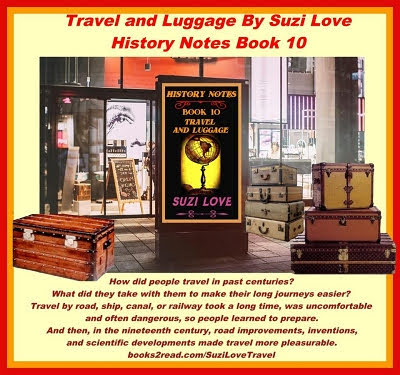
How did people travel in past centuries? What did they take with them to make their long journeys easier? Travel by road, ship, canal, or railway all took a long time and had dangers so people learned to prepare. And then, in the nineteenth century, road improvements, inventions, and scientific developments made travel more pleasurable. Travel and Luggage By Suzi Love History Notes Book 10 books2read.com/SuziLoveTravel
Horse Power To Steam. Various alternatives to horse power were tested in London’s streets during the 19th century. Steam powered road engines and trams proved too heavy and damaged the roads. Stationary steam engines were used to haul trams attached to a cable but these were only really effective on hills that we too steep for horses. There were also experiments with trams driven gas engines and battery electric power. but was successfully developed. Petrol engines were still primitive and unreliable in the 1890s. In 1900 the reliable horse still dominated the streets of London but new technology was to revolutionize road transport.
1816 Inside a dining room by Martin Drolling. Via Wikimedia Commons commons.wikimedia.org (PD-ART) This is typical of the inside of a gentleman’s household in Jane Austen’s times.
1800 Un salon, or public Room, at Frascati, Paris. This plate depicts a group of people at Frascati’s. The man in the foreground is plainly dressed in dark colors while pastels are favored by the women. From: Illustrations by Francois Courboin from Octave Uzanne’s Les Modes de Paris. (PD-Art) Although this is in Paris, there were similar places in England where Jane Austen and her contemporaries would meet to eat, drink and play games.
Frascati’s was a cafe in Paris, described by the text as “‘A stream of human beauty’, as the expression of the period has it, was still to be seen flowing through the galleries of Greek and Roman antiquities, spreading through the porticos, into the saloons, and smaller chambers, pouring and winding along the garden alleys, and disappearing at last into the kiosks where it was lost to sight. The great mirror at the end of the garden reflected, as in a wonderful prismatic vision, the surging crowd of veiled or turbaned heads of ever-changing couples, each whispering and fondly clasped. While farther off seated at tables in the open air, thirsty nymphs called for creams and tutti frutti and all the various iced compounds then so eagerly consumed.”
1800 Un Salon, or Public Room, at Frascati, Paris. Frascati’s was a popular cafe in Paris where people walked through the galleries of Greek and Roman antiquities, past the porticos, into saloons and smaller chambers, winding along the garden alleys and disappearing into kiosks. The man wears darker clothing while the women are in colorful dresses. via Suzi Love ~ suzilove.com
& Illustrations by François Courboin, French librarian (1865-1926)
From Octave Uzanne’s ‘Les Modes de Paris, or Fashion in Paris,’ the various phases of feminine taste and aesthetics from 1797 to 1897.
(PD-Art) via Brown University Library, U.S.A. 1800 Un Salon, Or Public Room, At Frascati, Paris. Regency #Paris #Art https://books2read.com/SuziLoveFashionMen1800-1819 Share on X
From the finish of the 18th century until 1820, men’s fashions in European and European-influenced countries moved away from the formal wear of brocades, lace, wigs and powder to more informal and relaxed styles. Focus was on undress rather than formal dress. Typical menswear in the early 1800s included a tailcoat, a vest or waistcoat, either breeches, pants, or the newer trousers, stockings, shoes or boots, all worn with an overcoat and hat. This basic ensemble was accessorized with some form of neckcloth or cravat, gloves, walking stick, cane or riding crop, handkerchief, fobs, watch and perhaps a quizzing glass or eye glass.
Skirted coats were replaced with short-fronted, or cutaway, tailcoats worn over fitted waistcoats and plain, white linen shirts. Knee breeches were gradually replaced by tight-fitting pantaloons and later trousers, decorative shoes with buckles were replaced with a variety of boot styles, and fussy and ruffled neckwear gave way to intricately tied, white linen neck cloths. A Regency Era, or early 1800s, gentleman was outfitted in more practical fabrics, such as wool, cotton and buckskin rather than the fussy brocades and silks of the late 1700s.
Craftsmen created containers of precious metals, leather, and silks and decorated them with jewels and engraving. Jane Austen and her contemporaries would have used writing boxes, linen boxes when travelling, boxes to hold their food and drink supplies while traveling by carriage, and decorative boxes to keep letters, ribbons, gloves, hairpins etc. Boxes, Cases, and Necessaires By Suzi Love, History Notes Book 11. books2read.com/suziloveBoxesCases.
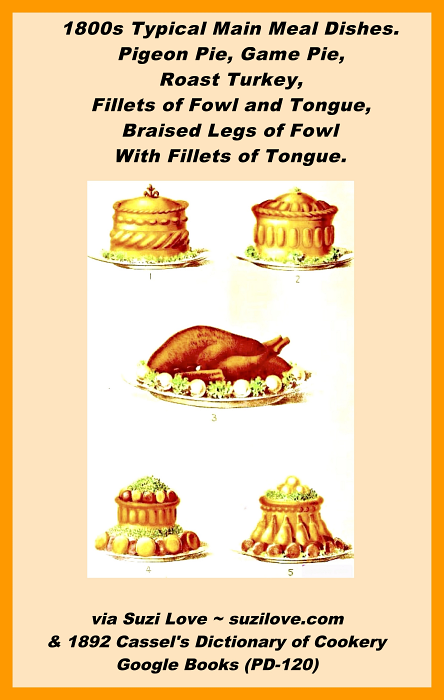
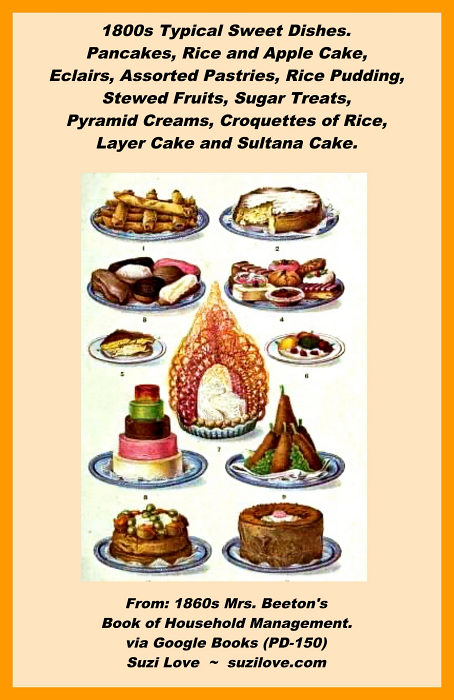
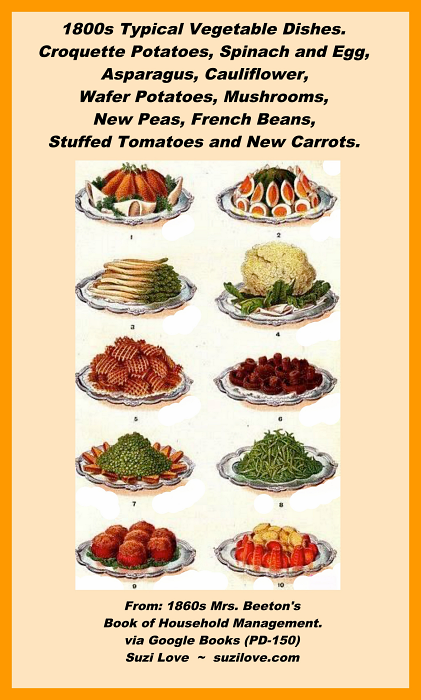
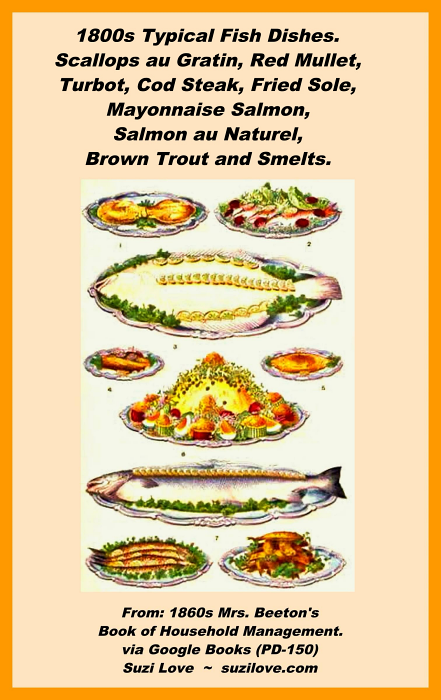
1800s Typical Game Bird Dishes Served during the 1800s. These are the sort of dishes Jane Austen’s family would have eaten on a regular basis. Banded Partridges, Roast Partridges, Roast Surrey Fowl, Larded Guinea Fowl, Roast Plovers, Stuffed Capons, Roast Gosling and Roast Pigeons. From: 1850s- 1860s Mrs. Beeton’s Books of Household Management. via Google Books (PD-150)
Craftsmen created containers of precious metals, leather, and silks and decorated them with jewels and engraving. Jane Austen and her contemporaries would have used writing boxes, linen boxes when travelling, boxes to hold their food and drink supplies while traveling by carriage, and decorative boxes to keep letters, ribbons, gloves, hairpins etc. Boxes, Cases, and Necessaires By Suzi Love, History Notes Book 11. books2read.com/suziloveBoxesCases.
1800s Typical Cold Collation Dishes served during the 1800s. These are the sort of dishes Jane Austen’s family would have eaten on a regular basis. Pigeon Pie, Raised Game Pie, Cutlets and Peas, Prawn Bouquet, Creamed Chicken, Plover’s Eggs, Lamb Cutlets, Stuffed Larks, Piped Ham, Boned Capon. From: 1860 Mrs. Isabella Beeton’s Book of Household Management.
1800s Typical Cold Collation Dishes. Pigeon Pie, Raised Game Pie, Cutlets and Peas, Prawn Bouquet, Creamed Chicken, Plover’s Eggs, Lamb Cutlets, Stuffed Larks, Piped Ham, Boned Capon. From: 1860 Mrs. Isabella Beeton’s Book of Household Management.
1800s Typical Cold Collation Dishes Served In Households Like Jane Austen’s During The Regency Era. #Food #Regency #BritishHistory #JaneAusten
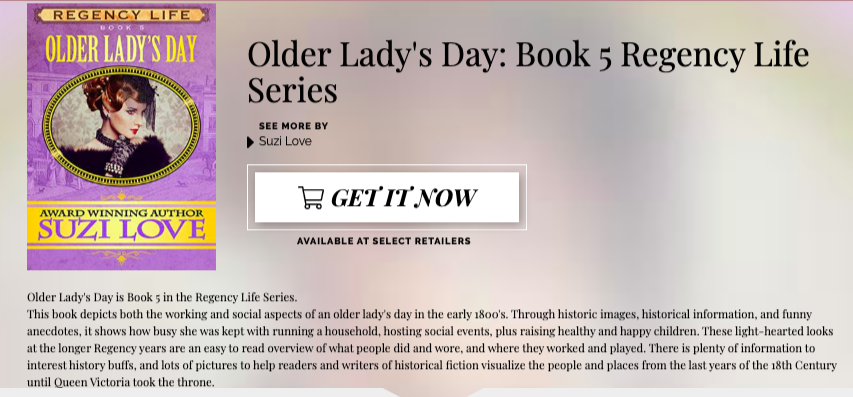
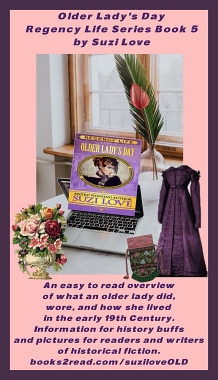
What did an older lady do and wear in the Regency Era? Information & pictures for readers and writers of early 1800s history, nonfiction and fiction. books2read.com/suziloveOLD The older lady’s day usually started with her toilette in her bedroom, where her maid helped her dress for the day and styled her hair. After that, she would join her family downstairs for breakfast unless she preferred a tray with either tea or hot chocolate in her bedroom as she prepared for her busy day. Her day would be made up of speaking with the housekeeper and the cook about the week’s menus, assuring that the servants were all available that day and no one was ill, and checking the list of foods needed.
What did an older lady do and wear in #RegencyEra? Information & pictures for readers and writers of #History #nonfiction #Regency books2read.com/suziloveOLD
She would also enquire if the laundry was up to date and that they had enough good linen to make up all the beds before extended family members and guests arrived. If she was in the country and hosting a weekend house party, she would assign rooms to the guests on her lists and query that all was in readiness for their arrival.