Want a glimpse into the life of a young lady in Jane Austen and the Bridgerton years? #bridgerton #RegencyEra #JaneAusten
Young Lady’s Day is Book 4 in the Regency Life Series. This book depicts the often-frivolous life and fashions of a young lady in the early 1800’s, but also gives a glimpse into the more serious occupations a young lady may undertake. Through historic images, historical information, and funny anecdotes, it shows how a young lady fills her day, where she is permitted to go, and who she is allowed spend time with. These light-hearted looks at the longer Regency years are an easy to read overview of what people did and wore, and where they worked and played. There is plenty of information to interest history buffs, and lots of pictures to help readers and writers of historical fiction visualize the people and places from the last years of the 18th Century until Queen Victoria took the throne. https://books2read.com/suziloveYLD
Love the life of Jane Austen and her stories? Fan of the Bridgerton series? Reader or writer of the early 1800s, or Regency Era? For information and pictures, try Regency Life Series by Suzi Love. Light-hearted series about Regency Era, or early 1800s. For writers, readers and history lovers.
Thes books use historic images, historical information, and funny anecdotes to give an overview of life through the late Georgian and the Regency years. A light-hearted look at the people, places, and fashions of the times, plus an easy to read overview of the politics and economics. There is plenty of information to interest history buffs, and lots of pictures to help readers and writers of historical fiction visualize the people and places from the last years of the 18th Century until Queen Victoria took the throne.
Try Books 1-5 Regency Life Series by Suzi Love. Regency Overview – Young Gentleman’s Day – Older Gentleman’s Day – Young Lady’s Day – Older Lady’s Day
Max shuddered at Carina’s passion-hazed command to make love to her, self-doubts rose like a thunder cloud. “Love making between us is impossible.” As soon as he’d spat out the harsh words, he regretted them. She pulled back. “Forgive me, but we cannot forget who we are and where we are. Let’s not delude ourselves, or lie to each other.”
She stared with unblinking, moisture-filled eyes, and that blasted pain shot straight through to his gut and caused a raw burn. She stopped his absent-minded rubs at his midriff. “Are you suffering some sort of aliment in your abdomen?”
He bristled. “Of course not. I enjoy perfect health.”
She lifted a brow. “Your veins may run with the bluest blood, but your human form suffers from the same frailties as the rest of us lower mortals. I’ve noticed that you rub your stomach quite often. Perhaps you should consult a physician.”
“Ridiculous charlatans. I’ll not listen to another swindler promising to cure a simple digestive disorder by bleeding me dry with leeches.”
She gasped and put her hand to her mouth. “Oh, Max. You’ve already visited physicians.”
“It’s nothing.”
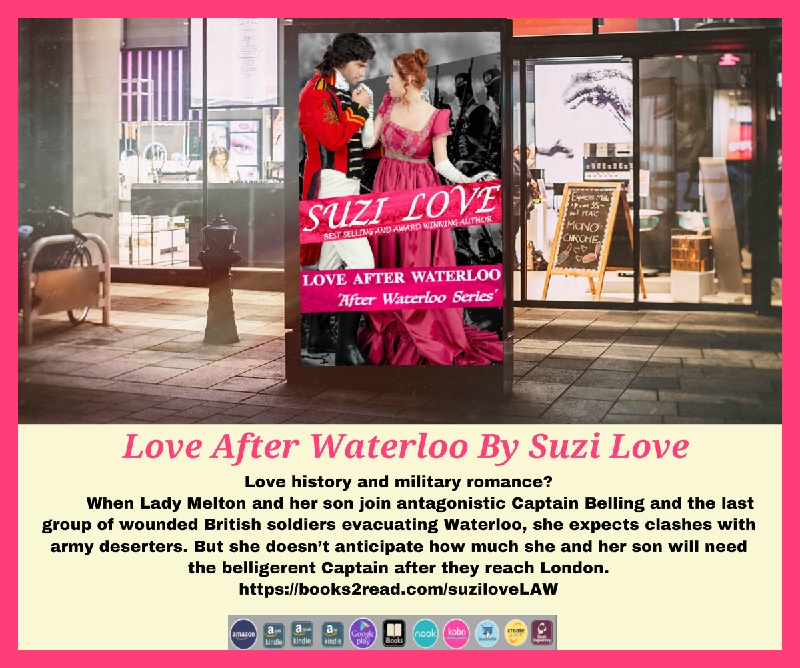
Tortured duke reunites with a mysterious lady to search for answers from their intertwined pasts and expose those who orchestrated the evil that scarred them both. She’ll do anything to protect her younger sisters and he’s desperate to make amends.
books2read.com/suziloveFTAV
1805-1810 ca. India Muslin Dress, English. Slight train, embroidered panel down centre between two lines of drawn-thread work, embroidery of cotton in chikan stitch and knots in scrolls and plume design. Elbow length sleeves with two insertions of embroidery in leaf pattern. via Manchester Art Gallery
Definition Empire Style: Named after the First Empire in France, by 1800 Empire dresses had a very low décolleté, or neckline and a short narrow backed bodice attached to a separate skirt. Skirts started directly under the bust and flowed into the classical relaxed wide styles of Greece and Rome. This style of dress is associated with Jane Austen and her contemporaries as a simple cotton high-waisted dress was worn most days and accessorized according to the importance of the occasion.
Captain Belling cleared his throat and turned to face Lady Melton. “I owe you an apology for not personally seeing to your comfort. I’ve not been at my most amicable recently. Our evacuation plans have changed five times in the past three days, because each messenger has brought worse news about conditions of the roads. Wellesley probably pictured us rounding up a fleet of comfortable carriages to transport the wounded to the coast, after which boats would magically whisk us across the Channel until, within a few days, the wounded would be under the care of a staff of competent physicians. Apparently, the first and largest batches of wounded soldiers managed that scenario and are, I hope, being loaded into the boats as we speak. Word is that the second group ran afoul of deserters on three separate occasions.”
“British or French?”
He shrugged. “Who knows? Men probably went rogue from many forces as soon as the battle turned and we became the winners. Napoleon was so confident of victory that he didn’t plan for retreat. So, retreating regiments were bottlenecked at the bridge at Sambre and soldiers ran away, rather than die during the chaos. Disenchanted soldiers from every country meet, form alliances, and will then kill without compunction, to stay free, or to appease their hunger for food and women. And every day, more will be on the roads.”
When she stiffened, he said, “Don’t worry. Our messengers reported where they’d seen large groups, and we’ll avoid those roads.” She sat still as a statue and listened. “I’d like to get to London without killing anyone else, because I’m tired of the fighting, tired of wars.”
She shuffled a few inches back towards him and laid her hand on his knee. “I’m sorry that I’ve added to your problems.” She looked down at her sleeping son. “Sorry you have two more passengers to worry about.”
“Our main problem is transport. The first groups needed the biggest wagons, so we must make do with inferior vehicles.”
“Daniel and I are used to cramped quarters. We’re grateful for whatever you arrange.”
“Humph. I’m glad to hear that.” When she gave him a puzzled look, he pointed to a mattress set at a right angle to her cot but with their ends almost touching. “I shall now be sleeping there.”
The small noise she made pleased him. She didn’t scream like a virginal girl would if told that a man would be sleeping in such close proximity, but sounded surprised to find that she’d pressed herself up against him.
Her hand flew to her mouth. “Oh, dear. I’ve taken your bed. I’ve forced you to use a mattress on the floor.”
He laughed softly. “Believe me, that’s far better than propping against a tree and trying to snatch an hour’s sleep before battle. Or squeezing between a sea of horses and men so you stay warm and don’t expire from frostbite.”
“How long have you been with Wellesley?”
He leaned forward and rested his arms on his knees. “Too damn long.”
“So you’re pleased to be going home?”
“Pleased? No. Resigned, yes. My friends, my fellow officers, were ordered back to Brussels. I feel guilty that I’m not with them.”
“But surely they will return home soon, now that we’ve defeated Napoleon?”
“We’ve thought the war finished several times before, and I fear this time may prove the same. Nobody can predict what the Corsican will do next.”
She squeezed his thigh. “You’re worn out, Gabe. Things will be better when you’re in London once again.”
George, Prince of Wales (1762-1830), later George IV. By Mather Byles Brown (1761-1831) via Royal Collection, London, U.K.
The decision to make Prince George the Regent took a lot of political debate. After nearly two and a half months of political wrangling, the British government agreed to grant the title of Prince Regent on George. The Act of Parliament was finally passed by a commission in the House of Lords on February 5th 1811 and the Prince was formally sworn in as Regent at Carlton House the next day. He continued to rule as Regent until 1820 when, on his father’s death, he assumed the title George IV and reigned until his own death in 1830.
The British Regency was the period from 1811-1820. King George III was deemed mad and unfit to rule so his son became his proxy, the Prince Regent, or Prinny to his close friends. This was the situation when Jane Austen was alive. The Regency Era was famous for its beautiful clothing as well as the magnificent buildings erected and furnished in the ‘Regency Style’ under orders from the extravagant Prince Regent.
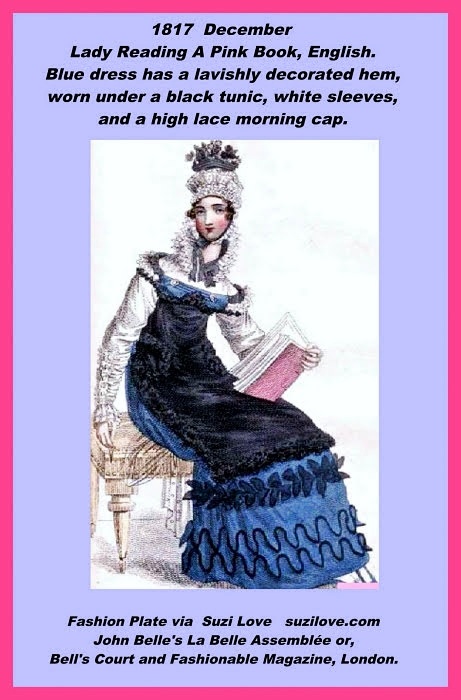
1811 January Walking Dress in the English style worn by Jane Austen and her female relations and friends. Pelisse of scarlet Merino cloth, buttoned down front and up arm with small gold buttons, collar and cuffs of purple velvet, empire tippet pointed in back, Scarlet bonnet turned up with velvet, veil through front, scarlet cloth boots trimmed with velvet. Fashion Plate via John Belle’s La Belle Assemblée or, Bell’s Court and Fashionable Magazine, London.Jane Austen and her contemporaries wore long coats like these to keep warm when out and about, visiting, shopping etc. The thin muslin dresses worn in the early 1800s were little protection against European winters.
Definition Merino Wool: Finest quality wool, originating in Spain. During Napoleonic wars, Merino sheep exported to Britain and other parts of Europe. Napoleon supported Merino growth in France. In 1808, after French invaded Spain, King George purchased additional 2000 Merinos for royal flock but Britain too wet for thriving industry. Other countries i.e. Australia, began producing fine quality Merino.
Definition Velvet: Historically made with silk pile on silk backing, or cheaper backing e.g. linen. Velvets were also made from cotton or wool. Today, silk velvet is usually rayon pile on silk backing so you only see the rayon and not the silk.
1811 May Walking Dress and Evening Dress, English. White muslin dress under green Pelisse, matching hat and reticule or bag, yellow gloves and green boots. Pink crepe dress with small train open at front over white satin underskirt with silver cord, yellow gloves, earrings and necklace of white pearls. Fashion Plate via The Lady’s Monthly Museum, London, UK.
Definition Walking Dress: Worn out shopping, walking in a city park or the country estate. Presentable and warm, more fashionable than Morning Dress but not overly accessorized.
Definition Evening Dress: Minute distinctions between ball, dinner, evening and opera gowns meant different quality of fabrics and designs.
Nothing had prepared Lady Katharine Montgomery for the jumble of feelings overwhelming her when Alex worshipped her body, first with words and later with his hands and mouth. For years around this house, she’d been forced to appear dowdy, unintelligent, and totally self-effacing to never anger her father, or draw his wrath. Now, though, every degrading restriction was lifted from her mind, body, and life.
Her father was dead. Yesterday, she’d buried her hatred for the despicable man who’d given her life during the quarter hour it took to stand at his grave and, along with all the other hypocrites present, pretend to mourn as they buried his mortal remains. He’d cheated traders, beaten plantation workers, and horse-whipped her within an inch of her life. She and all the other mourners hoped he’d rot in hell.
Last night, she’d felt free to liberate the passionate nature she’d kept buried for six and twenty years for fear of her father’s explosive wrath. But one night with Lord Alexander St. John had changed everything. One night with a lover who was gentle and caring had her aching for more, more of Alex and more of life with him.