1814 Statistics On Classes, Properties and Population In Great Britain. From: 1814 A Treatise On Wealth and Power. By Patrick Colquhoun. These are the statistics for England in Jane Austen’s time, or the early 1800s, or Regency Era.


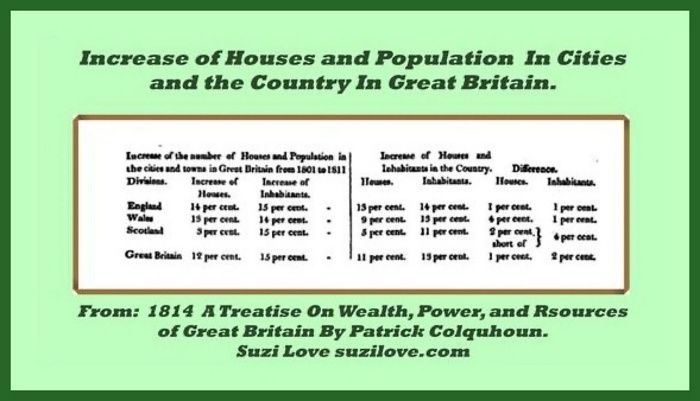






1814 Statistics On Classes, Properties and Population In Great Britain. From: 1814 A Treatise On Wealth and Power. By Patrick Colquhoun. These are the statistics for England in Jane Austen’s time, or the early 1800s, or Regency Era.
What did Jane Austen and friends wear? Early 1800s fashions were elegant and pretty with high waists and fabrics that were almost transparent. These Empire style gowns, named after Napoleon’s first Empress, became popular throughout Europe, and were then copied around the world. Colorful outwear was added to make an ensemble more attractive and warmer. History Notes Book 26 Fashion Women 1805-1809.
https://books2read.com/SuziLoveFashionWomen1805-1809
The Empire waist gown defined women’s fashion during the Regency Era. ‘Empire’ is the name given in France to the period when Napoleon built his French Empire. High-waisted, loose gowns were adopted by the aristocracy as a symbol of turning away from the fussy, elaborate and expensive clothing worn in the 1700s. Jean-Jaques Rousseau advocated copying peasants and returning to a simpler life and more natural fashions. Unrestricting clothing was part of the new Democracy in France and these simpler and flowing fashions were adopted all over Europe, including Britain and despite the continual wars being fought against France during the early 1800s. Not even war stopped fashions from being copied everywhere.

1823 Couple In Evening Costumes, French. Short length dancing dress of white gauze, short sleeves, pink ribbon trim, flowers, parure, or jewelry set, dancing shoes and hair in a bandeau. Man in half dress of black tailcoat, yellow vest, short length white trousers, high white
cravat, blue fob, and curled hair style. via Modes Francaises L’Indiscreet, France.

1823 Couple In Evening Costumes, French. #RegencyFashion #RomanticEra #HistoricalFashion https://books2read.com/SuziLoveFashionMen1800-1819 Share on X
From the finish of the 18th century until 1820, men’s fashions in European and European-influenced countries moved away from the formal wear of brocades, lace, wigs and powder to more informal and relaxed styles. Focus was on undress rather than formal dress. Typical menswear in the early 1800s included a tailcoat, a vest or waistcoat, either breeches, pants, or the newer trousers, stockings, shoes or boots, all worn with an overcoat and hat. This basic ensemble was accessorized with some form of neckcloth or cravat, gloves, walking stick, cane or riding crop, handkerchief, fobs, watch and perhaps a quizzing glass or eye glass.
Skirted coats were replaced with short-fronted, or cutaway, tailcoats worn over fitted waistcoats and plain, white linen shirts. Knee breeches were gradually replaced by tight-fitting pantaloons and later trousers, decorative shoes with buckles were replaced with a variety of boot styles, and fussy and ruffled neckwear gave way to intricately tied, white linen neck cloths. A Regency Era, or early 1800s, gentleman was outfitted in more practical fabrics, such as wool, cotton and buckskin rather than the fussy brocades and silks of the late 1700s.
1804 Men's Fashions In The Time Of Jane Austen. #Regency #Fashion #JaneAusten Share on X
Craftsmen created containers of precious metals, leather, and silks and decorated them with jewels and engraving. Jane Austen and her contemporaries would have used writing boxes, linen boxes when travelling, boxes to hold their food and drink supplies while traveling by carriage, and decorative boxes to keep letters, ribbons, gloves, hairpins etc. Boxes, Cases, and Necessaires By Suzi Love, History Notes Book 11. books2read.com/suziloveBoxesCases.


1818 January Fancy Mourning Dishabille. A lady reading a pink book while wearing Dishabille, or morning dress, though as this labeled ‘Fancy’, it was most likely more formal than any normal At-Home morning dress. Dress of crepe with a lavishly decorated hem, worn over a white cambric Spencer, ornamented with fine muslin, embroidered at the edge with black, finished at neck with a triple ruff of muslin, tied in front with black love. Black sarsnet French apron, edged round with a newly invented trimming of black love. Cornette, or hat, of fine muslin, crowned with a garland of black flowers. Black chamois slippers. Fashion Plate via John Belle’s La Belle Assemblée or, Bell’s Court and Fashionable Magazine, London. The magazine’s General Observations on Fashion and Dress tries to explain why the outfit is labeled ‘Fancy’, ‘However little versatility can possibly be attached to the sable garment of sorrow, yet the Print we have presented to our readers representing the home costume of a lady of high fashion, will prove to them how busy Fancy is in her endeavors to throw a changeful hue over the tinct of solid black.’
I can picture Jane Austen and her female friends and family wearing this sort of dress if they were in half-mourning yet wanted to look fashionable. .
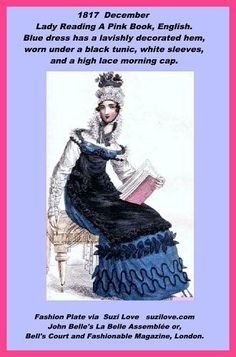
1818 January Lady Reading Book In Fancy Mourning Dishabille Of Blue Dress. #RegencyEra #HistoricalFashion #Mourning. https://books2read.com/SuziLoveFashionWomen1815-1819 Share on X

1808 Richard Trevithick’s Steam Circus, Bloomsbury, London, U.K. Site where Trevithick ran his locomotive ‘Catch Me Who Can’. Trevithick wanted to prove that traveling by train was faster than on horseback. Locomotive ran at top speed of 19 km per hour and people paid a shilling to sit in an attached car and be pulled around. Via Wikimedia Commons commons.wikimedia.org (PD-ART) This was the start of the railway expansions across England in Jane Austen’s time.


1800s French Palais Royal Sewing Box and Twelve Mother of Pearl Enamel Tools. This is the style of sewing box Jane Austen and her family would have used in the early 1800s, or Regency years. via via suzilove.com and 1st Dibs Auctions 1stdibs.com
Definition: Palais Royal: Name of an area around the Royal Palace in Paris, France, that specialized in making small and exquisite works of art during the 18th and 19th centuries. Palais Royal sewing tools were elaborate and usually feature mother-of-pearl, often intricately carved or engraved. During the 19th century, workboxes were often works of art with engravings, carvings, mother-of-pearl, and elaborate gilt metal mounts. Most popular were scissors with steel blades and gilt mounts, thimbles and needle cases which were often shaped like animals or other natural forms. Workmanship was exceptional and the tools almost too fragile to use.


1775-1777 ca. Snuffbox With Medallion, Russian. Made by Johann Baltasar Gass St Petersburg, Russia. Gold, silver, cut diamonds; chased, engraved and pounced. via liveinternet.ru

18th Century Snuff Boxes. Not only were boxes made to serve a purpose, but decorative boxes of all types were prized, especially in the 18th Century when everything decorative and extravagant was in vogue and taking a pinch of snuff was fashionable. Snuff is made from ground or pulverized tobacco leaves and is sniffed from a pinch of snuff placed on the back of the hand. Flavorings were added to the tobacco to give a fast hit of nicotine and a lasting scent. Snuff began in the Americas and was used in Europe by the 17th Century.
Snuff became popular from the mid 1600s to the mid 1800s and was more popular than smoking. Inhaling snuff, or snuffing, was first seen by a European missionary in 1493 in Christopher Columbus’s new world within Haiti’s indigenous Taino. Until then, tobacco had been unknown to Europeans, but its use spread quickly throughout Europe during the 1500s. By the second half of the 17th century, ornate boxes started being produced to keep the precious powder dry and an entire industry making accessories blossomed around the fashion of taking snuff. Noblemen, and some women, carried extravagantly decorated snuff boxes with them at all times and would offer a pinch of their own particular blend to friends and family. Therefore, these boxes were always on display and so it became a competition to see who could have the most bejeweled or expensive box possible.
1775-1777 ca. Gold, Silver and Cut Diamonds Snuffbox With Medallion, Russian. #Georgian #Antiques #Russia https://www.books2read.com/suziloveBoxesCases Share on XEarly 1800s Typical Regency Couple in a Curricle. The sort of vehicle Jane Austen and her contemporaries would have driven in. Young men loved them and occasionally women drove them.

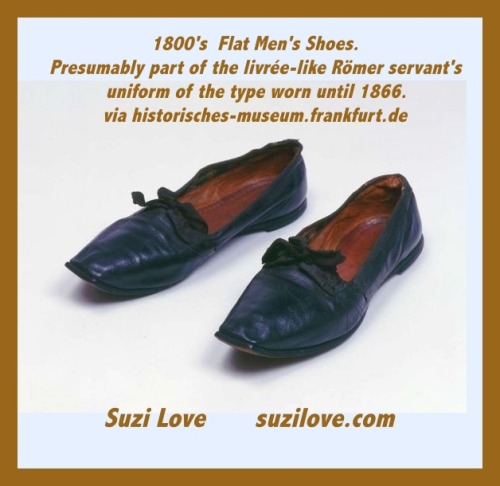
1800’s Flat men’s shoes, presumably part of the livrée-like Römer servant’s uniform of the type worn until 1866. via historisches-museum.frankfurt.de